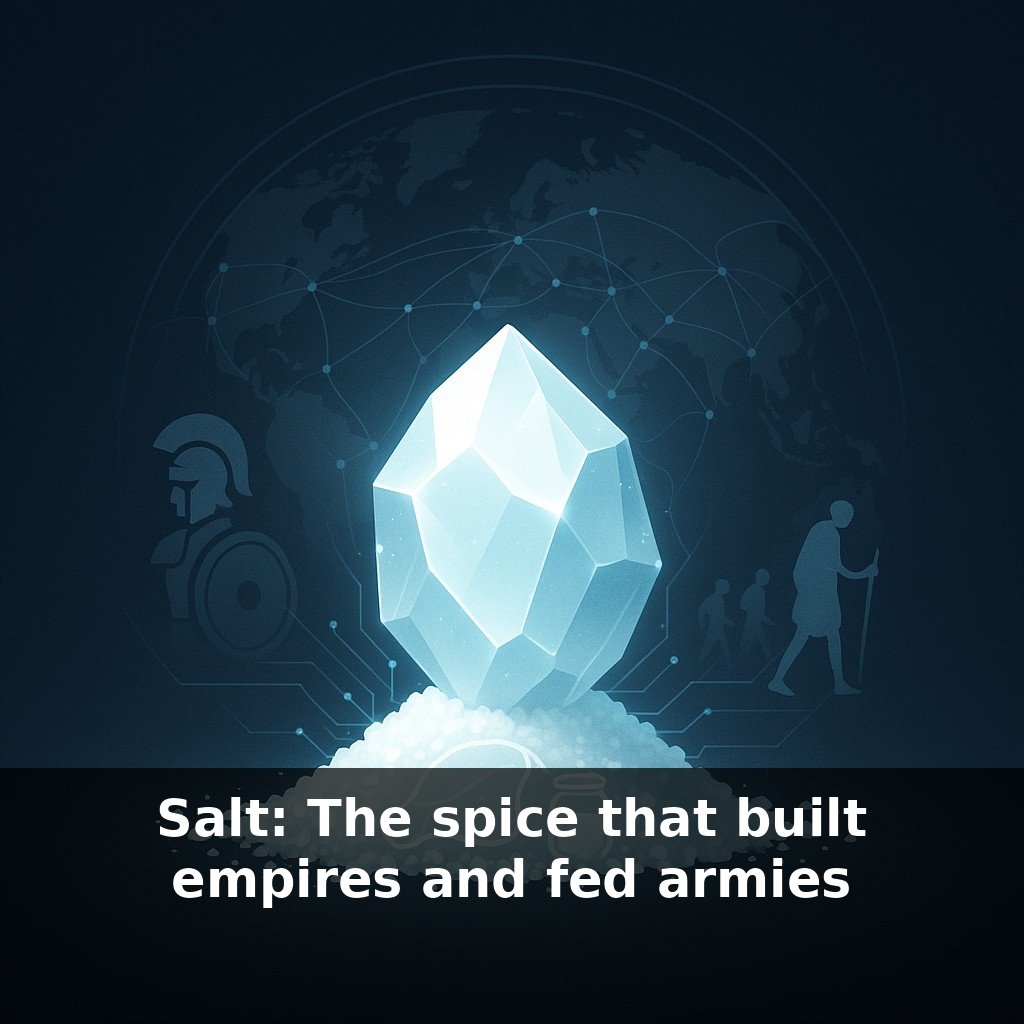
A whole empire once passed a law to keep foreign salt out—not gold, not silk, just salt. In one scene, a Roman soldier eats meat that’s months old; in another, Gandhi walks to the sea in protest. Same ingredient, two thousand years apart. How did salt gain that kind of power?
To follow salt’s trail, you don’t start in royal courts or on bloody battlefields—you start in the kitchen and the workshop. For most of history, preserving food wasn’t a lifestyle choice; it was the line between a stable community and hunger when the harvest failed or winter dragged on. Salt quietly sat at the center of that problem. Cure fish in a coastal village, and suddenly a perishable catch turns into cargo that can cross mountains. Pack meat in barrels, and an army can march weeks beyond its home fields.
But the story widens quickly. Where there was reliable salt, you often find early “infrastructure”: roads leading to brine springs, guarded storehouses, even small ports dredged a little deeper to take salt barges. And around those, you start to see law and conflict: guilds that control who may boil brine, city councils arguing over prices, and rulers who discover that taxing a daily necessity is far easier than chasing landowners for grain.
Follow the salt and you start to see how it quietly rewired geography. Certain towns exist largely because a spring, a marsh, or a seam of rock salt happened to lie nearby. Around those sources, techniques blossomed: solar pans laid out like patchwork quilts, brine boiled in iron pans, deep shafts sunk to reach buried deposits. Each method demanded fuel, labor, and capital, so states and merchants bargained, invested, and sometimes fought over access. Guild secrets, specialized tools, and regional “brands” of salt emerged, turning a stark mineral into a surprisingly diverse technology.
Beyond the shorelines and marshes, salt began to pull entire systems into its orbit. Once rulers grasped that everyone—from peasants to princes—needed it daily, they treated salt less like a kitchen staple and more like a lever built into society. The technology was simple enough: mines, pans, furnaces. The real sophistication appeared in how those were organized and controlled.
States experimented with different models. Some, like the Chinese dynasties, turned salt into a state monopoly, fixing prices and licensing producers. Others, like Venice, blended public power with private merchants, creating cartels that could dictate terms to whole regions. In both cases, the mineral sitting in a marsh or mine only became “wealth” once systems of measurement, record-keeping, and inspection wrapped around it. Scales, stamped barrels, official seals—these were as crucial as the pickaxes.
Salt also steered military logistics into a new kind of planning. It wasn’t enough to have access; commanders had to calculate how much preserved food an army could carry, how often supply trains needed to turn back, and where stockpiles should sit so troops could reach them without starving. This arithmetic of distance and delay quietly capped how far most pre-industrial campaigns could stretch. Strategies on the map bent around salt depots and provisioning depots the way rivers bend around rock.
Urban life felt the pull too. Bakers, tanners, cheesemakers, and fishmongers each needed steady, predictable deliveries. That meant contracts, credit, and insurance developed around something as blunt as a sack of crystals. Merchants diversified sources—coastal evaporation here, inland mining there—not for romance, but to hedge against storms, war, or a failed well. When one route faltered, prices in distant markets twitched, and you can almost trace the ripples by watching bread riots and market edicts.
Even resistance evolved in salt’s shadow. Smugglers learned coastlines and mountain passes with a precision surveyors would envy, slipping untaxed salt across borders. Reformers targeted salt laws precisely because they pinched everyone. When Gandhi chose salt as a protest focus, he was tapping into a very old nerve: control this one, unglamorous substance, and you quietly script how people eat, move, work—and how they push back.
Walk through a medieval street market and the “technology of salt” hides in plain sight. A cheesemaker adjusts how long her wheels sit in brine, not for taste alone but to keep mold and texture just right. A dyer adds carefully measured crystals so certain pigments bind better to cloth. A doctor prescribes salty broths to patients who’ve sweated through fevers, long before anyone names “electrolytes.” In each craft, salt isn’t a single-purpose tool; it’s more like a versatile instrument in an orchestra, playing rhythm for preservation here, harmony for chemistry there.
Follow that versatility into households: pickled vegetables stretching a short harvest, salted herring feeding inland families far from any coast, homemade cures where salt is mixed with ash, herbs, or oil. Even religious rituals fold it in—sprinkled on offerings, used to seal oaths, or ward off corruption in a spiritual sense. By the time industrial chemistry arrives, salt is already embedded in habits, recipes, and beliefs, ready to be rerouted into factories, labs, and public health campaigns.
As sensors join farms, kitchens, and roads, regulation may shift from taxing tons of crystals to governing flows of “salt data”: real‑time readings of soil salinity, blood pressure, corrosion on bridges. New firms already design microbes that tolerate brackish irrigation, or coatings that keep highway de‑icing from chewing through steel. The old politics reappear in quieter form—who owns the monitoring networks, and who gets to decide when “too salty” becomes a public risk?
So the next time you pass a shaker on a diner table, treat it like a tiny archive. Inside those grains live shipwrecks from ancient trade, quiet kitchen experiments, and future debates over oceans turned too saline. Your challenge this week: notice every non‑cooking moment salt appears—on roads, in products, in news—and ask, “Who benefits from this salt, and who pays?”