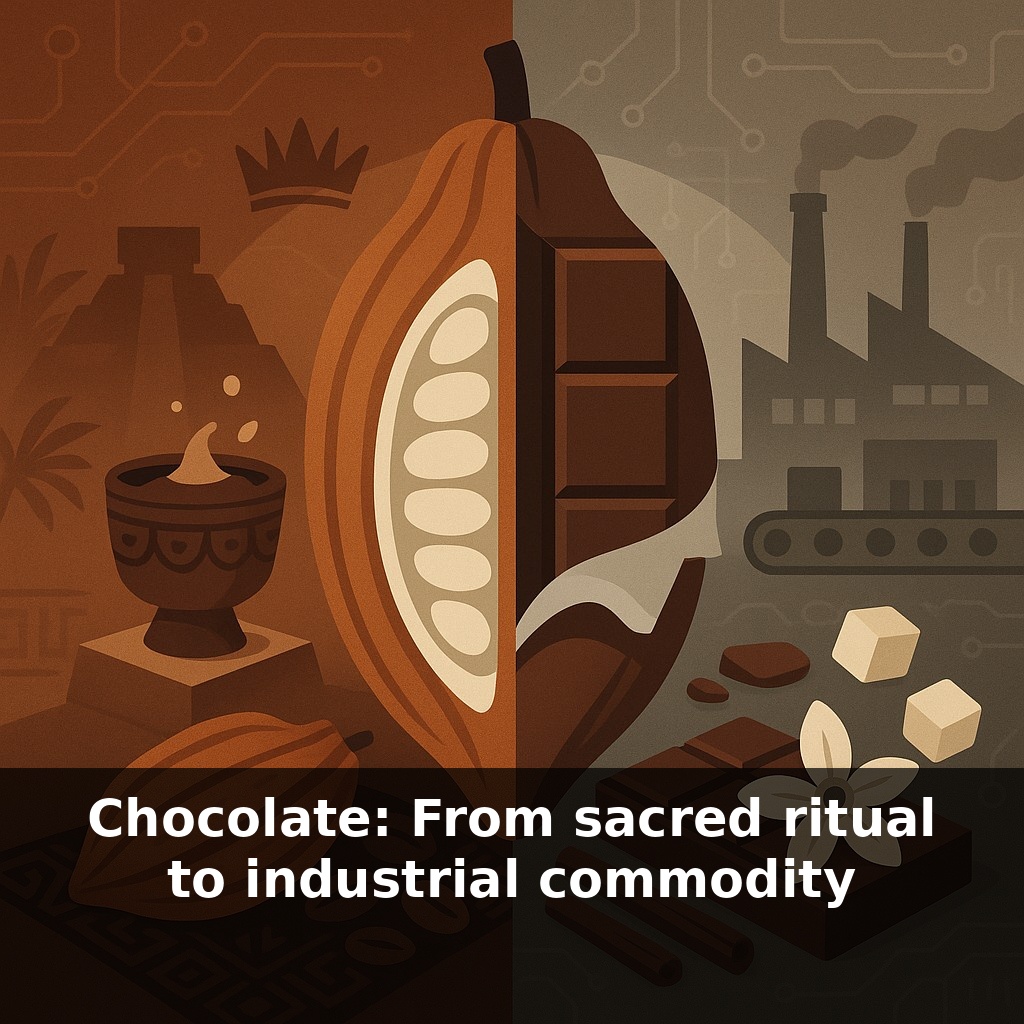
Cocoa beans were once worth more than gold to Mesoamerican elites—today, they fill discount candy aisles. One moment, a sacred, frothy drink sipped in royal courts; the next, a wrapped bar melting in your pocket. How did a bitter ritual potion become everyday sweetness?
Spanish colonizers didn’t just “discover” cacao; they quietly rewired its meaning. In 16th‑century kitchens, monks and court cooks began sweetening the bitter drink with cane sugar, cinnamon, and vanilla, turning a ceremonial brew into a fashionable stimulant for European elites. The church worried it might break fasting rules; physicians prescribed it as medicine; aristocrats flaunted porcelain chocolate cups the way some people flex limited‑edition sneakers today.
As demand grew, so did the need for cheaper, steadier supplies. That pressure pulled cacao out of its original forests and into plantation systems powered by enslaved labor across the Atlantic world. Long before chocolate was industrial, it was already global—and already entangled with power, status, and inequality.
Europe’s sweet tooth created a problem: traditional methods couldn’t keep up. Roasting, grinding, and whisking thick drinks by hand was slow, messy work—fine for courts, impossible for a continent. Enter early mechanization. Water‑ and steam‑powered mills began taking over the stone grinding once done in kitchens, turning cacao into a more uniform paste. At the same time, sugar from Caribbean and Brazilian plantations grew cheaper and more abundant, so recipes shifted. Chocolate edged away from medicine and devotion and toward something closer to an everyday luxury, primed for the next technological leap.
Factories didn’t just scale chocolate; they rewrote what it *was*. In the 1820s, Dutch chemist Coenraad van Houten treated ground cocoa with alkaline salts. This “Dutching” step toned down acidity and darkened the color, creating a smoother, milder base that mixed more easily with sugar and milk. Suddenly, chocolate could be engineered for consistency rather than tolerated for bitterness.
Soon after, the cocoa press squeezed out much of the cocoa butter from this treated paste. That did two things at once: produced a low‑fat cocoa powder that dissolved better in water or milk, and yielded surplus cocoa butter—the fat that melts just below body temperature, giving that precise “disappearing on the tongue” sensation. Industrialists quickly realized they could recombine these separated parts in new ratios, shifting chocolate from a thick drink toward something moldable.
In 1847, Joseph Fry’s company in Britain blended cocoa powder, cocoa butter, and sugar into a paste firm enough to hold a shape but soft enough to bite: one of the first modern eating bars. Two decades later in Switzerland, Daniel Peter added condensed milk, turning chocolate into a creamy solid rather than a heavy beverage. His neighbor Henri Nestlé, already in the dairy business, supplied the milk technology—and their regional experiment became a global template.
The last crucial texture breakthrough came from Rodolphe Lindt in 1879. His long, low‑speed mixer—called a conche—kept chocolate warm and moving for hours. This extended churning coated tiny cocoa particles in fat and drove off harsh flavors, transforming sandy, gritty slabs into the silky, slow‑melting bars we now take for granted. It was less a single “invention” than a controlled patience machine.
By the early 20th century, firms like Hershey’s in the U.S. and Cadbury in Britain had stitched these steps—alkalizing, pressing, milk‑adding, conching—into assembly lines. Chocolate was no longer a personalized recipe but a reproducible formula, tuned so a bar bought in a mining town or a capital city would taste exactly the same, every time.
Industrial chocolate today is less a single recipe and more a family of carefully tuned products. A dark baking bar, for instance, is formulated to snap cleanly and hold shape in the oven, while a truffle center is engineered to start softening almost the moment it leaves the fridge. That’s why one brand will advertise a “72% single‑origin” bar with bright, fruity notes from Ecuador, while another leans on ultra‑smooth, milky profiles built for Halloween candy mixes. Big manufacturers like Mars or Mondelez run sensory panels almost like orchestras rehearsing: testers quantify how fast a square should melt, how loud the snap should sound, how long the aftertaste should linger. At the other end, craft makers play with small ferments, lighter roasts, and minimal sugar, chasing flavor differences between neighboring farms. These parallel worlds—mass‑market consistency and micro‑batch experimentation—coexist in the same supply chain, both relying on that same delicate balance of sugar, fat, and finely ground particles.
Chocolate’s next chapter may feel less like candy and more like a negotiation. As weather squeezes yields and pests spread, prices and flavors could swing like volatile stock charts. Genetic tools and lab‑grown cocoa fats promise stability, yet raise uneasy questions about who owns taste itself. Your familiar bar may soon carry data—carbon scores, wage guarantees—turning every bite into a quiet vote about which futures get funded.
Chocolate now sits at a crossroads: future bars might come from drought‑tough trees, precision‑fermented cocoa, or fully synthetic fats built in steel tanks. Like updating a classic song with new instruments, each tweak keeps the melody—bitterness, sweetness, melt—but changes who controls the rhythm: small farmers, biotech labs, or you, choosing at the shelf.
Before next week, ask yourself: How would my relationship to chocolate change if I treated my next piece the way the Maya or Aztecs did—slowing down, smelling it, and considering who grew the cacao and how it traveled to me? When I buy chocolate at the store, what concrete clues on the label (origin country, certifications, % cacao, brand ownership) can I use to trace its journey from sacred crop to industrial product, and which brands actually reflect values I care about? If I imagined a “ritual” around eating chocolate today—whether that’s sharing a bar of single-origin dark chocolate with a friend or pairing hot chocolate with a moment of gratitude—what small, repeatable practice would make this everyday treat feel more meaningful and less automatic?