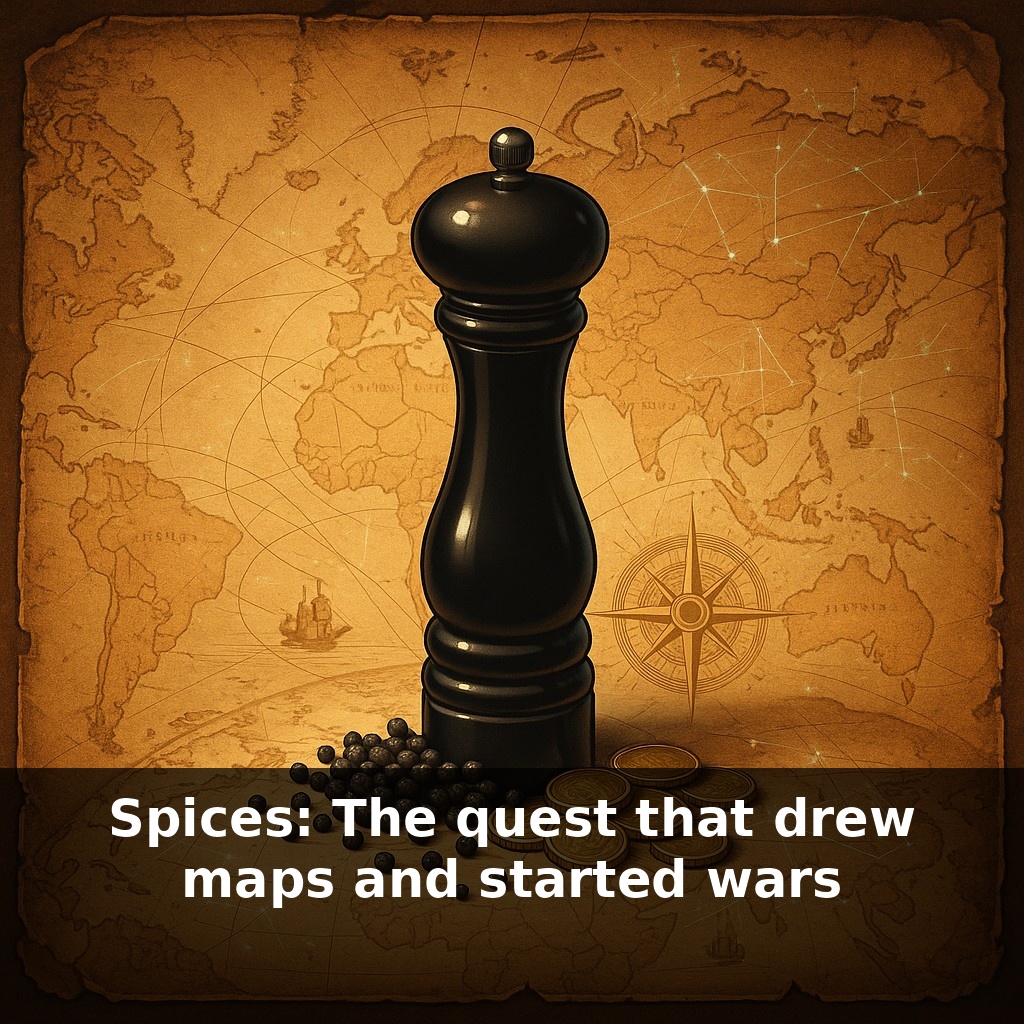
Black pepper once sold in medieval London for roughly the same price as gold. Now, think of the last time you casually twisted a pepper mill over dinner. How did a table spice go from treasure to afterthought—and what maps, mutinies, and mistakes paved that journey?
By the time pepper’s price cooled, Europe had a full-blown spice habit—and a serious logistics problem. The Mediterranean routes that once funneled aromatics from Asia now felt like a fragile extension cord stretched across rival empires, vulnerable to every war, tax, and storm. Monarchs wanted a private socket, a direct plug into the sources of cloves, cinnamon, and nutmeg. That pressure cooker of demand met a technological itch: better ships, new maps, and navigational tools that could turn rumor into sea lanes. So sailors set out following half-whispered coastlines and second-hand coordinates, chasing scents they’d never actually smelled—like trying to reconstruct a song from a few hummed notes and a smudged playlist. Every successful voyage didn’t just bring back sacks of spice; it redrew the very edges of the known world.
Those voyages collided with a brutal new arithmetic: risk, reward, and mortality. A single, well-timed cargo of cloves or nutmeg could cancel out years of failed expeditions, so investors treated dead sailors as line items and lost ships as acceptable “burn rate.” Portuguese, then Dutch and English backers essentially ran early high-risk startups at sea—pouring money into hulls, cannon, and provisions, hunting tiny islands most of them would never see. The lure wasn’t just profit; it was monopoly. Own the choke point, and you didn’t just trade in spices, you dictated the price of flavour itself.
The race quickly narrowed to specific molecules and microclimates. Pepper vines would grow in many humid places; cloves and nutmeg were far fussier. They came from tiny dots in the Eastern seas, where volcanic soil, rainfall, and human know‑how had quietly optimized production over centuries. Long before European companies arrived, local farmers already ran sophisticated agro‑systems: mixed gardens of tall shade trees, spice trees beneath, subsistence crops threaded between. Knowledge was encoded in practice, not patents—when to graft, how to dry, where to store so mould, not rivals, ruined your harvest.
European powers didn’t just want access to these systems; they wanted to freeze and centralize them. If you could confine a crop to a handful of islands and block everyone else from landing, price became a lever, not an outcome. That logic turned the Banda archipelago into a pressure point. Controlling who could plant nutmeg, where seedlings travelled, and which ships were allowed to leave became as important as the harvest itself. Restrictions got weirdly granular: penalties for smuggling seedlings, bans on exporting fertile soil, even efforts to scorch unwanted groves so “unauthorized” trees couldn’t mature.
But biology is bad at obeying monopolies. Seeds stick to birds, traders defect, storms push boats—and cargoes—off course. As Portuguese, then Dutch, then English captains mapped new coasts, they also mapped new climates that might host copycat plantations. The moment cloves or nutmeg could be coaxed to grow in Zanzibar, Ceylon, or the Caribbean, the monopoly model started to fray. The spice trade shifted from guarding wild or semi‑wild groves to designing repeatable systems: nurseries, grafting protocols, standardized drying racks, calibrated warehouse ventilation, even early quality grading.
On board ship, meanwhile, the human cost forced its own quiet innovations. If half your crew died before reaching port, you couldn’t scale your business. Logbooks became data sets, tracking diet, weather, and illness. Over time, captains altered provisioning, experimented—often clumsily—with fresh food stops, citrus, and water storage. Naval medicine inched forward because the balance sheet demanded it.
All of this meant that by the time modern firms like McCormick appeared, they inherited not just flavours, but a blueprint: treat distant farmers, shipping lanes, storage depots, and retail shelves as one continuous machine. The old battles over islands had morphed into battles over contracts, standards, and shelf space, yet the underlying logic stayed eerily consistent: whoever best orchestrates that entire chain shapes what the rest of the world tastes at dinner.
When cloves and nutmeg finally escaped their island prisons, they didn’t just travel—they changed jobs. In Java and Zanzibar they became plantation crops, scheduled like factory shifts: seedlings in regimented rows, harvests timed to labour contracts and monsoon charts, dried in uniform batches to hit predictable flavour “specs.” That same mindset quietly rewired kitchens. A Renaissance apothecary might lock a few fragrant nuggets in a cabinet; by the 19th century, urban grocers were selling neat paper packets, pre‑blended for pickling, baking, or curing meat. Recipes evolved around what industry could deliver consistently: gingerbread depended on ground spices that behaved the same way in London, Boston, or Bombay.
Today’s global brands extend this choreography. A jar of curry powder on a supermarket shelf might fold together chilli from India, coriander from Morocco, and fenugreek from Turkey—ingredients that never “meet” until a blending line in Europe or the US. What once required a private navy now runs on container schedules, residue tests, and barcode scans, but the underlying game is familiar: whoever best coordinates growers, grinders, and grocers quietly edits the world’s flavour palette.
A warming planet may redraw the spice map again. Cinnamon and vanilla could migrate to new latitudes while old heartlands struggle, much like vineyards inching uphill in search of cooler nights. Labs join the story too: CRISPR‑tuned chillies and yeast‑fermented “vanilla” turn flavour into software, editable and portable. Yet as exporters test blockchain to prove origin leaf‑by‑leaf, consumers face a new choice: chase the cheapest heat, or pay extra to keep specific landscapes—and cultures—on the plate.
Spices now sit in kitchen drawers like quiet bookmarks of those upheavals, yet their next chapter is still being drafted. As climate shifts and biolabs re‑score flavours at the molecular level, our choices—fair‑trade jar or bargain blend, single‑origin chillies or lab‑made vanilla—act like tiny steering wheels, nudging future trade winds, farming, and even borders.
Before next week, ask yourself: “If I opened my kitchen cabinet like a 15th‑century explorer, which 2–3 spices (pepper, cinnamon, nutmeg, cloves, etc.) would I ‘claim’ to experiment with, and what new dish could I try tonight that actually lets one of them be the star?” “Knowing that empires once fought over these flavors, what would it look like for me to honor that history—could I spend 20 focused minutes today reading the origin story of one spice I own and then cooking a simple recipe from that region?” “When I taste those spices this week, how does it change my experience if I pause for a moment and ask, ‘Whose hands might have grown, traded, or protected this, and what part of that story am I choosing to keep alive in my own kitchen?’”