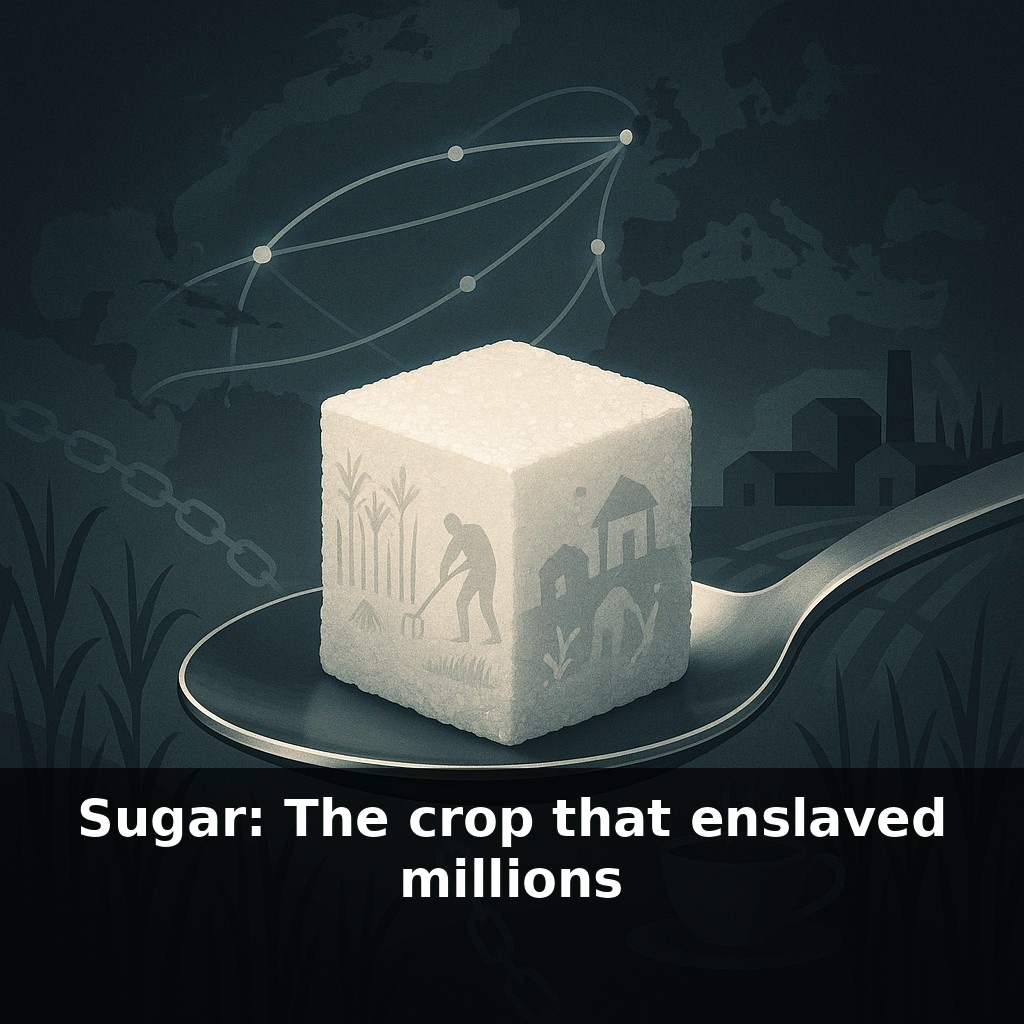
Sugar killed more people building empires than some wars did fighting them. A spoon in a Paris café, a lump in a London tea, a candy in Boston—each depended on unseen Caribbean fields, all-night boiling houses, and a trade route powered by captive human lives.
In the early modern Atlantic, sugar wasn’t just a sweetener; it was an operating system for a new kind of economy. To follow its path is to watch a brutal form of “industrialization before factories” take shape in real time. On a single plantation you’d find synchronized shifts, task specialization, timed workflows, and punishment for falling behind—like a nightmarish assembly line running on human bodies instead of steam.
But sugar’s reach stretched far beyond the fields and boiling houses. Its production required ships, credit, insurance, warehousing, and long-distance coordination. London bankers, Bordeaux refiners, Lisbon shipowners, and Dutch insurers learned to treat human lives, tropical land, and future harvests as entries in ledgers and bundles of risk. In the process, techniques born in cane fields and countinghouses quietly trained Europe to think in spreadsheets and supply chains.
As Europeans acquired a taste for sweetened drinks—tea, coffee, chocolate—demand didn’t just rise; it became habitual, almost automatic. Households that once used honey sparingly now treated refined crystals as a daily staple, much like background music you stop noticing until it’s gone. That steady craving pressured planters to squeeze more work from each acre and each captive worker, driving innovations in milling, fuel use, and transport. Ports grew specialized districts for refining, storage, and resale, while governments quietly rewrote tax systems so that every spoonful meant money for the state.
The technology of sugar began with a plant and ended with a system that treated time itself as a raw material. On a large estate, the day was carved into narrow, unforgiving segments: pre‑dawn cutting, mid‑morning carting, afternoon crushing, night‑long boiling. Cane starts losing sucrose almost as soon as it’s cut, so mills and boiling houses were engineered around a single, ruthless constraint: every delay was money—and lives—burned.
Planters poured capital into machinery to beat that clock. Early Caribbean mills were simple animal‑ or water‑driven rollers. By the 18th century, you see heavy iron crushers, compound gearing, even experimental steam engines on a few estates decades before factories in Manchester normalized them. The goal was always the same: extract more juice per ton of cane, and do it faster. Skilled enslaved mechanics kept these machines running, improvising repairs with scrap metal and local materials; their expertise rarely appears in ledgers, but without it the hardware would have frozen the moment a shaft cracked or a boiler leaked.
Inside the boiling house, heat became a precision instrument. Juice moved through a line of cauldrons, each hotter than the last, impurities skimmed at every stage. Getting from cloudy green liquid to dry, marketable crystals required careful sequencing: misjudge a temperature, stir at the wrong moment, and you ruined an entire batch. Over time, planters adopted vacuum pans, better thermometers, and insulated clarifiers borrowed from European refineries, tightening control over each step.
Even waste was reengineered into fuel or feed. Bagasse—the fibrous residue after crushing—fired the furnaces. Molasses, once an inconvenient byproduct, became feedstock for distilleries; rum could be sold locally, traded for provisions, or used as currency in further slave purchases. Technical tinkering therefore cascaded outward into new products, new trade loops, and fresh incentives to expand cultivation.
What emerged was not just a crop but a tightly coupled system where plants, metal, heat, and coerced labor were calibrated together. Change one variable—a tougher cane variety, a more efficient roller, a hotter furnace—and the entire choreography adjusted, always in the direction of more output from the same exhausted land and bodies.
On the periphery of those plantations, entire port cities learned to “hear” sugar long before it arrived. Merchants in Bristol or Nantes read price sheets like musicians sight‑reading a score: a half‑penny rise in London might trigger a flurry of letters, chartered ships, and quietly renegotiated loans. A cargo still weeks at sea could already be pledged three times over—first to pay the planter’s debts, then as collateral for an insurer, and finally bundled into speculative contracts traded in coffeehouses dense with pipe smoke and gossip.
Refineries in European harbors became their own kind of laboratory. Workers there experimented with cone molds, filtration methods, and animal‑bone charcoal to produce whiter, more uniform crystals aimed at different buyers: coarse loaves for taverns, fine powder for aristocratic kitchens, sticky syrups for urban breweries. Each refinement step created a new price tier and a new customer. Over time you get a stratified sugar market where color, clarity, and grain size indexed not just quality, but class itself.
By the late 1800s, sugar’s logic began to fold back on itself. Beet fields in temperate Europe undercut tropical cane, like a new instrument slipping into an old orchestra and quietly taking the melody. Today, climate shocks, health rules, and reparations debates tug at that same inherited score. Supply chains are mapped like subway systems; “fair” and “low‑carbon” labels act as new ticket classes. The open question: who will conduct the next rewrite—governments, corporations, or organized consumers?
Sugar now hides in breakfast cereals, sports drinks, even “health” bars, nudging bodies toward diabetes and heart disease the way a quiet background hum frays nerves. As lab‑grown sweeteners and sugar taxes spread, we’re co‑writing the sequel: will sweetness stay cheap and everywhere, or become a carefully rationed spice of modern life?
Before next week, ask yourself: How much of the sugar I eat each day (in my coffee, snacks, sauces, drinks) comes from products whose supply chains I’ve never questioned, and what would it look like to deliberately swap just one of those for a fairly traded or less-processed alternative? When I think about enslaved and indentured labor on sugar plantations—from the Caribbean to Brazil and beyond—whose suffering has been erased from the way I talk, teach, or post about “sweet treats,” and how could I bring one concrete story or historical fact into a conversation, classroom, or social feed this week? If I traced the history of the sugar in my kitchen back through colonialism and forced labor, what specific company or product would I be most uncomfortable supporting, and am I willing to stop buying that one item starting today?