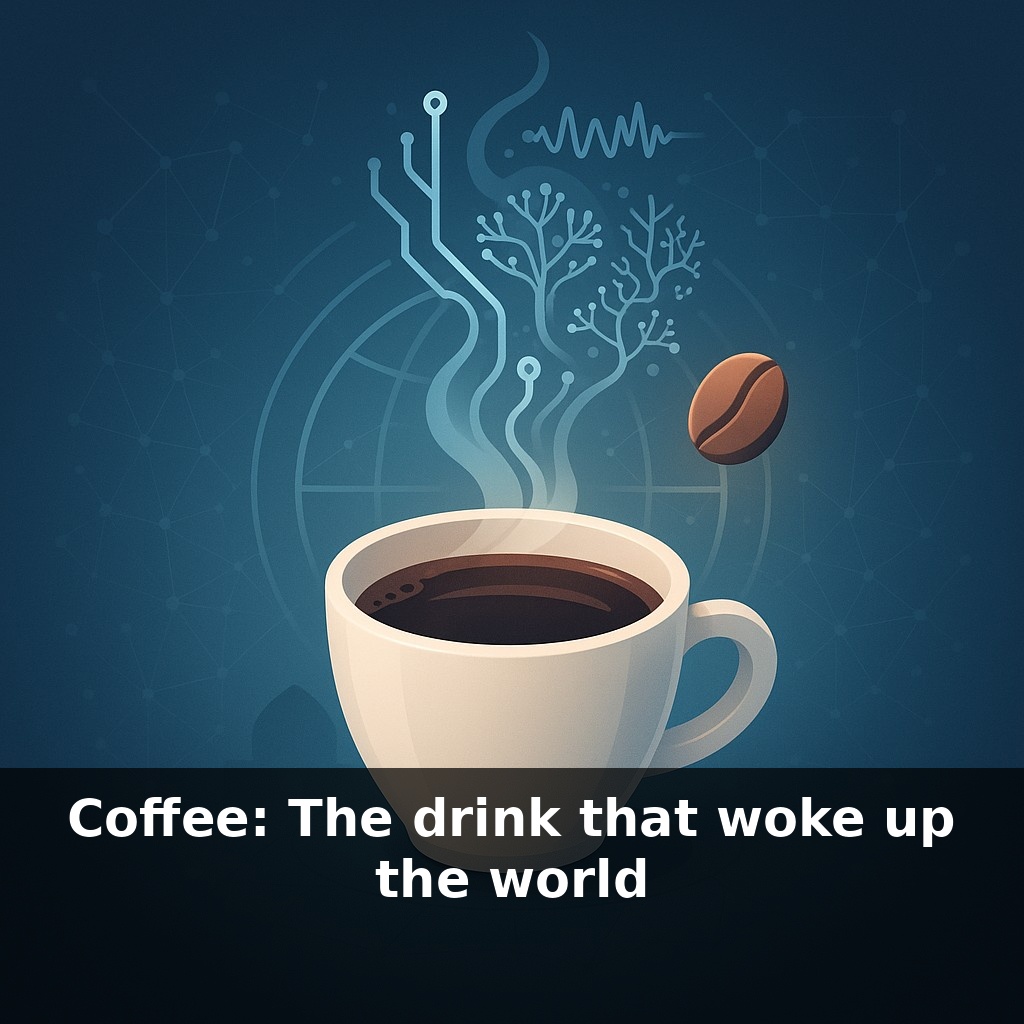
A drink once banned as the “bitter invention of Satan” ended up powering revolutions, stock markets, and your Monday meeting. Today, people on every continent start their day with it—often without knowing that a small, dark seed quietly rewired how the modern world thinks.
By the time European cities woke up to this strange, sleepless drink, it had already lived another life entirely—half a world away, in Yemeni Sufi monasteries where monks drank it to stay alert through all‑night chants. From there, traders carried it across Red Sea ports and caravan routes, and coffee slipped quietly into bustling Islamic cities: Cairo, Istanbul, Mecca. Each stop reshaped it. The sacred focus of Sufi rituals turned into an urban social habit, like a whispered prayer growing into a street chorus. Coffeehouses multiplied near mosques and markets, becoming unofficial headquarters for poets, scholars, and gossip dealers. Rulers noticed: wherever the cups gathered, talk got bolder, news moved faster, and authority felt just a little less solid. That tension—between control and conversation—would follow coffee wherever it went.
Merchants quickly realized this restless drink was more than a passing fad; it was a product that made people want to stay awake, stay talking, and stay buying. Ports from Mocha to Venice began treating beans like tiny brown tickets to profit, bundling them onto ships alongside spices and textiles. As demand swelled, rulers and traders tried to control who could grow, roast, or sell it, turning geography into strategy. A hillside in Yemen or later Brazil wasn’t just farmland anymore; it was a lever that could nudge the tempo of entire cities, the way a drummer quietly sets the pace for an entire band.
By the time European ports like Venice and Marseille caught the aroma in the early 1600s, the beans arriving in their warehouses carried more than flavor—they carried a business model. Importers didn’t just sell a drink; they sold time. A cup that stretched someone’s waking hours meant more work, more talk, more trade. City authorities, accustomed to ale‑soaked mornings and wine‑softened afternoons, found themselves confronting something unnerving: people who stayed sharp late into the night.
The first European coffeehouses in Oxford and London charged a fixed entry fee—often a penny—for access not just to coffee, but to information. On the tables: newspapers, shipping lists, handwritten price sheets. At Lloyd’s Coffee House, shipowners and merchants compared notes on storms, pirates, and cargoes. Out of those chats grew formal risk‑sharing agreements, which hardened over time into marine insurance contracts. No state decree ordered this into existence; it congealed, cup by cup, from people who kept returning to the same room, awake enough to keep refining an idea.
Elsewhere in London, Jonathan’s Coffee House posted stock prices. Regulars began buying and selling ownership shares in companies like the East India Company. What had been rumor—“I heard this ship made it back from Asia”—turned into numbers on a wall, then trades, then a stock exchange. Parisian spots like Café Procope incubated something different: long arguments about philosophy, monarchy, and rights that would help set the mood music for revolution.
Behind these bustling rooms, the supply chain thickened. European powers, eager to escape dependence on Ottoman and Yemeni intermediaries, smuggled live plants to colonial territories. Dutch growers experimented in Java. The French established plantations in the Caribbean. The Portuguese expanded across Brazil’s interior. Each transplant turned forests and Indigenous lands into monoculture rows, tying rainfall in distant tropics to the price of a cup in a chilly northern city.
By the 19th century, coffee had become a daily habit for industrial workers. Caffeine‑boosted shifts aligned neatly with factory whistles and office hours; spreadsheets and assembly lines both ran smoother when minds didn’t drift. The “little luxury” in a mug was quietly synchronizing human attention with the clock.
In the 20th century, industrial roasters turned those buzzing rooms into brands. Think of a supermarket aisle: rows of tins and pods are really rows of time‑packages. Instant crystals promised a shortcut for soldiers and office workers; vending‑machine cups became the liquid punctuation between meetings on factory floors and hospital wards. Meanwhile, at the other end of the spectrum, baristas began treating beans like vintners treat grapes—tracking altitude, processing methods, and roast curves with near‑medical precision. A single café might now list tasting notes that sound more like a wine bar menu than a breakfast spot: “blackberry, jasmine, bergamot.” Behind that flourish sits a vast, standardized system—shipping databases, futures contracts, certification schemes—quietly synchronizing a student’s $4 latte in Seoul with a smallholder’s harvest in Ethiopia. Global production, once a scattered patchwork of plots, now behaves more like an orchestra’s rhythm section, keeping tempo while the world adds its own melodies of habit and ritual.
The next disruption may happen before your cup is even poured. As climate pressure reshapes where beans can grow, breeders are quietly crossing varieties to survive heat and disease, much like doctors tailoring treatments to a patient’s DNA. Fermentation geeks are also re‑coding flavor with custom microbes, turning drying patios into open‑air labs. And as zero‑waste cafés experiment with reuse and upcycling, our morning ritual becomes a daily vote on which futures get funded.
So tomorrow’s cup isn’t just about origin or roast; it’s a daily remix of biology, climate, labor, and code. Algorithms now predict harvest peaks the way DJs read a dance floor, tweaking prices and logistics in real time. Your challenge this week: notice each place you buy or brew coffee, and ask, “Who had to coordinate for this sip to feel effortless?”