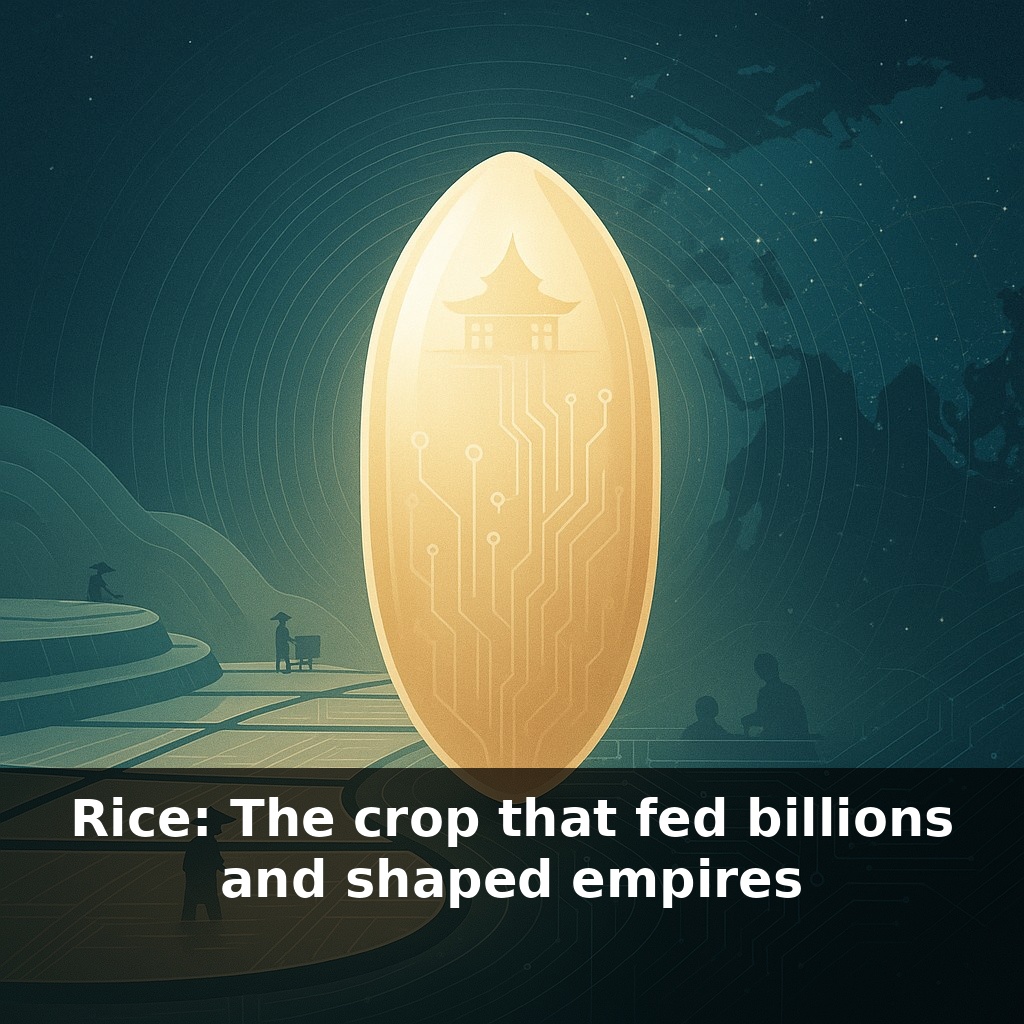
Right now, roughly half of humanity will eat the same plant before the day is over. A farmer in Vietnam, a street vendor in Lagos, a sushi chef in Tokyo—all depending on a single grain that built empires, flooded fields, and quietly reshaped our planet.
Long before it filled plastic bags in supermarkets, this grain was a political technology. Dynasties rose or fell on the timing of monsoons, the precision of canals, and the ability to squeeze one more harvest from a flooded valley. Following its trail is like tracing the wiring behind a city’s walls: you suddenly see how power, money, and people really move.
In Southeast Asia, terraced hills became vast staircases of food and taxation. In West Africa, farmers adapted it to tidal estuaries, turning brackish fringes into dependable larders. Later, European colonizers copied these techniques in Carolina and Brazil, importing not just enslaved labor but specialized knowledge.
Today, labs from Manila to Montpellier tweak its genes, while governments argue over subsidies, export bans, and carbon footprints—all to control the quiet rhythm of bowls being filled, three times a day.
To follow rice through history, we need to track more than just what people planted. We have to watch how it rewired landscapes, labor, and even time itself. In river valleys from the Yangtze to the Niger, calendars shifted around transplanting and harvest the way school years now orbit exam season. Whole families synchronized their days to the slow choreography of flooded fields, bending, weeding, and threshing in practiced unison. States learned to read these rhythms, timing tax collections, storage, and grain shipments so precisely that a late barge or broken dike could echo through markets thousands of kilometers away.
Farmers didn’t start with the watery rectangles we now recognize from airplane windows. Early rice in the Yangtze and in West Africa grew more like other grains, on seasonally wet ground that rose and fell with the rain. The breakthrough was learning to trap and choreograph that water instead of merely enduring it. Once people realized you could transplant seedlings into controlled paddies and push yields far beyond dry fields, the grain stopped being just a crop and became a system.
That system demanded specialists. Surveyors who could judge gradients by eye. Craftspeople who learned how thick a dike needed to be to survive a swollen river. Officials who could calculate how many laborers it would take to repair a breach before the next storm. Early records from Han China and later from kingdoms along the Niger describe whole bureaucracies built around these skills—titles and ranks tied not to noble ancestry, but to competence with mud, wood, and flow.
The payoff was extraordinary. A well-managed paddy could support multiple crops a year, and interplanting fish or ducks added protein without extra land. In parts of Southeast Asia, farmers stacked harvests vertically in time: early rice, late rice, then vegetables or legumes in the drained fields. The more precisely they could control flooding and drainage, the more they could compress hunger out of the calendar.
But the very features that made this system powerful also made societies vulnerable. Drought turned carefully leveled basins into cracked pans. Too much water, and one broken embankment could send a shockwave of hunger downriver. Chronicles from imperial courts and local chronicles alike are filled with panicked repairs, emergency grain loans, and the political fallout when promises of “ever-normal granaries” collided with failed seasons.
Over centuries, rice cultures diverged. In some Japanese domains, lords measured wealth directly in koku—the amount of rice needed to feed one person for a year—and paid samurai accordingly. In parts of South Asia, village credit networks emerged around the expectation of future harvests, binding families to lenders through interest rates calculated in sheaves, not coins. The grain in people’s bowls was inseparable from the contracts, calendars, and quiet negotiations that kept that flow going year after year.
In a medieval Japanese village, a good harvest might quietly decide who could afford to marry that year. A family with surplus rice could sponsor a son’s union, while a poor harvest postponed weddings, births, and even house-building. In 18th‑century Paris, rice arrived as an exotic import; cooks like Carême treated it the way high-end restaurants now treat rare single-origin chocolate—an ingredient that signaled status as much as sustenance. Meanwhile, in coastal West Africa, women traders built fortunes moving rice between inland growers and port cities, using social ties like an informal logistics network, long before container ships and spreadsheets.
Later, when IR8 and its descendants spread, they didn’t just raise yields; they reshaped village soundscapes. Diesel pumps replaced the creak of animal-powered waterwheels; threshing moved from communal pounding songs to the whine of small machines. New calendars emerged around input delivery trucks and mill opening hours, as if someone had quietly retuned the metronome that set rural life’s tempo.
Soon, fields may respond like smart cities: sensors sampling soil, roots, and air, sending data to phones where farmers tweak water depth or variety choice in real time. CRISPR lines could be ordered like custom playlists—salt‑tolerant for one plot, aroma‑rich for another. Yet archivists, chefs, and elders are quietly saving landraces, songs, and rituals, so the future bowl might carry firmware updates and folk memory in the same handful of grain.
In the end, each bowl becomes a quiet referendum on what future we choose: drought‑ready strains or fragrance, yield or heritage, methane cuts or tradition. As new varieties move across borders like touring bands, local cuisines remix them into sushi, jollof, congee, risotto—a global playlist where every culture adds its own verse.
Before next week, ask yourself: How does knowing that rice shaped empires and trade routes change the way I see the cheap bag of rice in my kitchen, and what might I cook this week (e.g., a labor-intensive dish like hand-washed sushi rice or a heritage biryani) to honor that history? When I buy rice next time, could I intentionally choose a specific variety (like basmati, jasmine, or a local heirloom grain) and ask: what landscapes, irrigation systems, and labor histories are “hidden” in these grains, and am I comfortable supporting that system? If my community or culture has any rice-related tradition—however small—what’s one story, recipe, or memory I can ask an older relative or neighbor to share, and how does that conversation change my sense of belonging to a much older rice-growing world?