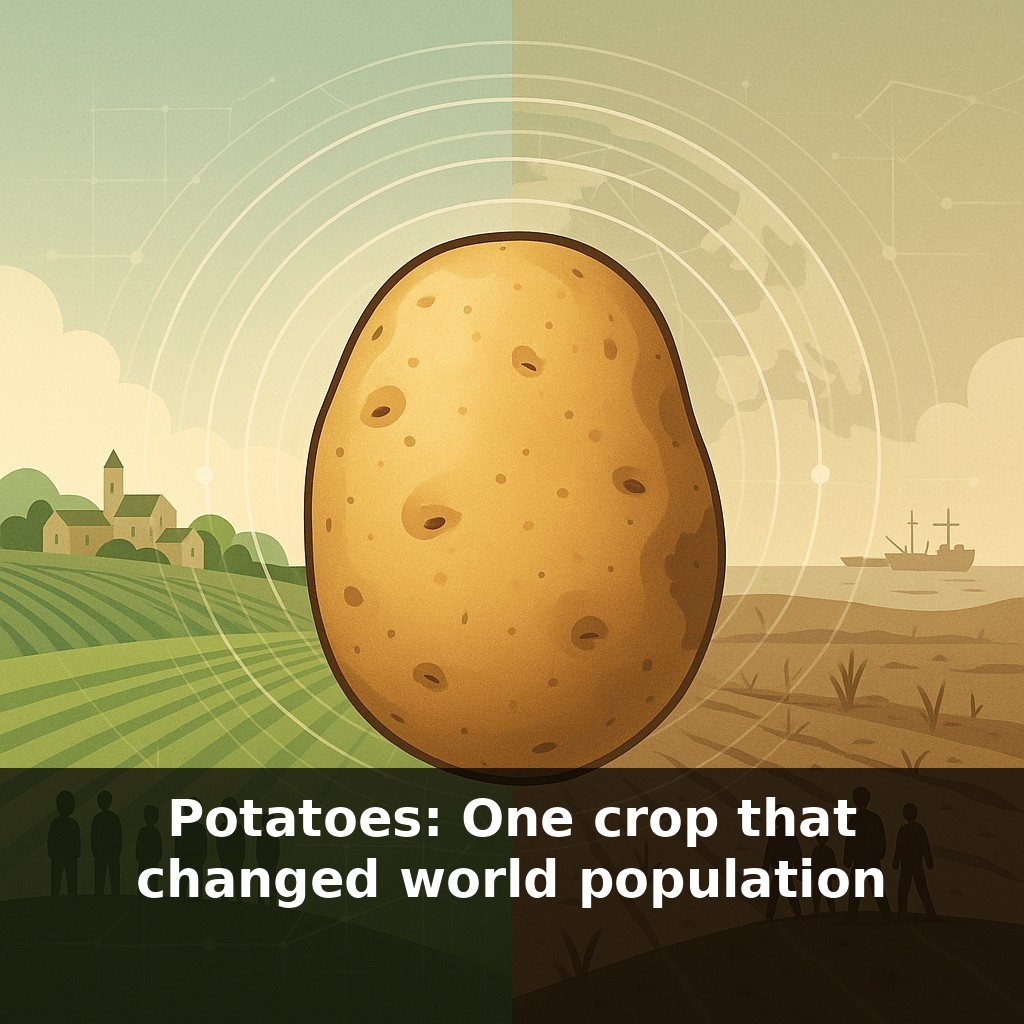
A single mountain crop from Peru helped Europe roughly double how many people it could feed on the same land. In one village, that meant fuller bellies and more babies; in another, decades later, it meant a million people boarding ships, fleeing a failed harvest.
By the time that Andean crop reached European fields, farming was stuck in a kind of technological traffic jam: land was finite, soils were tired, and most families lived one bad season away from hunger. The potato didn’t just add another food; it quietly rewired how households used land, time, and risk. Suddenly, poorer, rockier plots that barely grew rye could produce hearty meals. Women and children could dig, store, and cook potatoes with simple tools, folding them into everyday routines as naturally as brewing morning coffee today. Governments took notice too—Prussian officials staged public potato feasts to convince skeptical peasants it was safe, while military planners realized armies could march farther on cheaper rations. The result was more than fuller plates: it was denser villages, earlier marriages, and new pressures on cities already straining to absorb rural migrants.
Suddenly, farming families could rethink their entire yearly rhythm. Spring fields no longer dictated every meal; plots near the doorstep, ditches, even former pasture became quiet engines of calories. This shift altered power inside villages: landlords renegotiated rents, parish records filled with larger families, and local markets expanded from rare fairs to regular weekly trade. In cities, bakers and street vendors folded this new tuber into cheap foods for laborers, while physicians noticed fewer signs of malnutrition in regions that adopted it early, especially among children and pregnant women.
The quiet revolution lay in what was happening underground. European grains stored their energy in fragile seeds; this newcomer hid it in thick, starchy tubers that could survive cold, damp, and careless storage. That changed how families thought about security. A good grain harvest filled barns; a good tuber harvest filled pits, cellars, and even heaps under straw—literally embedding a food reserve into the landscape. Suddenly, “a bad year” didn’t always mean an empty table; it might just mean digging deeper.
This underground insurance helped fuel an 18th‑ and early 19th‑century surge in population. In parish after parish, more children survived the hungry gap between harvests, and adults had enough steady energy for long days in fields, workshops, and, increasingly, factories. In emerging industrial towns, this was transformative. Employers wanted workers who could show up daily, not seasonally, and cheap, filling meals based on the tuber made that routine possible. Where bread set the price of hunger, these tubers quietly set a floor under it.
Yet the very success of this crop led to a technological trap. As more regions leaned on a few high‑yield varieties, genetic diversity shrank. In places like Ireland, tenant farmers ended up planting almost nothing else, packed onto small plots where livestock had once grazed. On paper, this looked efficient: extraordinary calorie output from tiny holdings. In practice, it meant that a single new pathogen could behave like a fast‑spreading software bug in a system with no backups.
Elsewhere, the lesson landed differently. In Central and Eastern Europe, farmers mixed several varieties and paired tubers with rye or buckwheat, cushioning local diets against total collapse. In the Andes, Indigenous growers maintained even richer diversity, experimenting with altitude‑specific types and preserving bitter, frost‑hardy lines. Modern breeders would later return to these highland gene banks to tackle emerging threats—early proof that food technology is never just about inventing something new, but about deciding which older options we refuse to discard.
In 19th‑century Prussia, officials didn’t just preach about this tuber; they redrew crop maps so villages had to plant it alongside rye, a kind of enforced “portfolio diversification” for food. In France, poor districts that adopted it early recorded fewer bread riots during grain shocks, because vendors could pivot to cheap stews and street snacks. In the Russian Empire, serf communities used the new calories to carve out side incomes—spinning, seasonal factory work, even sending a son to the city—because fewer hands had to chase every last sheaf of grain.
Across the Atlantic, urban planners later banked on this crop when provisioning fast‑growing industrial centers; municipal reports literally counted tons of tubers like a safety valve against winter shortages. Modern development agencies still treat it as a strategic tool: in parts of China and East Africa, extension programs introduce blight‑resistant lines to hill farmers much as vaccination campaigns target remote clinics—deliberately placing resilience at the edges, where failure would hit hardest.
Blight‑resistant lines and CRISPR edits hint at a next chapter where this crop becomes a climate‑era shock absorber, not a single point of failure. Urban farmers already test stacked trays of tubers under LEDs, treating basements like experimental plots. Policymakers eye it as a quiet stabilizer: a way to buffer food prices when trade routes seize. Yet the deeper lesson is cultural—treat staple diversity less like a backup plan and more like a band playing in harmony, no instrument allowed to solo forever.
Today that same tuber travels in instant flakes, frozen fries, even lab‑modeled starches for bioplastics. Gene banks guard its wild cousins like rare vinyl, each with traits we might need in harsher climates. Your dinner plate becomes a quiet voting booth: mix staples, try overlooked roots, and you help decide whether tomorrow’s diets bend or break.
Before next week, ask yourself: 1) “If my community suddenly depended on a single staple the way 18th–19th century Europeans depended on potatoes, what weak spots in our local food system would be exposed, and what’s one concrete way I could start diversifying what I buy or grow this week?” 2) “Looking at the history of the Irish Potato Famine, whose risks and suffering are being ‘hidden’ in the modern foods I eat every day (farm workers, seed control, monoculture), and what’s one product I could swap for a more resilient or fairly sourced alternative today?” 3) “If potatoes could rapidly reshape global population and power structures, what overlooked ‘potato-like’ crop in my region (cassava, millet, sorghum, beans, etc.) could build resilience now, and how could I experiment with actually cooking it in one meal this week?”