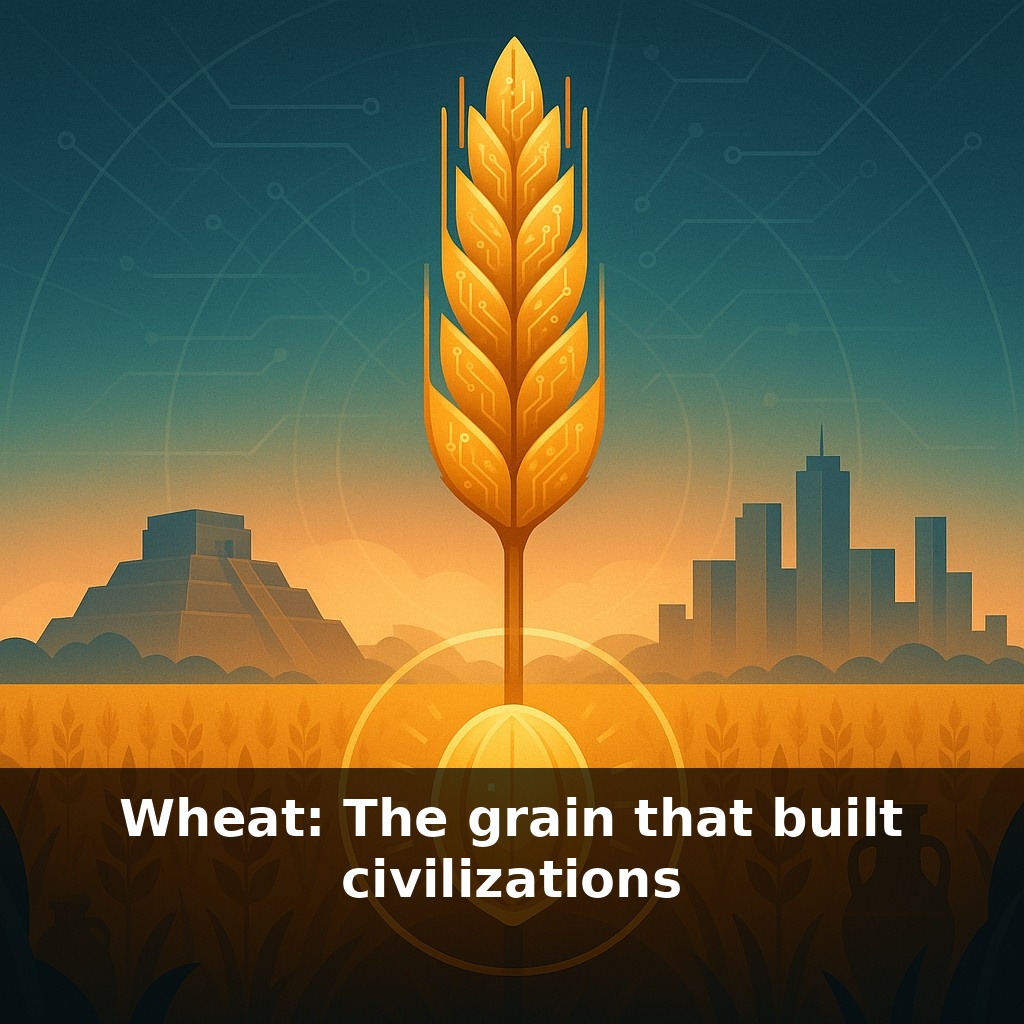
Right now, roughly one in five calories humans eat comes from a single grass. You bite into toast, sip beer, tear off pizza crust… and you’re tapping into the same ancient technology that powered the first cities and still shapes modern geopolitics every harvest.
Wheat’s real magic wasn’t just that it grew—it waited. Those tough little kernels could sit in clay jars through winter, war, or a bad season and still spring back to life as bread. That “pause button” on hunger let early farmers think beyond the next week’s meals: storing surplus, planning harvest schedules, even negotiating grain debts written into some of the first known legal codes. In a world where most foods spoiled fast, wheat was a quiet revolution in time management. Fast‑forward a few millennia, and the same trait underpins national grain reserves, school lunch programs, and food‑aid shipments that circle the globe. The story of wheat is less about a plant and more about how humans learned to stretch one season’s sunlight across an entire year—and then across borders, markets, and political systems.
Yet that stored grain was only the starting point. The real transformation came when people began tinkering with how to grow, grind, and bake it better. Farmers noticed which patches of land fattened kernels, millers experimented with new ways to crush and sift, and bakers learned how heat, water, and time turned dull paste into chewy bread or crisp flatbreads. Each small tweak was like upgrading a tool in a workshop: irrigation canals here, draft animals there, then waterwheels, steel rollers, and controlled yeasts. Across centuries, these incremental hacks turned a humble harvest into a global food technology system.
For early farmers, the real breakthrough wasn’t just planting wheat—it was convincing it to behave. Wild grasses shatter: ripe seeds fall off at the slightest touch, perfect for the plant, terrible for anyone trying to harvest. Over generations, people quietly selected “lazy” ears that held onto their kernels, stalks that ripened more evenly, and plants that stood a little taller above weeds. They weren’t drawing gene maps; they were keeping the sheaves that were easier to cut and thresh. Bit by bit, this turned a scruffy wild grass into a crop that bent to human schedules.
As villages grew into cities, specialization kicked in. One person could now spend all day mastering a single step in the chain. Millers invested in heavier stones and clever gearing; bakers experimented with softer doughs and hotter ovens; farmers rotated fields and tinkered with sowing dates. Think of it less as a single invention and more as an orchestra slowly adding instruments—irrigation as the deep percussion, plows as the brass, yeast as the woodwinds—until “grow grass, eat seeds” became a complex performance we’d recognize as a wheat economy.
Energy sources changed the score again. Hand‑turned querns gave way to animal power, then waterwheels and windmills. Each upgrade multiplied how much grain a community could process in a day, which quietly expanded how many people bread could feed. By the 19th century, steam and then electric roller mills could peel apart wheat’s bran and endosperm with surgical precision, producing ultra‑white flour that stored well and baked into lofty loaves. That same separation also stripped away fiber and some micronutrients, sparking early debates over “refined” diets that still echo in today’s supermarket bread aisle.
Meanwhile, new wheat types were on the move. Durum varieties followed pasta‑makers into Mediterranean kitchens; hard red wheats rode railroads onto North American prairies; softer wheats fed booming biscuit and cake industries. Each region nudged the plant in a different direction—shorter or taller, earlier or later, tougher or more tender—laying the groundwork for the yield “miracles” and vulnerabilities that modern breeders now juggle against climate stress and disease.
Walk through a modern bakery and you’re really touring a gallery of wheat “software updates.” A baguette, a chewy naan, a springy ramen noodle, a dense rye‑wheat sourdough: each is a different way humans have re‑coded the same grain with water, heat, microbes, and mechanics. Industrial food companies push this further. Cereal makers tweak flake thickness and toasting curves to control how long each spoonful stays crunchy in milk. Pasta factories fine‑tune extrusion pressure and drying schedules so spaghetti doesn’t crack in transport but still cooks al dente in nine minutes flat. Even snack makers engineer crumbs to break in a satisfying way without turning into dust in the bag. Behind those everyday textures lie quiet revolutions: high‑gluten wheats bred for stretchy doughs, low‑ash flours for pale crackers, and durum lines tailored for instant couscous. One plant, but an expanding menu of behaviors—much like a single musical scale yielding symphonies, film scores, and pop hooks depending on who’s composing.
Climate shifts will redraw the map of who can grow wheat, much like changing sea levels quietly redraw coastlines. Some cool regions may become new breadbaskets; others may face heat, salinity, or rust outbreaks that flip exporters into importers. Gene‑edited lines promising drought tolerance or lower gluten will raise questions: who controls the code, and who benefits first? AI may forecast yields field by field, but societies will still decide whether those insights cushion markets—or deepen inequality.
Wheat’s next chapter may hinge less on yield records and more on who gets a seat at the table: smallholders with sandy soils, breeders trading DNA like sheet music, policy makers tuning subsidies, and eaters choosing flatbread or noodles. Your challenge this week: trace one wheat food you eat back two steps—farm and mill—and see what futures it depends on.