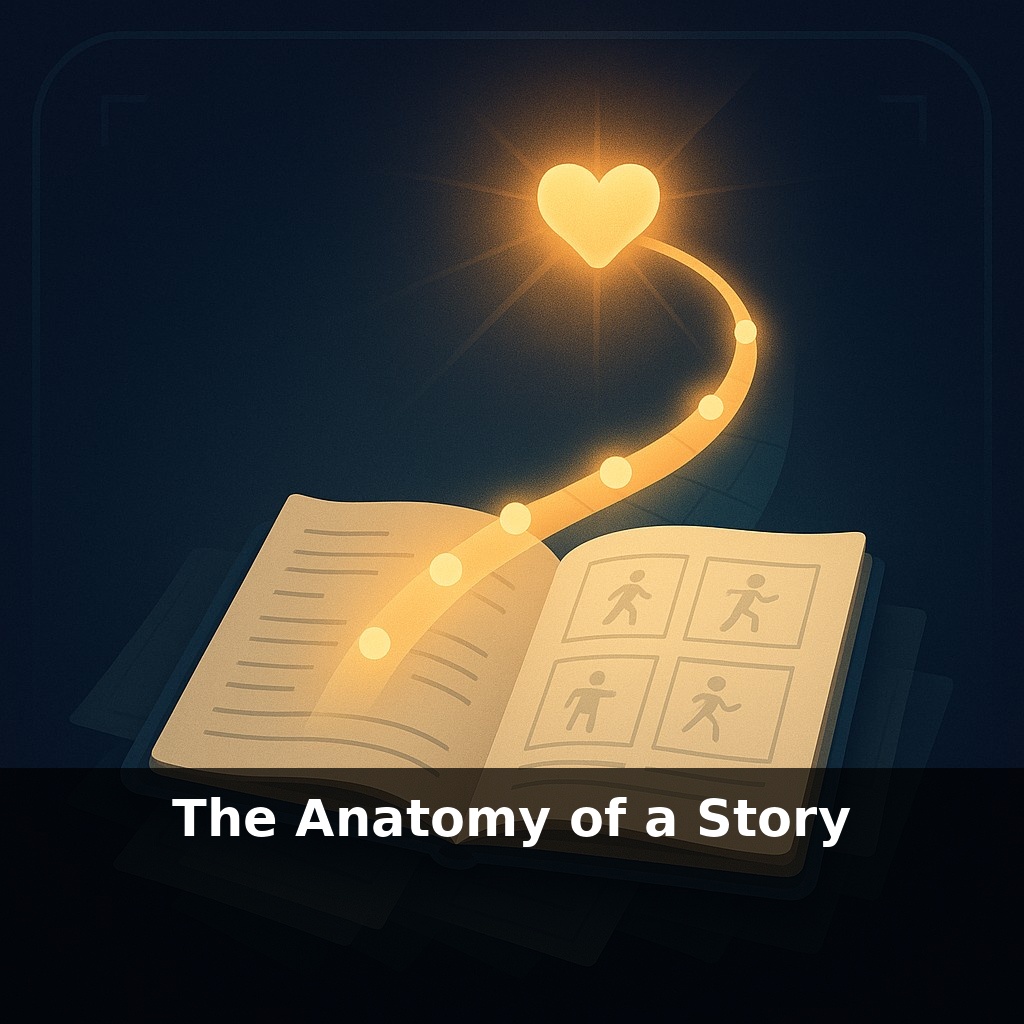
The Anatomy of a Story
📝 Transcript
A Pixar script is rewritten about a dozen times—and each draft lives or dies on one thing: did the emotional peak land in the right moment? Today, we drop straight into that turning point, then work backward to ask: what secret spine holds every unforgettable story together?
Think of your favorite series—the one that kept you up “just one more episode” too many nights in a row. It wasn’t an accident that you were hooked. Beneath the jokes, explosions, or quiet conversations, there’s a hidden architecture doing heavy lifting: a pattern of promises and payoffs that your brain is wired to track. Across cultures and formats, the same ingredients keep showing up: someone we care about, something they desperately want, obstacles that get nastier, and a moment where everything tilts one way or the other. Story architects call these beats different names, but they’re all measuring the same thing: how tension rises, crests, and settles. Today, we’ll zoom out from any single movie or novel and examine this underlying blueprint—not as a rigid formula, but as a flexible set of pressure points you can bend, break, or sharpen to make your own stories impossible to turn off.
Writers across time have sketched that spine in different ways: three acts, five acts, circles, pyramids, even color-coded spreadsheets on writers’ room walls. Yet when you strip away the jargon, they’re all trying to answer a few practical questions: whose change are we tracking, what are they moving toward, and how does each scene shove them closer to a point of no return? Think less about “saving the cat” and more about managing audience curiosity. Every structural choice you make either sharpens that curiosity, dulls it, or accidentally points it at the wrong thing.
Let’s start with the simplest X-ray of a story: a protagonist, a goal, and something in the way. Everything else is ornament. The moment you decide who wants what and why they can’t have it yet, you’ve created a line of tension the audience will follow, consciously or not.
The inciting incident isn’t “the beginning” so much as the first *irreversible* complication. It turns a situation into a problem. In *The Queen’s Gambit*, Beth is already an orphan before the story really ignites; the spark is discovering chess and the tranquilizers that both sharpen and endanger her gift. One event, two vectors of conflict—external and internal—both aiming directly at the same goal: mastery.
From there, rising complications aren’t random obstacles. They’re curated tests that clarify the stakes. A weak draft piles on events; a strong one narrows pressure onto what matters most. In *Finding Nemo*, every new setback—sharks, jellyfish, the fish tank—presses the same nerve: how far will a fearful father go for his son? Notice how each challenge doesn’t just delay success; it forces a *choice* that slightly changes the character or our understanding of them.
This is where many writers quietly slip: they mistake movement for escalation. A chase, a witty argument, a twisty reveal can still be flat if it doesn’t shift power, information, or options. To track this, professionals often map turning points as beats where one answer to the central question (“Will they succeed?” “Can they stay together?” “Will the truth come out?”) suddenly becomes more likely than another.
As the story barrels toward its decisive clash, you’re really steering toward one crystallizing decision. That decision at the climax should feel both surprising and inevitable—surprising in *how* it plays out, inevitable in *why* it had to. In *Parasite*, the party explosion doesn’t come out of nowhere; it’s the most extreme collision of class resentment, humiliation, and secrecy the film has been threading from frame one.
Only after that answer lands does resolution matter. The denouement isn’t cleanup; it’s commentary. It’s where theme quietly steps forward, not as a moral, but as an implied sentence: “Given everything you just saw, this is what it adds up to.”
Your challenge this week: take a favorite movie or episode and, without rewatching, write a one-sentence answer to each of these: Who is the protagonist? What do they want *specifically*? What is the central question of the story? When is it first asked, when does the likely answer flip, and when is it finally decided? Then rewatch and see where your memory disagrees with the actual beats—and how the creators nudged your expectations.
Think of structure the way a great chef thinks of a menu. They don’t just cook random dishes and hope you’re full at the end; they plan the order so each course sharpens your appetite and then satisfies it. Story works the same way: you’re deciding *when* to serve specific flavors of information, reversal, and emotion.
Take *Knives Out*. The early “whodunit” quickly flips into “how will she get away with it?”—a quiet change in the central question that re-aims our attention without a lecture. Or look at *The Queen’s Gambit* again: notice how tournaments aren’t just bigger versions of each other. Each one exposes a different cost—loneliness, addiction, pride—so we’re not just tracking wins and losses, but a running total of what those wins mean.
Even comedies obey this logic. In *The Office*, big episodes often hinge on a single decision: confess a feeling, sign a contract, leave a job. The jokes orbit that choice, but they’re not the point. Underneath, you’re still being walked—beat by beat—toward a place where “What happens?” and “What does it *mean* that it happens now?” collide.
Interactive stories are quietly rewriting the “straight line” we expect from plots. When viewers can choose branches, creators must design multiple arcs that still feel like one cohesive experience. AI tools will likely draft the flatter stretches—summaries, connective tissue—while people focus on subtext and emotional risk. Narrative literacy may soon matter as much in pitching data or lessons as in writing novels: whoever can wrap information in a clean arc will win attention in increasingly crowded, click-heavy spaces.
So the next time a scene drags or a chapter feels thin, zoom out. Ask not “what happens next?” but “what pressure hasn’t been tested yet?” Treat each beat like adjusting sliders on a mixing board—stakes, mystery, emotion, consequence—nudging them until the pattern of shifts feels alive. Structure isn’t a cage; it’s a set of dials you can tune to your own voice.
Before next week, ask yourself: 1) “If my life right now were a story, what’s the *central problem* my ‘hero’ (me) is actually facing—and am I accidentally treating a symptom (like procrastination or stress) instead of the real underlying conflict?” 2) “What would be a *meaningful transformation arc* for me over the next six months—who is the ‘me at the end of the story,’ and what specific beliefs, habits, or relationships would have to change for that version of me to be believable?” 3) “Where is my current ‘story’ boring or stuck—what scene (a recurring meeting, a relationship pattern, a daily routine) needs a plot twist, boundary, or brave conversation to move the story forward starting this week?”
From this course
The Magic of Storytelling
7 episodesUnlock all episodes
Full access to 7 episodes and everything on OwlUp.
Subscribe — $1.99/monthLess than a coffee ☕ · Cancel anytime