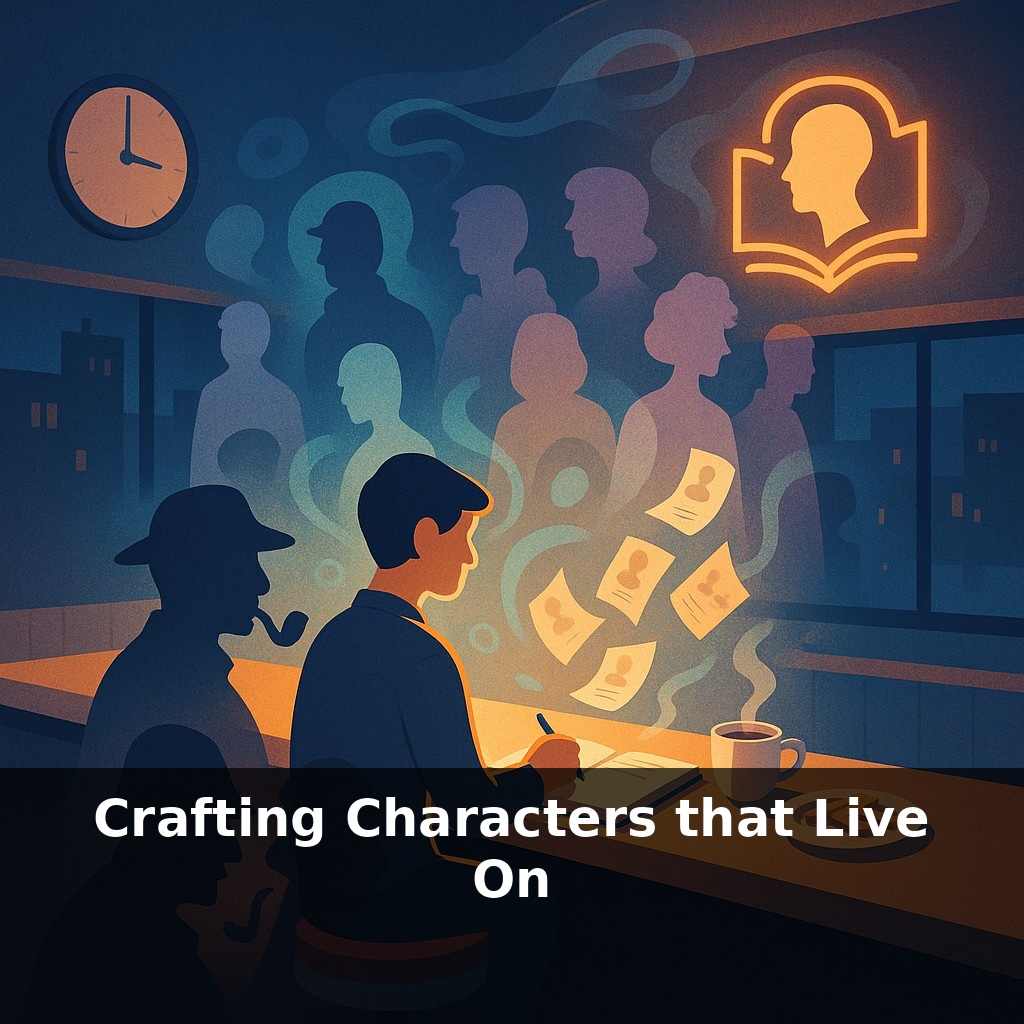
Sherlock Holmes has been rewritten more than any other fictional human in history—yet readers still feel they “know” him. Today, we’re stepping into that strange territory where made‑up people outlast real ones, and asking: what makes a character refuse to leave your mind?
Some characters feel less like inventions and more like people you could bump into at 2 a.m. in a 24‑hour diner—haunted, hilarious, or quietly falling apart over a plate of cold fries. That eerie familiarity isn’t an accident; it’s the result of careful choices buried under the surface of the story. Research on reader memory shows we cling to names and personalities long after we’ve forgotten the twists that carried them. Neuroscientists argue our brains are wired to store people more efficiently than events, so when a character rings true, they hitch a ride in our social wiring instead of our short‑term recall. The craft challenge for you as a storyteller isn’t “How do I make someone quirky?” but “How do I design a mind, then let it collide with trouble?” In this episode, we’ll dig into the quiet mechanics of that design—and how to stress‑test a character until they start talking back.
To move from theory to practice, we’re going to zoom in on three levers you can actually pull: psychology, emotion, and change. Think of them as sliders on a mixing board that you’ll keep nudging as you draft. Instead of asking “What would be cool here?” we’ll ask, “Given who this person is, what would cost them the most?” That shift forces you to tie every choice to an inner logic. We’ll look at how contradictions create friction, how specific desires attach your character to the plot’s highest stakes, and how small, observable habits can act like breadcrumbs, hinting at deeper layers the story hasn’t revealed yet.
When you want a character to linger, start where their world would actually hurt. Not in the abstract—“they fear failure”—but at the point where that fear would force an ugly choice. A character who can’t stand being judged doesn’t just “dislike criticism”: they delete the unsent text, they rehearse jokes in the bathroom mirror, they say “no big deal” while their jaw tightens. These are behavioral tells, tiny surface glitches betraying the system underneath.
Psychological credibility lives in those tells. One practical way to find them: write a list of three situations your character would secretly love, and three they’d quietly dread. Then, for each, jot the smallest visible thing they’d do differently from everyone else. Maybe they always choose the seat with a clear exit. Maybe they talk too much when they care, too little when they’re hurt. Patterns of detail make a mind feel built-in rather than bolted on.
Emotional resonance often comes from misalignment: what your character *says* they want versus what their choices keep proving. The parent who swears their career is “for the kids” but misses every recital. The hero who claims to value honesty but keeps lying to avoid conflict. Let their actions embarrass their self‑image; readers feel the gap and supply the ache without you explaining it.
Dynamic progression doesn’t require fireworks. A shift from “I never apologize” to an awkward, half‑mumbled “you were right” can land harder than a dramatic sacrifice, if we’ve seen the cost. Map three pressure points across your story: an early moment where their default wins, a midpoint where that default starts to crack, and a late moment where they either double down or pivot. Growth, stagnation, or collapse—any can work, as long as each beat is traceable to prior choices.
Finally, individuality is less about uniqueness than specificity. Ten characters can be “brave,” but only one clicks their pen exactly three times before bad news, or refuses to learn names because names make departures hurt. Track 2–3 such anchors and let them evolve—snapping the pen in half, finally asking for someone’s name—so readers feel the inner plate tectonics through tiny, shifting rituals.
Watch how this plays out in practice. Take a character who’s a junior lawyer at a cutthroat firm. On paper, she “wants justice.” In scenes, let her volunteer for pro bono cases—then sabotage them by staying late on lucrative corporate work because she’s terrified of being seen as “soft.” The contradiction isn’t a label; it shows up in calendar invites, ignored texts from clients, a suit she keeps in her car so she’s always “on.”
You can also bind her arc directly to plot stakes. The firm lands a case defending a company accused of poisoning local water. If she wins, she finally becomes partner; if she loses on purpose, the town survives—but her career is over. The external dilemma is simple. The internal cost is not.
One way to keep traits evolving is to treat each scene like a tiny A/B test. In meeting A, she laughs along with a cruel joke. In meeting B, weeks later, the same partner makes a similar joke and she goes quiet instead of laughing. That silence *is* movement.
Some studios already prototype “character operating systems”: layered profiles that decide how an avatar reacts when a user flirts, fails, or rebels. As tools spread, audiences may expect every story world to remember them—shifting dialogue, loyalties, even entire subplots. Writers who can encode values, blind spots, and breaking points as reusable logic will shape not just stories, but how future apps teach, comfort, and negotiate with people one decision at a time.
Let your next character surprise you the way a glitch reveals a hidden feature in an app: follow the odd line of dialogue, the inconvenient desire, the refusal to cooperate with your outline. Those “errors” are often where the truer version lives. Stay curious about what they hide from *you*, not just other characters—that’s where they start to outgrow the page.
To go deeper, here are 3 next steps: (1) Re-listen to the section where the host breaks down “contradictory desires” and then open Lisa Cron’s *Wired for Story* to chapter 3, using one of your own characters to answer every question she poses about misbelief and internal struggle. (2) Pull up the “character interview” template from K.M. Weiland’s Helping Writers Become Authors site and spend 20 minutes filling it out for your protagonist, forcing yourself to add one specific sensory memory from their childhood for each major question. (3) Open Scrivener, Notion, or a simple Google Doc and build a “Character Echoes” page: list three defining traits from the episode (e.g., moral wound, secret shame, conflicting want/need) and then map exactly where they will surface in five different scenes of your current story—dialogue lines, small actions, and one moment where the character fails because of that trait.