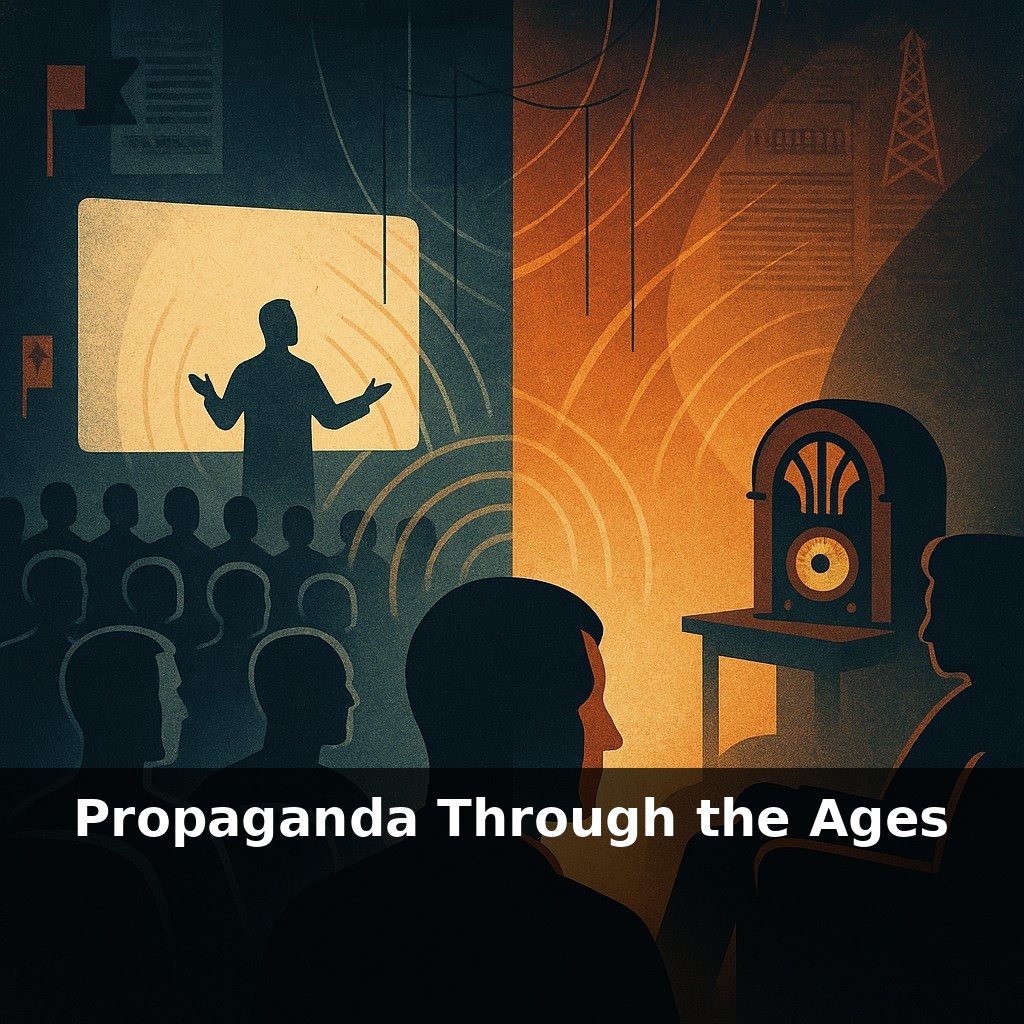
In a darkened movie theater during World War One, a stranger stands up and starts talking. Four minutes later, hundreds of people walk out more eager for war than when they walked in. No special effects. No internet. Just words, timing, and a system built to steer their thoughts.
By World War II, the theater stranger had a powerful rival: a cheap box in the living room that spoke with the authority of the nation. Goebbels didn’t just hope people would tune in—he redesigned everyday life so that 70% of German households owned a ‘Volksempfänger’ radio, turning casual listening into a constant political soundtrack. That’s the quiet trick of propaganda through the ages: it doesn’t just craft messages, it quietly reshapes the channels those messages travel on.
Fast‑forward a few decades and a single TV ad—the 1964 “Daisy” spot—airs officially only once, yet lingers in voters’ minds like a song you didn’t mean to memorize. Today, the same logic operates at a different scale: fake accounts by the billions, data firms boasting thousands of data points on each of us, and feeds that learn which stories keep us staring just a little bit longer.
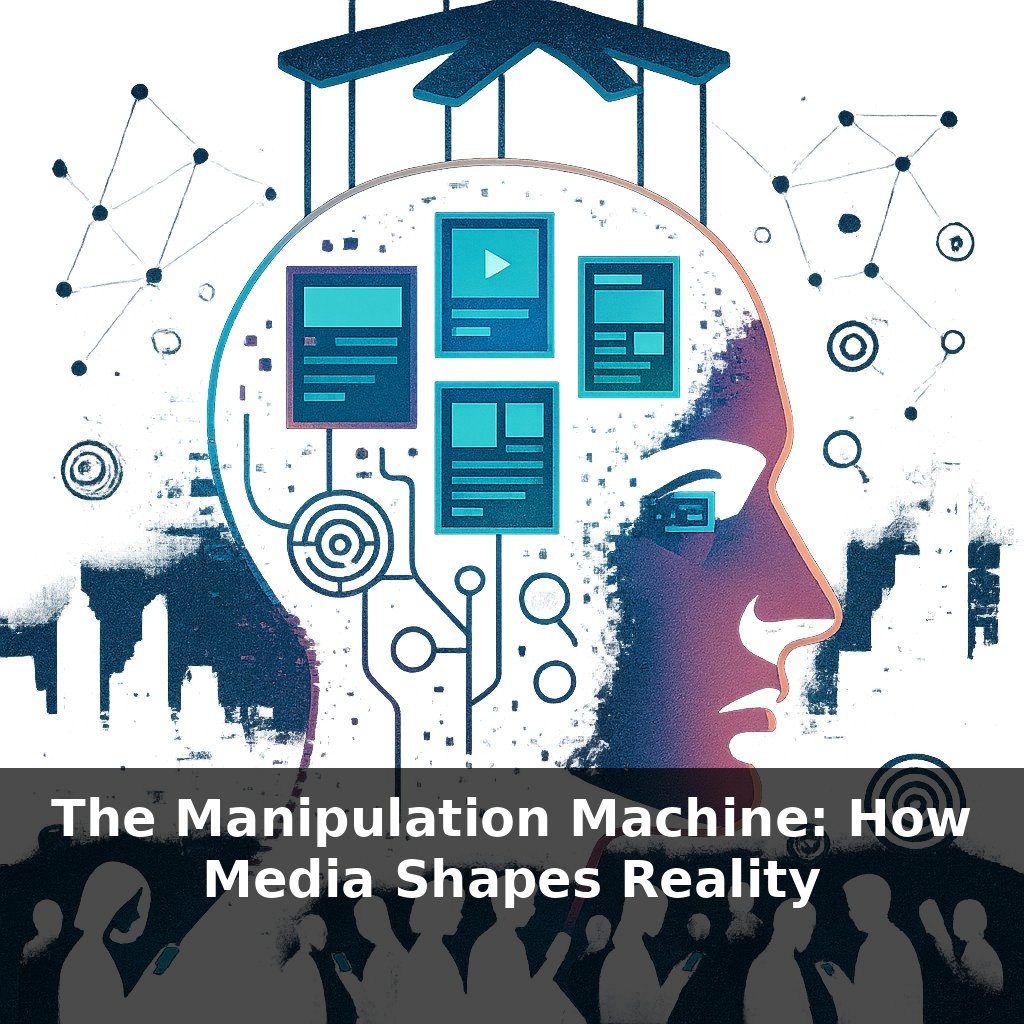
By the time social media arrived, the stage was already set: each leap in communication had tightened the feedback loop between message and reaction. What changed wasn’t just speed, but the ability to watch you respond in real time. Click, pause, rewind, share—every move is a signal. Modern platforms quietly test hundreds of variations of a headline or image, then double down on whatever keeps you there a fraction longer. It’s less a single dramatic broadcast than a constant, invisible A/B test on your attention, tuning the feed around you the way a thermostat adjusts a room.
The same levers that moved those wartime crowds are still being pulled—but the hands have multiplied, and the grip has tightened.
Early print campaigns had to bet on a few big ideas and hope they landed. A government poster might shout “Enlist now!” or “Loose lips sink ships!” and then wait weeks to sense any shift in mood from newspapers, letters, or reports. Radio and TV added tone of voice, music, pacing—yet they were still mostly one‑way blasts. You tuned in or you didn’t; broadcasters guessed what worked from ratings and election results.
Today, the guessing is over. Behavioral science has turned old hunches into measurable recipes: fear spikes sharing; anger boosts comments; moral outrage keeps people scrolling. Strategists test which images of threat, pride, or belonging make certain groups stay a little longer, trust a little more, doubt a little less. It’s not just what you see, but when: anxiety at night, triumph in the morning, indignation during lunch breaks.
And the audience is no longer a single crowd. It’s millions of overlapping micro‑groups, sorted by what they click, where they pause, which phrases make them flinch. A health campaign, a political movement, or a foreign influence operation can send dozens of tailored versions of the “same” message: hopeful for one segment, ominous for another, conspiratorial for a third. Side by side, people think they’re reacting to a shared reality, but they’re actually responding to different, customized prompts.
What used to be planned in annual campaigns now unfolds minute by minute. If a rumor suddenly catches fire in one region, messages can pivot within hours to feed, redirect, or smother it. If a slogan falters, it quietly disappears from your feed, replaced by a sharper, stickier phrase.
Propaganda is like seasoning in cooking: the core ingredients—national identity, fear, hope, resentment—don’t change, but the precise mix can now be adjusted dish by dish, table by table, until each plate tastes “just right” to the person eating it.
A century ago, a poster might shout the same slogan at everyone passing the town square. Now, picture three neighbors scrolling in the same minute: one sees a heartfelt story of a struggling veteran, another sees a fiery clip about “unpatriotic elites,” the third sees a meme mocking people who don’t “support the troops.” All three posts push toward the same conclusion, but each takes a different emotional route calibrated to their past clicks.
Something similar plays out during a crisis. When a new disease appears, one feed fills with uplifting tales of community volunteers, another with graphs and “expert” charts, another with videos hinting that “they’re hiding the truth.” The destination—shaping what feels plausible, urgent, or suspicious—remains shared, but the path there is split into countless emotional side streets.
Your challenge this week: whenever a piece of content strongly moves you—pride, anger, fear—ask: “If my friend with opposite views opened their phone right now, what *different* version of this story might they be seeing?”
As deepfakes and AR filters mature, the next battle won’t be over *what* you see, but over whether you trust your own eyes. A neighbor’s “live” video, a “casual” group chat, a street sign seen through smart glasses could all be tuned in real time, like a personalized radio station for your biases. Provenance tools and media literacy may become as routine as spam filters—quietly running in the background, flagging when reality has been edited mid‑sentence.
Now the frontier slips closer to home: recommendation engines sketch rough outlines of your habits the way a barista learns your “usual.” Not evil on their own, but easy to weaponize. The open question isn’t just “Who is trying to sway me?” but “Who set the defaults of the feeds, alerts, and trends that quietly decide what I never even see?”
Start with this tiny habit: When you’re about to share or react to a post that feels outrage-y or too perfectly aligned with your views, pause and whisper to yourself, “Who benefits if I believe this?” Then glance at the source name and do one super-quick check: ask yourself if it’s a government, a company, a political group, or a random account with no clear owner. If it reminds you of the wartime posters or Cold War leaflets mentioned in the episode—big emotion, simple enemy, easy villain—just wait 30 seconds before clicking anything. That tiny pause is your modern version of spotting old-school propaganda posters on the city wall and choosing whether to walk past or stop and stare.