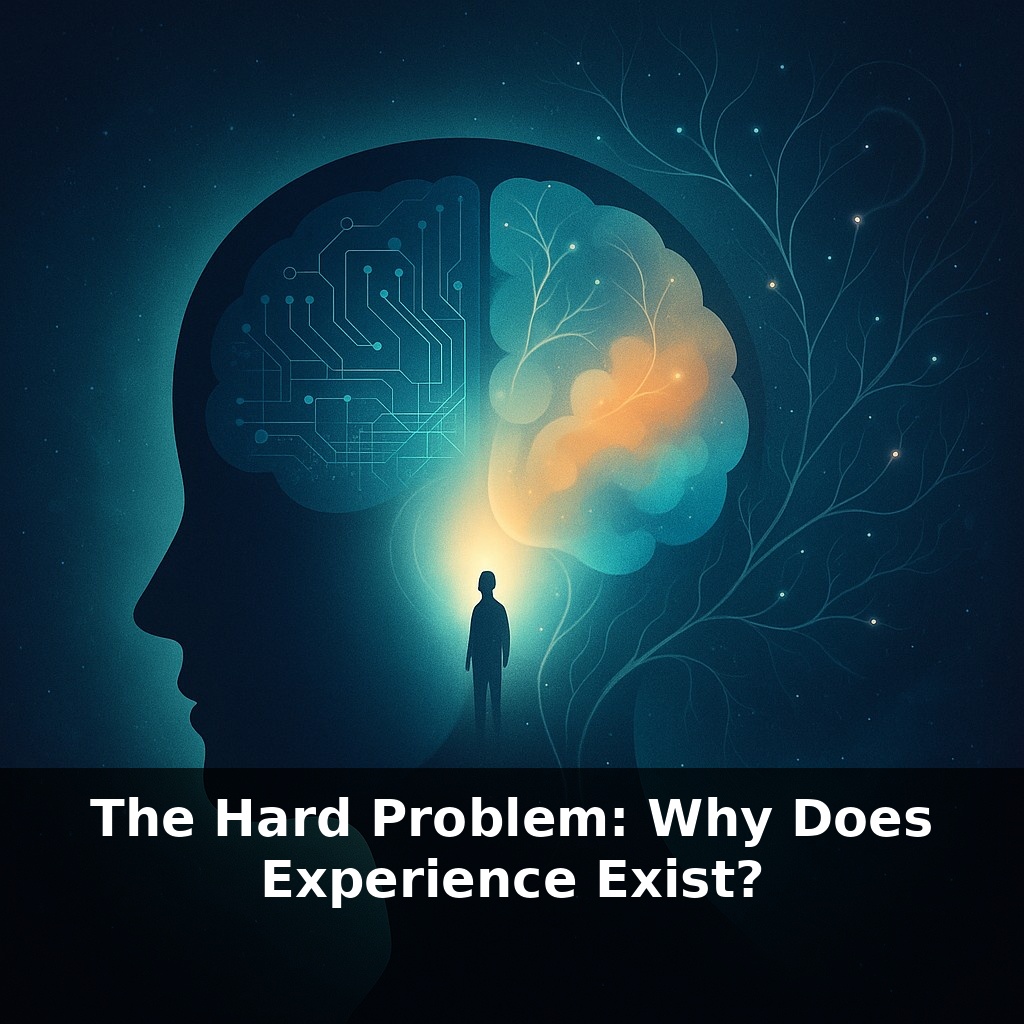
The Hard Problem: Why Does Experience Exist?
📝 Transcript
Right now, as you listen, billions of neurons are firing in your brain—yet science still can’t explain why that electrical storm *feels* like anything at all. In this episode, we’ll walk straight into that mystery and tug at the loose threads of consciousness itself.
Your brain can already solve differential equations, recognize a friend’s face in a crowd, and catch a falling glass before it hits the floor—long before you can say how you did any of it. Modern neuroscience is getting impressively good at tracing these feats: we can track spikes of activity, predict which button you’ll press, even watch memories being stabilized during sleep. Yet one stubborn question keeps slipping through the instruments: why is any of this *felt* from the inside? Why is pain not just a damage signal, but a hurt; why is red not just a wavelength, but a vivid presence in your awareness? In this episode, we’ll follow philosophers and scientists as they confront that gap, and you’ll test, in real time, where your own explanations of experience start to run out.
Philosophers call this the “hard problem”: not how the brain does clever things, but why any of it is lit up from within. David Chalmers sharpened the puzzle, arguing that no amount of behavioral or neural description seems to *demand* the existence of a felt point of view. In response, theories have multiplied. Some claim experience is just complex information broadcast across the brain; others say it’s tied to how tightly information is woven together. Still others insist consciousness is fundamental, like charge. Each route promises insight, but each leaves a residue of mystery we’ll probe next.
Start with a puzzle that looks almost too simple: take a brain described in complete physical detail—every neuron, every synapse, every firing pattern nailed down. Now add one more sentence: “and therefore, there is something it is like to be this system.” That last step is exactly where many thinkers say the explanation silently jumps the tracks.
One response tries to deny there’s a jump at all. On a “nothing extra” view, if you specify what information is accessed, integrated, and used to guide behavior—like in Global Workspace–style models—you’ve already captured everything there is. If it walks like a conscious system and talks like one, there’s nothing left over to explain. Critics push back: you can imagine a perfect physical duplicate of you that behaves identically yet, by stipulation, has no inner life. If that picture even seems coherent, they argue, then function can’t *just be* experience.
Others bite a different bullet: maybe experience is a basic feature of reality that shows up when matter is organized in certain ways. Integrated Information Theory, for instance, assigns a quantitative score to how much a system’s current state depends on its parts acting together rather than separately. More irreducible structure, higher Φ, richer experience. Anesthesia studies showing Φ dropping under propofol are suggestive, but they don’t yet explain *why* that particular kind of integrated cause–effect structure should feel like anything from within.
Go further and you reach panpsychist territory, where even very simple systems carry minuscule “sparks” of experience, and complex brains just knit them into the blazing, structured consciousness you know. That evades the question of how you get mind from absolute zero, but creates a new “combination problem”: how do countless tiny proto-experiences merge into the single, unified field you’re aware of right now?
At the opposite extreme are illusionists, who argue the “hard problem” itself is a kind of cognitive magic trick. On this view, biology builds creatures that insist they have private, ineffable qualia; what needs explaining is why brains generate that conviction, not some extra inner glow. Yet when you notice the raw feel of a toothache or the taste of garlic, the idea that this is *only* a story your brain tells about its own activity can seem oddly thin—like being handed a recipe when what you’re really asking about is the flavor on your tongue.
Think about anesthesia in a hospital: one moment a patient is chatting; a few breaths of propofol later, the lights are out—no dreams, no time, no “you,” yet the heart and lungs carry on. Monitors show activity hasn’t vanished; it’s *reorganized*. Tononi’s camp says what’s lost is a special pattern of cause–effect structure, reflected in a drop in Φ. Workspace theorists instead point to signals no longer “broadcast” widely enough for report and memory. Both camps can predict when a patient will stop responding, but neither can say why that specific shift in patterns should silence the inner movie.
Something similar lurks in everyday habits. You can drive a familiar route and “wake up” in your driveway with only scattered islands of recall. The movements were skilled, the decisions adequate to stay alive, yet your sense of having *been there* is patchy. The hard problem hides in that contrast: same body, similar behaviors, wildly different degrees of felt presence.
A lab tweak that nudges Φ or workspace dynamics might someday change what patients, animals, or AIs *say* about their inner life. That tempts us to treat reports like weather forecasts: noisy but actionable. Law and policy could then hinge on thresholds of “felt” capacity—who can suffer, consent, or be trusted with open‑ended autonomy. Yet each step raises a deeper worry: are we measuring experience itself, or just the sophistication of systems built to talk about it?
Maybe the hard problem is less like a riddle to crack and more like a horizon that moves as we walk. Each new theory—workspace, IIT, illusionism, panpsychism—shifts where the mystery sits but never quite dissolves it. Explore one instance this week where your reactions seemed unexpected or unplanned, and reflect on what this reveals about the nature of your consciousness that neuroscience might struggle to explain.
Unlock all episodes
Full access to 8 episodes and everything on OwlUp.
Subscribe — $1.99/monthLess than a coffee ☕ · Cancel anytime