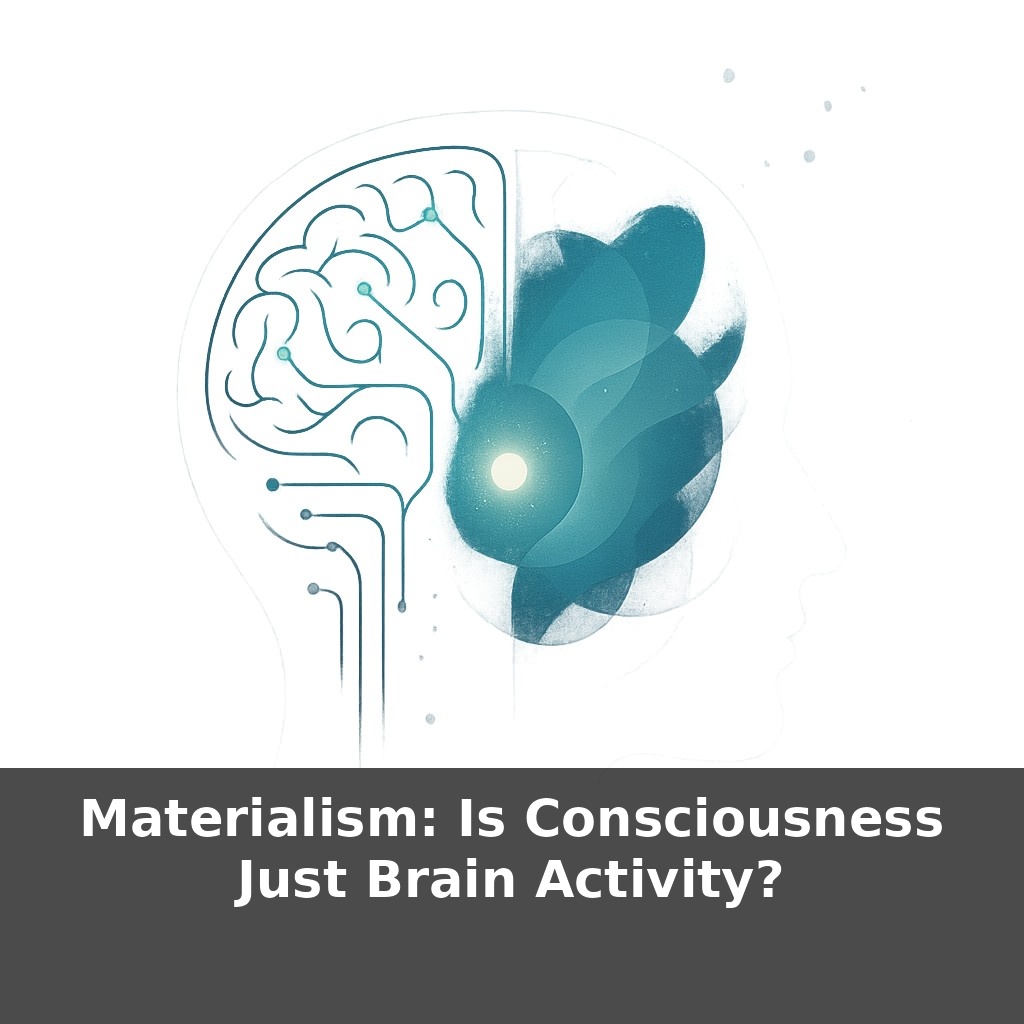
Right now, the three pounds of tissue in your skull are burning through about a fifth of your body’s energy—just to keep your experience of this moment going. Here’s the puzzle: if it’s all just brain activity, where does the feeling of “being you” actually come from?
Some philosophers argue materialism is “obviously false” because no scan of your brain seems to reveal the blueness of blue or the hurt in pain. Yet every time scientists look for where experiences *fail* to track the brain, they come up empty. Change the chemistry enough—through anesthesia, psychedelics, antidepressants—and your inner world shifts in lockstep. Still, there’s a gap: why should electrochemical signals feel like anything at all, instead of unfolding in pure darkness? This is the “hard problem” of consciousness. Materialists respond by turning the question around: rather than asking how mere matter could ever think or feel, they ask whether our idea of “mere matter” is simply too thin. Maybe what we call physical processes already include the seeds of subjectivity, just described from the outside rather than the inside.
Neuroscience pushes this debate from armchair speculation into the lab. When surgeons electrically stimulate tiny patches of cortex, people report precise flashes of color, fragments of music, or sudden memories—like pressing oddly specific “buttons” on awareness. Damage a few cubic millimeters in Broca’s area and fluent speech can vanish, while a nearby injury might spare language but erase faces. Under anesthesia, high-frequency brain rhythms fade as reports of experience do. These findings don’t settle the hard problem, but they narrow the space where non-physical explanations can comfortably hide.
Neuroscientists don’t just note that brain states and experiences line up; they try to *predict* one from the other. One strategy is “neural decoding”: record activity, then infer what someone is seeing, hearing, or deciding before they report it.
In visual experiments, for example, researchers show volunteers thousands of images while scanning their brains. Over time, a machine-learning model learns the subtle patterns that distinguish “face” from “house,” “dog” from “car.” Later, when the person sees a new image, the algorithm can often guess what category it belongs to just from the neural data. In some labs, the reconstructions are now crude but recognizable picture-like outputs. That doesn’t prove all of consciousness is captured, but it shows mental content is not a mysterious extra floating free of the brain; it leaves a measurable, decodable signature.
The same applies to intentions. In certain decision tasks, activity in motor and frontal regions can reveal which button someone is about to press, sometimes seconds before they say they’ve “chosen.” Materialists take this as evidence that conscious choice is tightly integrated with, and possibly arises from, prior neural competition and selection. Critics reply that prediction is not explanation: knowing *where* and *when* doesn’t tell us *why it feels like something* to choose.
Contemporary theories try to bridge this. Global Workspace Theory proposes that a stimulus becomes conscious when it’s broadcast across widely separated networks, making it available to memory, verbal report, and planning. Integrated Information Theory, by contrast, focuses on how much a system’s parts constrain one another as a whole. On this view, a highly integrated structure has an intrinsic “point of view,” and the quantity and quality of that integration map onto the richness of experience.
Both approaches stay within a broadly physicalist picture, yet they tweak what “physical” means. Instead of matter as inert stuff, the emphasis shifts to patterns of organization, communication, and causal structure. That’s where some see a possible softening of the intuitive gap: maybe what we call consciousness is what highly organized biological matter is doing when it reaches a certain level of complexity and interdependence, the way a mature immune system “knows” self from non-self in a way no single cell does.
Consider a patient who suddenly loses the ability to name objects after a tiny stroke, yet can still use them perfectly. They pick up a key, unlock a door, but can’t say “key.” Materialists point out that when we zoom in, we don’t find a “language soul” gone missing; we see damaged links in specific neural networks for word retrieval. Or take split-brain cases: when the connection between the hemispheres is severed, two semi-independent streams of awareness can emerge, each with access to different information. That’s hard to square with a single, indivisible non-physical mind, but it fits a picture where “you” are what a particular large-scale pattern of activity is doing.
In clinical practice, neurologists routinely classify states like coma, locked-in syndrome, and minimally conscious states by tracking which networks still coordinate. It’s less like flipping a magic on–off switch and more like tracing which communication lines in a city are still open when the power grid falters.
If mind is fully physical, then mental privacy becomes a technical challenge, not a metaphysical right: future “thought leaks” might look less like lie detectors and more like unauthorized screen-recordings of inner life. Law and medicine would need new norms for consent: is a court-ordered brain scan like a blood test or like forcing testimony? Your weekly moods might be tuneable, the way we now adjust sleep or diet—raising the question: how much editing of the self is still *you*?
If inner life is nothing over and above organized matter, the mystery shifts from “what is mind?” to “what can this kind of matter eventually do?” Minds built from silicon or gene-edited tissue might cook up values we barely recognize, the way a new cuisine surprises old palates. For now, each thought is a live experiment in what matter can mean.
Before next week, ask yourself: (1) “When I pay close attention to a vivid experience—like tasting coffee, feeling anxiety, or noticing a color—does it feel like ‘just’ neurons firing to me, or like something more, and why?” (2) “If I fully accepted that my thoughts and choices are nothing over and above brain activity, how would that change the way I treat blame, praise, or forgiveness in one real relationship in my life?” (3) “Can I recall one moment (a dream, a ‘flow’ state, a feeling of awe) that seems hardest to square with strict materialism, and what specific brain-based explanation would I honestly find satisfying for that moment—if any?”