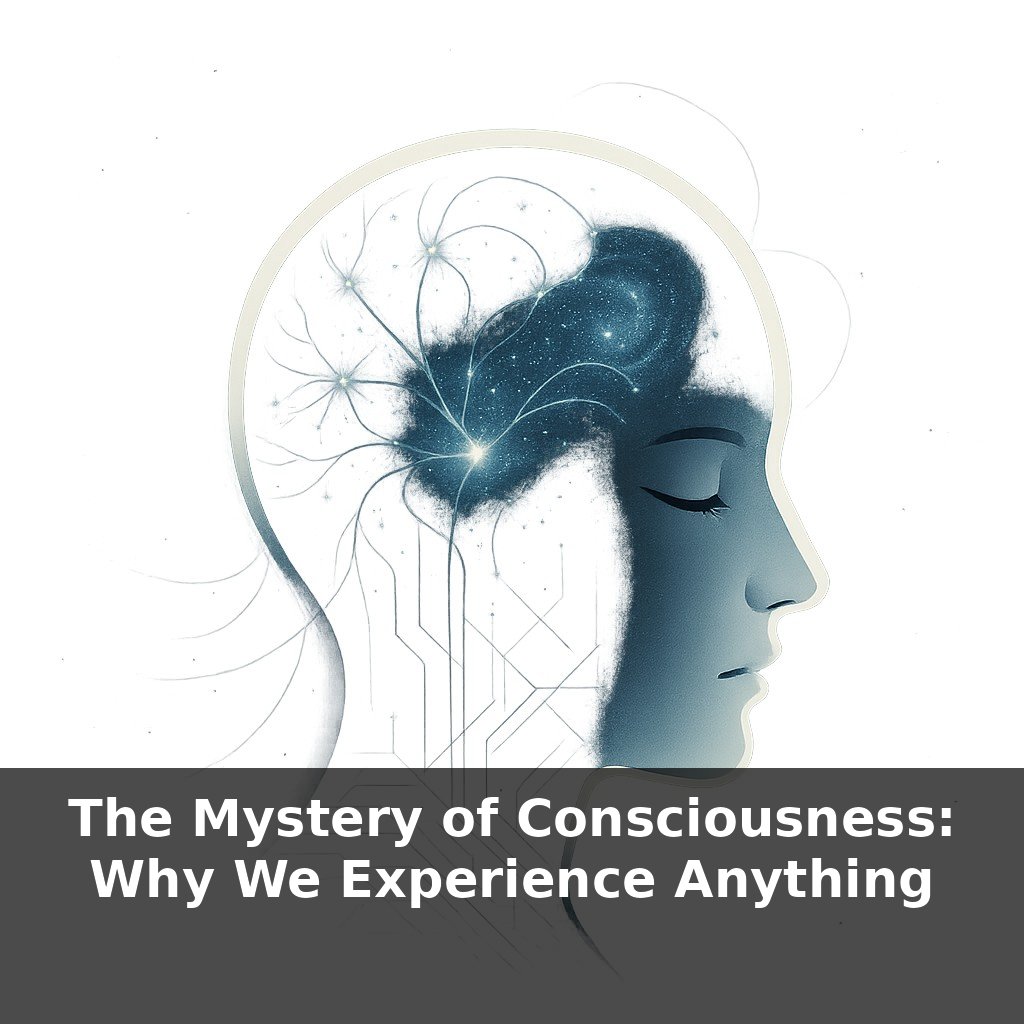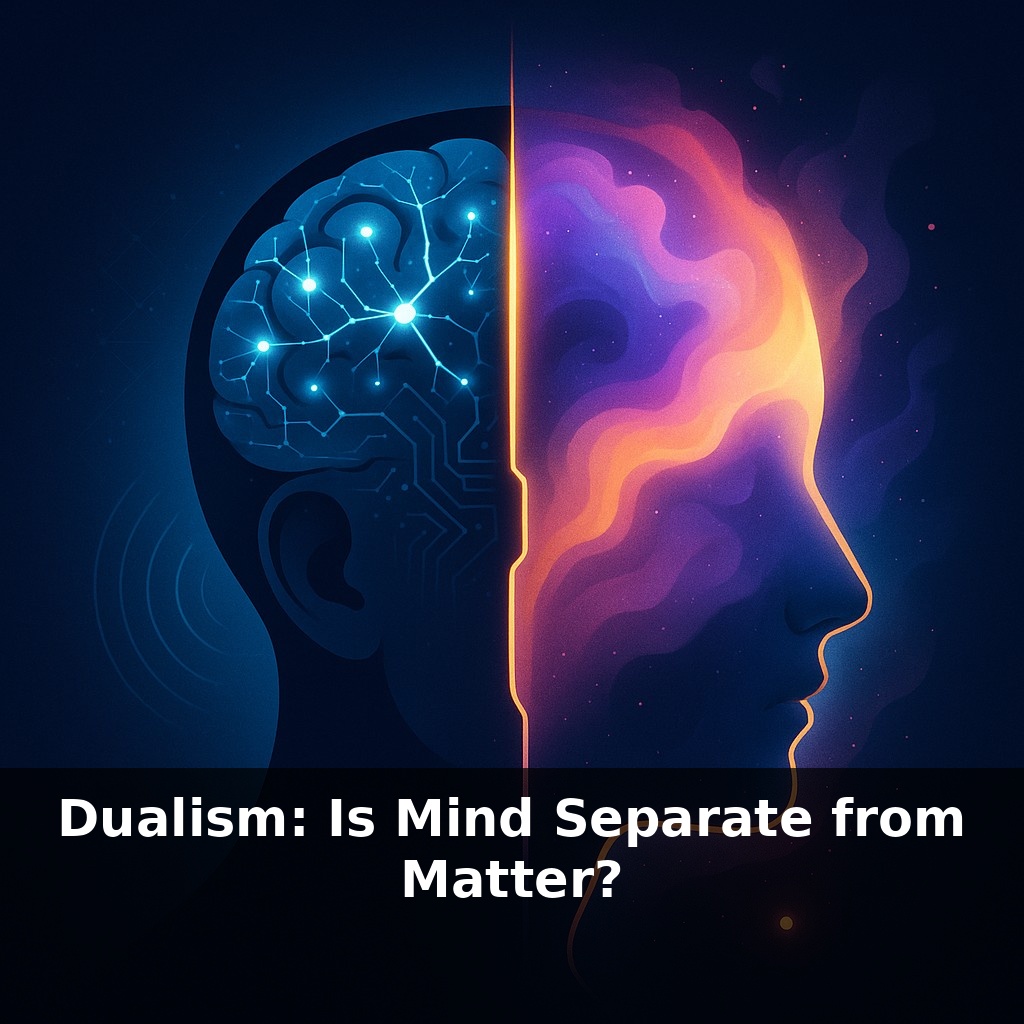
Right now, as you listen, your brain is a storm of electrical sparks—yet your experience feels smooth, unified, personal. Here’s the puzzle: are those sparks *all* you are… or is there a “you” that isn’t made of matter at all? Today, we walk into that mystery.
Scientists can now watch specific patterns in your brain that line up with particular words you hear, images you see, even decisions *before* you’re aware you’ve made them. At the same time, surveys show that most people still feel there’s “something more” to them than a body—something that could, in principle, exist without a brain at all. That tension sits at the heart of mind–body dualism: the claim that your thoughts, pains, hopes, and awareness belong to a fundamentally different kind of stuff than your neurons. In this episode, we’re going to trace how that idea took shape, why it refuses to die, and what modern experiments—from life-changing brain injuries to deliberately severed hemispheres—seem to reveal about whether the mind can truly float free of matter.
To see what’s at stake, we need to step outside abstract philosophy and into everyday life. When someone close to you dies, we instinctively talk as if “they” have gone somewhere, leaving the body behind like clothes folded on a chair. Yet in hospitals, neurologists treat a flat EEG as the end of the person, not just the end of the body. Legal systems, too, quietly pick a side: responsibility, competence, even consent are tied to measurable brain states, not invisible souls. And still, in prayer, grief, or awe, many of us feel a presence that seems bigger than biology, as if the story can’t end with tissue.
Dualists claim that when you feel pain, fall in love, or consider a moral dilemma, something is happening that cannot, even in principle, be captured by talking only about atoms and fields. On this view, there are at least two kinds of reality: the physical and the mental. Descartes called them *res extensa* (extended stuff) and *res cogitans* (thinking stuff). Modern dualists update the terms, but keep the core: consciousness has properties—like subjective feel, or “what it’s like”—that no amount of physical description seems to entail.
Their main ally is a set of puzzles. One is about knowledge. You can know everything a neuroscientist could write about color vision—the wavelengths, the receptors, the circuitry—and yet, dualists say, you’d still learn something new the first time you actually see a ripe tomato. That “what it’s like” seems left over, as if experience and description belong to different realms.
Another puzzle is about possibility. Many people find it coherent to say, “I could exist without *this* body,” or “My mind could be uploaded someday.” If that scenario even makes sense, dualists argue, then mind and matter can’t be identical, the way water and H₂O are.
Physicalists push back hard. They point to cases where a small dose of anesthesia, a single tumor, or a degenerative disease can erase not just memory or movement, but humor, guilt, or the sense of self. If the mind were truly independent, why would its finest textures track so tightly with the condition of tissue? For them, the right picture isn’t two separate worlds, but one world described at different levels. A migraine is, at once, a throbbing agony and a thicket of firing neurons—no competition, just two vocabularies.
Still, even many physicalists admit an “explanatory gap”: we can map correlations, build theories, even predict choices, yet it remains obscure why *this* pattern of matter should light up as *this* experience rather than silence. The debate over dualism lives in that gap—between what current science can measure and what it still struggles to make intuitively intelligible. Whether that gap will close with better tools, or marks a real boundary in nature, is the question that keeps the controversy alive.
Think about how differently we treat a living and a dead language. Latin has grammar, texts, even recordings of people pronouncing it—yet we say it’s “dead” because no one *speaks from within it* anymore. Some dualists say the mind is like that “speaker-from-within”: not just patterns in the system, but an interior presence those patterns alone can’t guarantee.
Clinical cases sharpen this. People under deep anesthesia sometimes report a patchy, timeless void, while patients in so‑called “locked‑in” syndrome describe vivid inner lives despite minimal outward response. Their brains meet medical criteria, yet the reported quality of being someone shifts dramatically. Does that mean we’re just misreading physiology, or that first‑person life has a semi‑independent status?
Here’s where the debate turns: if we could build an AI that talks about love, fear, and meaning as richly as any human, would we owe it moral concern—or wait for some sign that there’s a genuine “inside” there, over and above its circuits?
If mind really isn’t just what the brain does, then our laws, hospitals, even prisons might be built on the wrong blueprint. Consent, guilt, and capacity could hinge on an invisible ingredient no scan can certify. If, instead, mind is fully “baked into” matter, then copying a brain might copy a person, forcing us to treat uploads and advanced AI less like tools and more like new citizens, with rights that grow as their inner lives become harder to dismiss.
Maybe the live question isn’t “Is mind separate from matter?” but “How many ways can reality wear a mind?” From near‑death reports to debates on animal pain and AI feelings, we’re still groping for a test of “who’s really there.” Your challenge this week: notice when you treat something as a *someone*—and what evidence you quietly rely on.