 2min preview
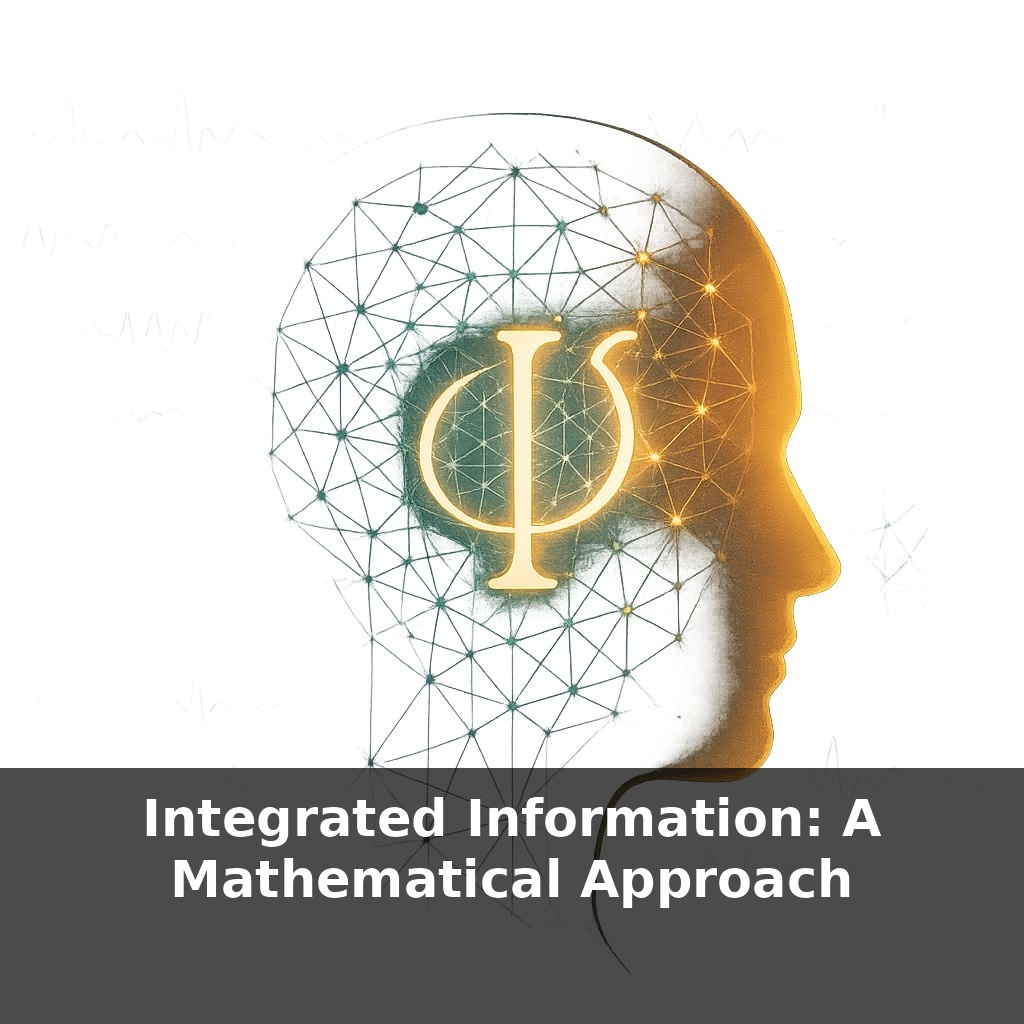
Integrated Information: A Mathematical Approach
📝 Transcript
Right now, a theory of consciousness is being tested with real hospital patients—using math. In one room, a seemingly awake person scores “unconscious.” Next door, a silent, unresponsive patient shows a clear signal of awareness. Same machines, same test…opposite answers.
In this episode, we zoom in on the bold claim behind those hospital tests: that consciousness can be captured by a single number, Φ (phi), and that this number falls out of the *structure* of a system, not how impressive its behavior looks from the outside. According to Integrated Information Theory, what matters is how deeply the parts of a system depend on one another for what they can cause and what they can remember. Break the system into pieces, even just conceptually, and ask: how much meaningful structure vanishes when I “cut” here? The more that disappears, the higher the Φ. That’s why IIT predicts that a fancy but strictly feed-forward AI can be blazing fast and still score near zero on consciousness, while a smaller, recurrent biological network might rank higher. Strikingly, these ideas are now embedded in real tools—like PCI and PyPhi—that researchers are using to probe brains, circuits, and even silicon.
In practice, IIT forces us to ask a different kind of question about brains and machines: not “what can it do?” but “how much would fall apart if we could somehow silence this piece, or that connection?” Instead of tracking outward behavior, researchers trace internal cause–effect structure, sometimes down to specific microcircuits or layers. This shift has concrete implications: an anesthetized cortex and a dreaming one can look similarly inactive overall, yet differ radically in how patterns propagate. The surprise is that such subtle differences may map onto a single, computable Φ.
Subscribe to read the full transcript and listen to this episode
Subscribe to unlockSubscribe for $1.99/month to unlock the full episode.
Unlock all episodes
Full access to 8 episodes and everything on OwlUp.
Subscribe — $1.99/monthLess than a coffee ☕ · Cancel anytime