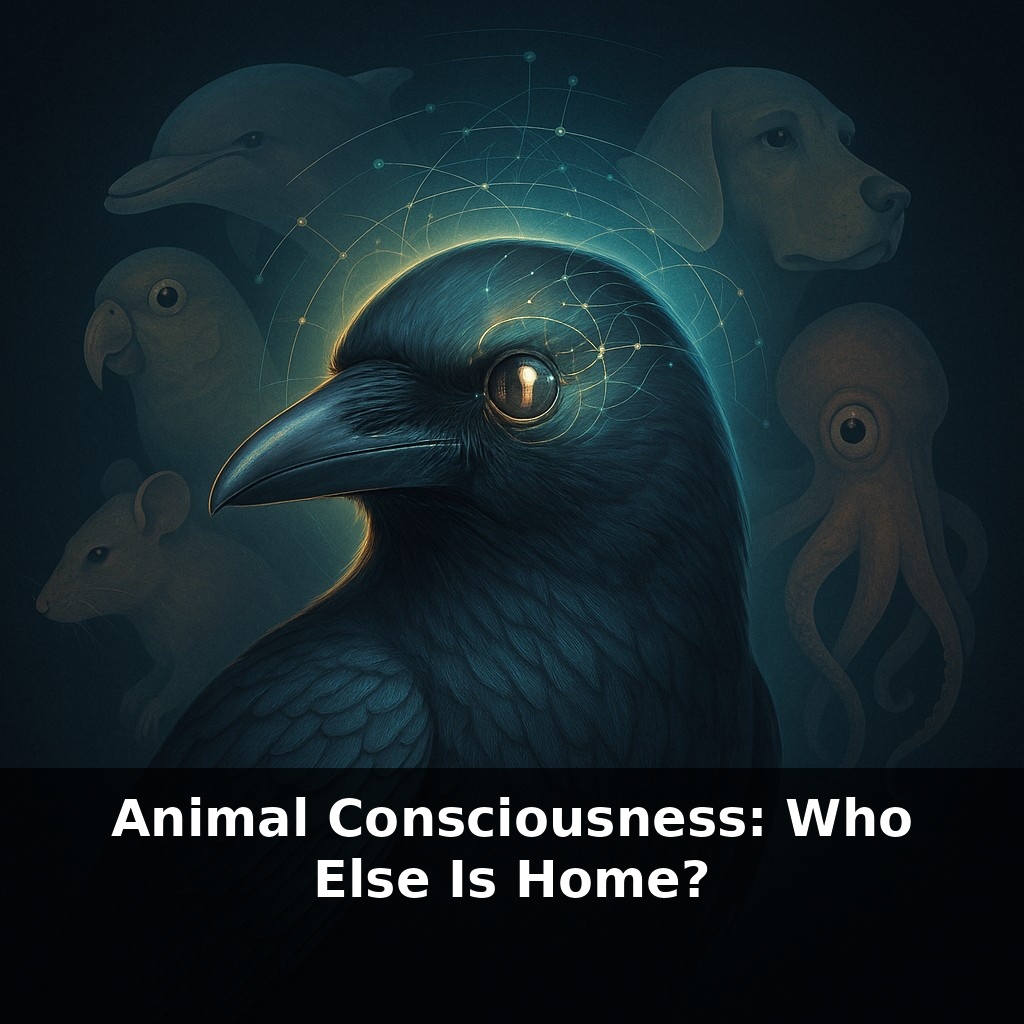
Despite the sophisticated feats observed in animals like dolphins, crows, and octopuses, the question lingers: are these actions merely instinctual, or do they reflect a conscious mind at work? We’ll explore the hidden depths of animal consciousness and the implications of these behaviors in this episode.
A parrot that lies to avoid a vet visit. A rat that will stop pressing a lever for treats to free a trapped companion. A dog that looks guilty only when you catch it in the act. These aren’t just cute stories; they’re data points in a much larger investigation into who else might have an inner life. As we move beyond simple reflexes and ingrained routines, researchers are starting to ask a sharper question: not just “Are animals conscious?” but “What kinds of experiences are they having?” Are they worried, curious, bored, planning ahead? In labs and field sites, scientists now design experiments that tease apart habit from choice, and fixed patterns from real-time decisions—more like a live conversation with another mind than a one-off test. The mystery is shifting from yes-or-no to a more uncomfortable possibility: that many everyday animals around us might be having quietly rich mental lives.
In this episode, we zoom in on the evidence itself: the odd, stubborn findings that don’t fit the old picture of animals as biological robots. Corvids caching food can later re-hide it if a rival was watching, as if they remember not just where, but who saw what. Elephants linger at bones of their dead for long stretches, touching them repeatedly in patterns researchers still struggle to classify. Lab rats hesitate longer before harming a familiar peer than a stranger, a tiny behavioral trace of social evaluation. Each of these results nudges scientists to ask: what kind of point of view would make these choices make sense?
When scientists try to move from “something interesting is happening” to “there’s likely a subjective point of view here,” they generally lean on three kinds of clues: flexible behavior, brain architecture, and evolutionary logic.
First, flexibility. Some animals don’t just solve a task once; they reshuffle their strategies when the rules silently change. Scrub jays that have learned which foods rot quickly will later switch their hiding choices if experimenters alter decay times, as though they’re updating an internal model, not just repeating a learned routine. Chimpanzees faced with a puzzle box sometimes abandon an inefficient, trained method after watching a peer discover a shortcut—suggesting they can compare “what I know” with “what you just did” and revise on the fly. Bottlenose dolphins tested on self-control will forego an immediate fish if waiting earns them a larger reward, and they adjust that waiting time when the payoff structure shifts, hinting at a sense of future outcomes, not mere conditioning.
Second, the hardware. Across very different species, we keep finding neural “solutions” that echo one another. Great apes, whales, and elephants share specialized spindle neurons implicated in rapid social evaluation in humans. Birds lack a layered neocortex, yet the pallial regions of corvid and parrot brains show dense, recurrent loops strikingly similar to our own decision and working-memory circuits. Octopus nerve cords distributed through their arms can operate semi-independently, while a centralized brain coordinates exploration and learning; when they navigate mazes or choose novel objects to investigate, recordings reveal distinct activity patterns that track preference and uncertainty.
Third, evolution. Wherever complex social living, long lifespans, and demanding environments coincide, we see convergent patterns: richer problem-solving, more nuanced communication, longer developmental periods for learning. Dolphins use signature whistles that function like names. Some parrots combine calls in ways that shift meaning with context, edging toward compositional “syntax.” Even jumping spiders with tiny brains display context-sensitive hunting tactics, approaching prey differently depending on angle, distance, and prior success.
The emerging picture isn’t a single line from “unconscious” to “conscious,” but a branching landscape of partial, overlapping capacities, sculpted again and again by the pressures of survival in other bodies and other worlds.
A honeybee returning from a rich flower patch performs a “waggle dance” that changes with distance, direction, and even crowding at the food source. It’s not rote: bees revise the dance if conditions shift, as though comparing a current map with a remembered one. Cut to a border-collie trained on hundreds of object names; some can fetch “the blue ball that is not small” on first ask, suggesting they’re not only matching sounds, but sorting through options on the fly. In labs, cuttlefish given a choice between a small meal now or a larger one later can wait—yet they wait longer if their usual dinners are unpredictable, adjusting patience the way investors adjust risk.
One way to picture this is like a doctor reading different vital signs: heart rate, blood pressure, temperature. No single measure “is” health, but the pattern matters. Across bees, dogs, and cuttlefish, scientists are starting to track behavioral “vitals” that, taken together, hint at someone navigating options from the inside.
Laws, labs, and dinner plates may all look different if we treat other creatures as “someone” rather than “something.” Courts are testing ideas like nonhuman personhood; farms quietly trial designs that reduce stress the way cities add parks to ease human strain. As brain-scanning tools shrink, we may map pockets of awareness the way weather radar tracks storms—patchy, shifting, sometimes surprising in where they appear and how long they last.
As evidence piles up, the question subtly flips: not “Which animals qualify?” but “Where should we stop drawing lines at all?” Your dog, a city pigeon, a squid in the deep—each might carry a small, private weather system of moods and meanings. Your challenge this week: pick one nonhuman neighbor and act as if its inner sky matters, then notice what changes in you.