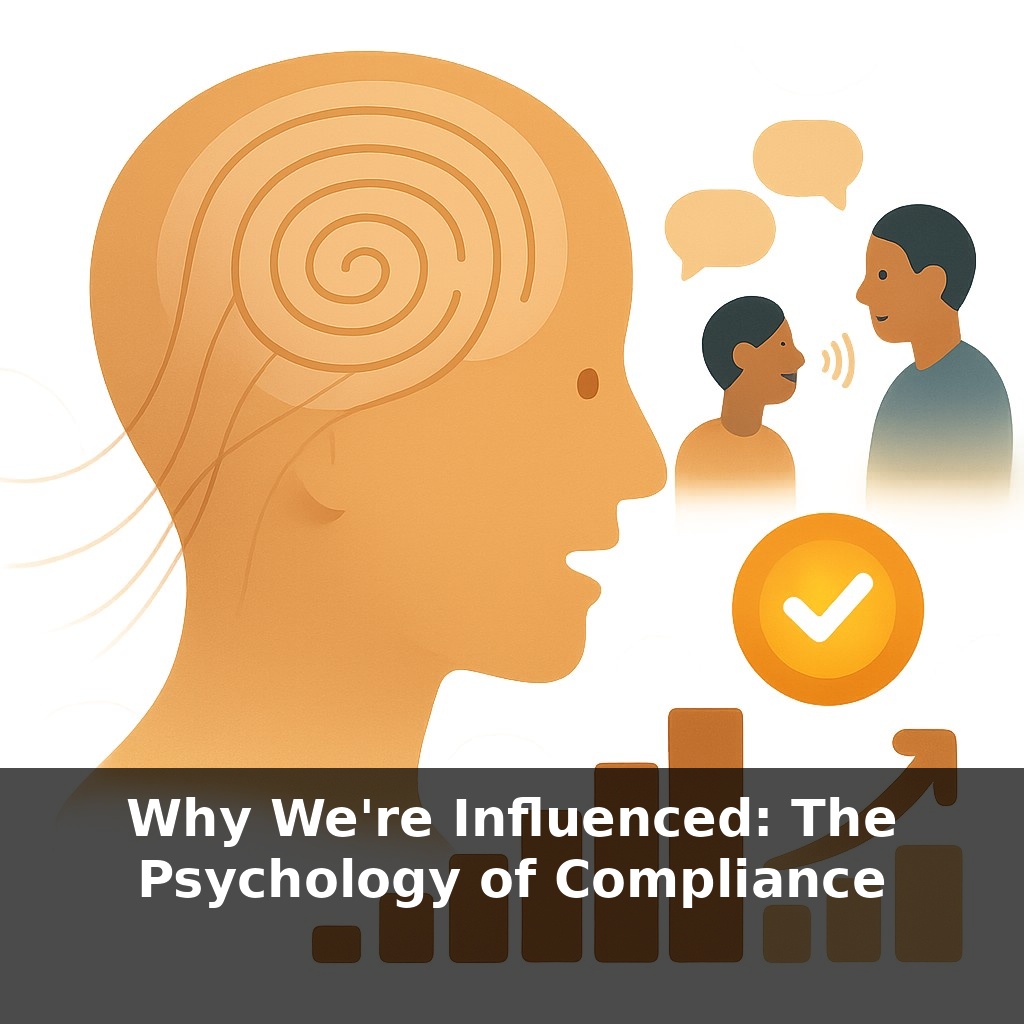
Why We're Influenced: The Psychology of Compliance
📝 Transcript
A single click on Facebook once nudged roughly three hundred thousand extra people to vote. Now, think about this: you say “yes” to a friend’s favor, a boss’s request, a pop-up online—without quite knowing why. Hidden scripts are steering you. Today, we’re going to start uncovering them.
You’ve felt this in your relationships, too. You agree to stay late “just this once,” and suddenly it’s expected. You offer a small favor to a friend, and before you know it, you’re their go-to problem-solver. These moments rarely feel like big turning points, but they quietly reset what’s “normal” between you and other people. Compliance in close relationships isn’t usually about pressure; it’s about patterns. The brain is scanning for shortcuts: Who do I trust? What do people like me usually do? What’s been true between us before? Those quick answers shape whether you say yes or push back. And because both sides are running on these shortcuts, couples, friends, and families can slide into roles—giver, decider, peacekeeper—without ever really choosing them. This series is about seeing those patterns clearly enough to decide which ones you actually want.
Some of those “yes” patterns are baked so deep into us that they fire before we’ve even formed a conscious opinion. The classic studies weren’t run on “weak-willed” people; they were run on ordinary adults who believed they were just making reasonable choices. That’s the unnerving part: in the moment, our decisions feel self-directed. In reality, specific cues—favor exchanges, urgent deadlines, authority tones, “everyone else is doing it” signals—quietly tilt the scales. In close relationships, these same levers don’t just influence one choice; over time, they can reshape power, trust, and even whose needs get airtime.
Most of what we call “persuasion” in relationships isn’t a big conversation; it’s a series of tiny tilts. One partner casually says, “Since you’re already up, could you grab my charger?” The next night, “Could you also fold the laundry while you’re in there?” Each request feels harmless in isolation. But psychology research shows that once we say yes to a small ask, we’re more likely to agree to a bigger, related one later—the “foot-in-the-door” pattern playing out not in a lab, but in your living room.
Across hundreds of studies, a handful of levers keep showing up. Reciprocity makes you feel a subtle pull to “even the score” when someone does something for you. Commitment and consistency make you want to act in line with what you’ve already said or done—especially if you’ve said it out loud: “I’ll handle the finances,” “You’re the organized one,” “I don’t mind helping.” Social proof inside a relationship sounds like, “All my friends’ partners go to these work events,” or “My family always does it this way.” Authority can be as simple as “I’ve read more about this than you,” gaining weight over time if it goes unchallenged.
Liking and unity are especially powerful in close ties. You’re not just dealing with someone you enjoy; you’re dealing with “us.” When a request is framed as part of protecting the relationship—“If you really cared about us, you’d…”—it quietly fuses compliance with loyalty. Scarcity shows up when time, attention, or affection feel limited: “I only have tonight free,” “This is your last chance to fix this.” Under that pressure, people often agree first and process later.
Think of these levers like cooking techniques in a shared kitchen: whoever quietly controls the heat and timing shapes the meal, even if you both brought ingredients. In relationships, the person who reliably frames choices—what’s urgent, what’s normal, what “we” do—often ends up steering more decisions than either person intends.
None of this means one partner is a villainous manipulator. These are default settings, not moral judgments. But without noticing them, it’s easy for a relationship to drift into one-sided giving, chronic over-accommodation, or simmering resentment—while both people still believe they’re just being “reasonable.”
Your weekend starts disappearing this way: “Can you help me move this one box?” becomes hauling an entire apartment’s worth of furniture. That’s not just a pushy friend; it’s how small asks stretch into bigger ones when no clear boundary stops the expansion. Or think of agreeing to “help with emails tonight” for your partner’s side project; a month later, you’re basically unpaid customer support.
Social proof can creep in sideways, too. Your sibling mentions that their partner always handles holiday travel, and suddenly your reluctance feels selfish instead of reasonable. Scarcity often slips under the radar in long-term relationships: “I hardly see you anymore, can you cancel your plans?” When time together feels rare, saying no feels like rejecting the relationship, not just the request.
In each case, the request isn’t outrageous on its own. The friction comes from the accumulation: tiny tilts that, stacked over weeks or years, leave one person quietly carrying more than they ever consciously agreed to.
Influence literacy may soon feel as basic as learning to budget. As tech quietly tracks when you’re tired, rushed, or lonely, it can time requests the way a smart thermostat times heating—precisely when your “no” is weakest. That’s not just marketers; it could be bosses, apps, even co‑parents using tools that predict your next yes. The emerging skill isn’t resisting every ask, but noticing, in real time, when the situation is shaping your choice more than your values are.
Noticing influence isn’t about becoming suspicious of everyone; it’s about seeing the “why now?” behind each ask. Over the next episodes, we’ll zoom in on specific levers—how they show up in texting, money talks, even breakups—so you can tell when a request fits your values, and when it’s just riding a psychological tailwind.
Start with this tiny habit: When you notice someone using one of Cialdini’s principles on you (like “limited time only,” “everyone’s buying this,” or “do this small favor first”), quietly say in your head, “Which principle is this?” and name it. Don’t try to resist or change your behavior yet—just tag it: scarcity, social proof, reciprocity, authority, liking, or commitment/consistency. This 3-second pause builds an automatic “psychological speed bump” so you start seeing influence attempts in real time instead of after the fact.
From this course
The Psychology of Influence: How People Persuade
7 episodesUnlock all episodes
Full access to 7 episodes and everything on OwlUp.
Subscribe — $1.99/monthLess than a coffee ☕ · Cancel anytime