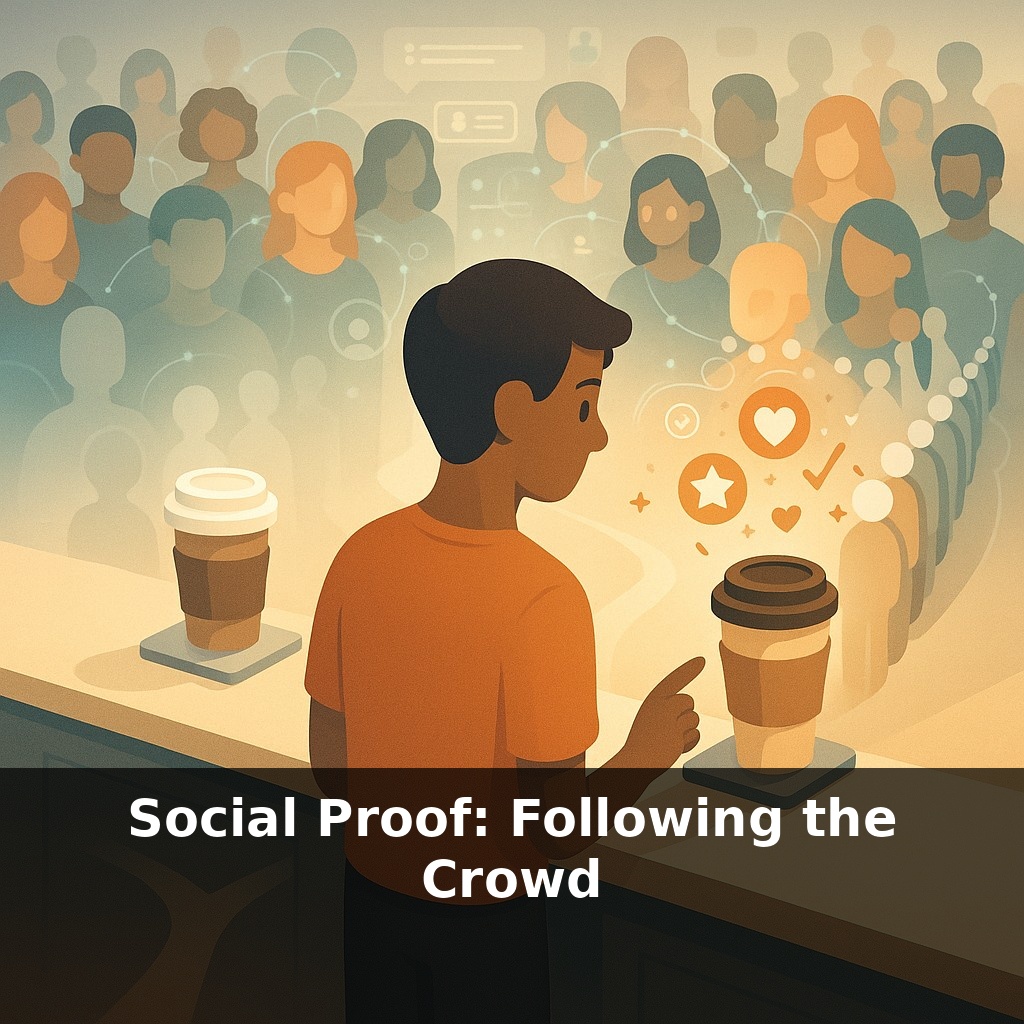
A single Facebook message once nudged roughly a third of a million people to vote—just by showing them what their friends had done. You’re in a café, choosing between two nearly identical drinks. One cup has a long line, one has none. Which one do you trust, and why?
You probably think of your choices as personal—your playlist, your favorite restaurant, even the kind of relationship you want. But tucked inside almost every “I just prefer this” is a quiet calculation: “What are people like me doing?” That’s social proof at work. We scan star ratings before trying a new therapist, feel oddly reassured when a dating profile has many matches, and trust a book more when it appears on “most wished for” lists. In close relationships, the effect can be subtle: we feel more confident about a new partner when friends approve, or doubt a healthy boundary when “everyone else” seems more easygoing. Just as a navigation app reroutes you based on traffic patterns, your brain constantly reroutes decisions based on what the crowd appears to be doing—often before you consciously notice.
Scroll through a dating app and you’ll see social proof everywhere: “most liked,” “recently active,” little badges that suggest, “other people picked this, so it’s safe.” In relationships, that same pull shows up when you feel oddly drawn to the person all your friends approve of, or start doubting a partner the moment group chat goes quiet about them. It colors whose messages you answer first, which conflicts you talk about, even how quickly you say “I love you.” The tricky part is that these signals feel like your own taste, not borrowed confidence from the crowd.
Step into a crowded comment section after a breakup story goes viral: “Dump him,” “Work it out,” “Men are trash,” “Therapy first.” None of these strangers know the couple, yet their voices still tug at how breakups feel in your own body. That’s the quieter side of social proof in relationships—less about who you choose, more about what you believe is normal, forgivable, or deal‑breaking.
There are two especially powerful levers here: uncertainty and visibility. Uncertainty shows up in messy moments: “Is this argument a red flag or just stress?”, “Is it weird we haven’t moved in together yet?”, “Is it okay that I don’t want kids?” The less sure you feel, the more tempting it is to reach for consensus: friends’ stories, TikTok takes, Reddit threads, “attachment style” memes. Visibility adds weight: numbers of likes, views, shares, comments, mutual friends. A private opinion feels tentative; a public pile‑on feels like a verdict.
This matters because “what everyone seems to be doing” quietly sets the baseline. If your feed is full of “if he wanted to, he would” content, patience can start to look pathetic. If all your friends glorify staying no matter what, leaving can feel like betrayal. The behavior that gets the most attention starts to look like the behavior that’s most common—even when it’s actually extreme.
Marketers understand this. Dating apps highlight “you’re in the top X% of liked profiles” or “4 people liked you today,” not because you needed that information, but because being wanted by others makes you feel more certain about wanting yourself. Influencers screenshot DMs about their “amazing relationship” to signal desirability. Even therapists and coaches post “client success stories” that subtly hint: people like you are choosing this path.
The tricky part is that crowd signals often mix real wisdom with loud distortion. A genuine trend—like more people leaving emotionally neglectful relationships—can ride alongside performative hot takes that punish nuance. The risk isn’t that you’ll suddenly become a mindless follower; it’s that, over time, your “gut feelings” get trained by whatever your particular crowd rewards or shames.
Your group chats and feeds act like little thermostats for your relationship life. New partner soft-launch gets ten heart‑eyes and three “omg I love this for you”? The “temperature” for committing nudges upward. Same photo gets silence or one lukewarm “cute”? Suddenly you’re replaying every minor quirk like it’s a clue.
Think about how platforms stack these cues. A creator posts “I blocked my ex and never looked back.” The video has 1.2M likes, plus a pinned comment: “Same, best decision of my life,” with 30k likes. The story isn’t just “I did this”; it’s “millions of people co‑signed this move.” That turns a private option into a public template.
You see this in smaller ways too: screenshots of “ideal boyfriend texts,” “standards” checklists, friends loudly praising “low‑drama” couples while rolling their eyes at on‑again, off‑again pairs. Each signal quietly ranks options—not just who to date, but which feelings to distrust, which repairs count as “enough,” and which exits will be celebrated instead of questioned.
Algorithms quietly decide which “relationship norms” show up on your plate, the way a restaurant keeps refilling your favorite side dish until you’re too full to try anything else. Over time, extreme stories, rigid rules, and performative healing can crowd out quieter models of love. One future skill will be “social proof hygiene”: asking not just “what are people doing?” but “who picked these people to represent reality, and what got left off the menu?”
Treat those likes, comments, and “relationship rules” less like laws and more like weather reports: useful, but changing by the hour. Before you act, pause and ask, “Is this my forecast or just today’s storm?” When you notice patterns, you can borrow wisdom without outsourcing your standards—and let your own data shape what “normal” means.
Before next week, ask yourself: 1) “Where in my life am I mostly ‘going with the ratings’—like choosing the highest‑reviewed restaurant, book, or course—without pausing to check whether it actually fits my tastes, values, or goals?” 2) “Next time I see a big ‘best‑seller’ badge, ‘most people chose this option’, or a long line somewhere, can I pause for 30 seconds and ask: ‘If no one else were doing this, would I still choose it?’” 3) “In one upcoming decision this week (buying something, joining an event, or agreeing with a popular opinion), how can I deliberately seek out a minority or dissenting view before I decide, just to see if my reasoning still holds up?”