The Birth of Athens: Myth and Reality
📝 Transcript
An entire city claimed it had never been born. Athenians said they sprang straight from their own soil, children of the land itself. Yet beneath the Acropolis, archaeologists keep finding older homes, older graves, older fires. So whose version of Athens’s birth do we trust?
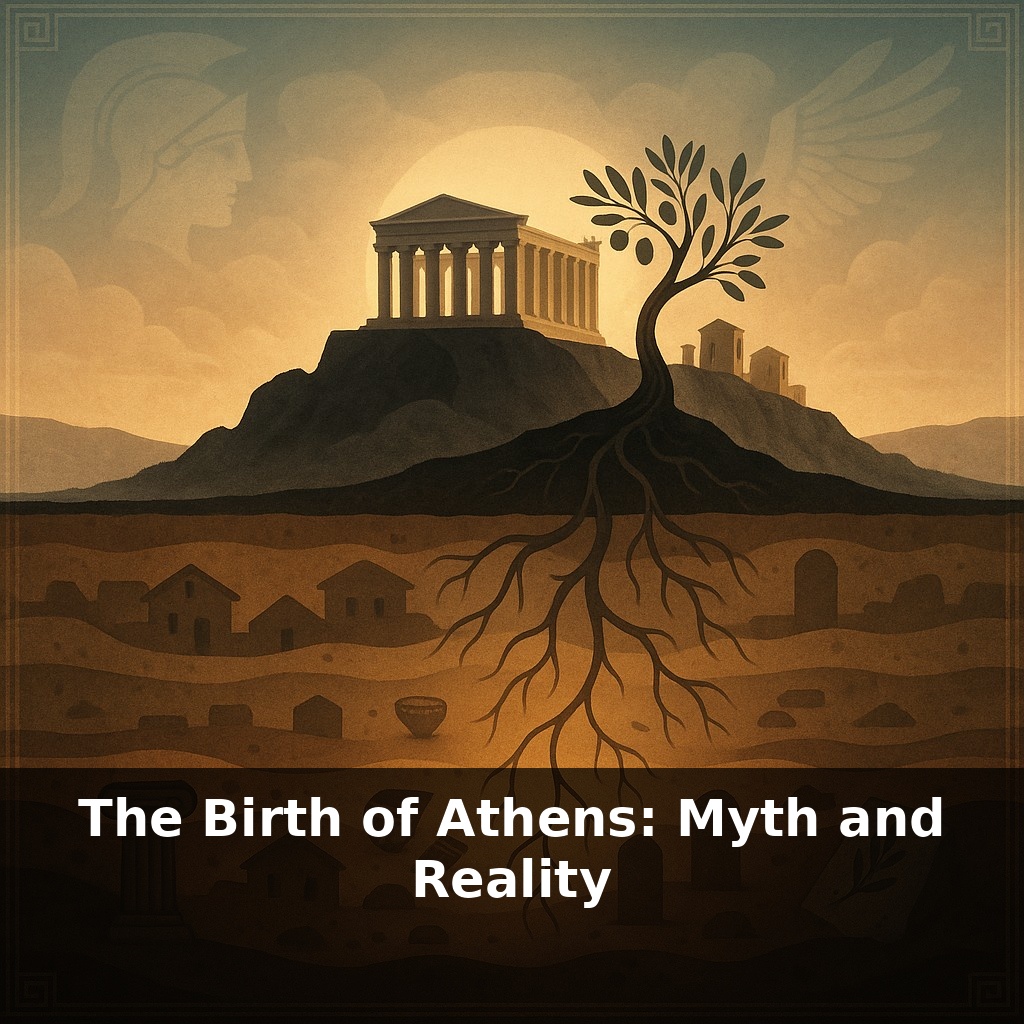
To get closer to the “real” beginning of Athens, we have to watch two timelines run side by side and constantly cross wires. On one, gods argue over who will protect the city, heroes broker unity, and a single olive tree becomes a lifetime guarantee of divine patronage. On the other, potters’ quarters expand, burial customs shift, and hilltop shrines harden into stone temples while trade routes quietly fatten the city’s wealth.
Think of it like following two blueprints for the same building: one drawn by a visionary architect, all sweeping lines and grand promises; the other by an engineer, full of load‑bearing walls and stress calculations. They describe the same structure, but in utterly different languages. In this episode, we’ll track when those blueprints align, when they clash, and how Athenians used both to convince themselves—and everyone else—that their city was destined to lead Greece.
To pin Athens down in time, we’ll move across three layers. First, the ground itself: Neolithic postholes, Bronze Age walls, and ash from long‑forgotten hearths that show people living on and around the Acropolis millennia before anyone called it “Athens.” Then, the political map: scattered villages in Attica slowly folding into a single community, until a real synoecism in the 8th century BCE turns local hills into one civic landscape. Finally, the institutions: councils, demes, and new rules that harden like software updates, each version reshaping who counts as an Athenian.
Start with the ground. When archaeologists cut trenches into the slopes below the Acropolis, they don’t find a “founding moment”; they find layers that refuse to line up with any single story. Late Neolithic postholes give way to Early Bronze Age houses, then to Mycenaean walls and tombs. The place we call Athens is less a birth than a stubborn habit of returning to the same hill, over and over, for five thousand years.
By the Early Iron Age, that habit starts to look like a community that remembers itself. Graves cluster in distinct zones, pottery styles become locally distinctive, and small sanctuaries pull in offerings from wider and wider circles of visitors. These are the kinds of quiet changes that never make it into legend but signal something crucial: people around the Attic countryside are beginning to see this hill not just as a refuge, but as a reference point.
The political knitting-together of those people comes later than many expect. The story credits Theseus with uniting Attica in one heroic stroke; the soil tells us a slower tale. Village sites continue to flourish well into the early first millennium BCE, while the urban core thickens only in the 9th and 8th centuries. Around then, we see public spaces in the lower city acquiring a more formal shape: open areas that start to work like an early agora, and traces of communal buildings that imply shared decision-making beyond a single clan or royal household.
This is also when writing appears in Athens, adapted from the Phoenician alphabet. Scratched owners’ marks on pots and short dedicatory inscriptions in sanctuaries hint at a new way to pin identity to place: you can now literally write “I belong here.” Over time, those brief texts expand into the decrees and laws that let us watch the city reinvent itself on paper.
If the Acropolis was the symbolic high ground, these written rules and gathering spaces were the operating system running underneath—patchable, negotiable, and, as later reforms would show, open to radical updates when crisis struck.
Athens’ self‑portrait only really comes into focus when we watch specific choices stack up. Take Theseus: later Athenians credited him with a once‑and‑for‑all political unification, but the “credit” hides how useful that hero was for smoothing over centuries of haggling between countryside elites and an increasingly assertive urban core. Or look at Cleisthenes: his division of Attica into 139 demes sliced old loyalties into new patterns, shuffling coast, city, and inland populations into ten fresh tribes that scrambled aristocratic power blocs.
A more concrete lever was silver. The Laurion mines, worked by thousands of enslaved laborers, generated enough annual output to underwrite a naval policy that changed everything. The choice to invest a windfall in triremes before Salamis didn’t just win a battle; it made rowers—poor citizens—militarily indispensable, strengthening the social base for democratic practice.
Your challenge this week: trace one modern city’s “origin story.” Compare a slogan or legend it tells about itself with a hard economic or political change that actually transformed who held power there.
Future work on Athens may look less like digging and more like debugging a vast, layered codebase. High‑resolution scans of inscriptions could be cross‑referenced with climate models, revealing how droughts or quakes nudged politics and building agendas. As preservation tech spreads, the Acropolis might function as an open “test server” for global heritage: a place where new methods for stabilizing stone, crowds, and narratives are trialed, then exported to cities still writing their own founding myths.
Athens keeps asking us to read it twice: once in stone, once in story. Future digs may matter less than re‑sorting what we already know—like reindexing a vast library so new patterns leap out. As we refine dates, isotopes, and text databases, small shifts—a house re‑dated, a treaty re‑read—could redraw the city’s “origin” yet again, without moving a single rock.
Here’s your challenge this week: Pick one Athenian value from the episode—democratic debate, civic duty, or respect for law—and host a 30-minute “mini-ekklesia” at home or with friends where you debate a real decision (like how to spend a shared budget or set house rules) using majority vote at the end. Before you meet, spend 10 minutes jotting down how myth (like Athena vs. Poseidon or the autochthony story) shaped Athenian identity, and open your gathering by sharing that in under 3 minutes. After the vote, record a 60-second voice note reflecting on how the process felt compared to how decisions usually get made in your life.
From this course
The Rise and Fall of Athens
10 episodesUnlock all episodes
Full access to 10 episodes and everything on OwlUp.
Subscribe — $1.99/monthLess than a coffee ☕ · Cancel anytime