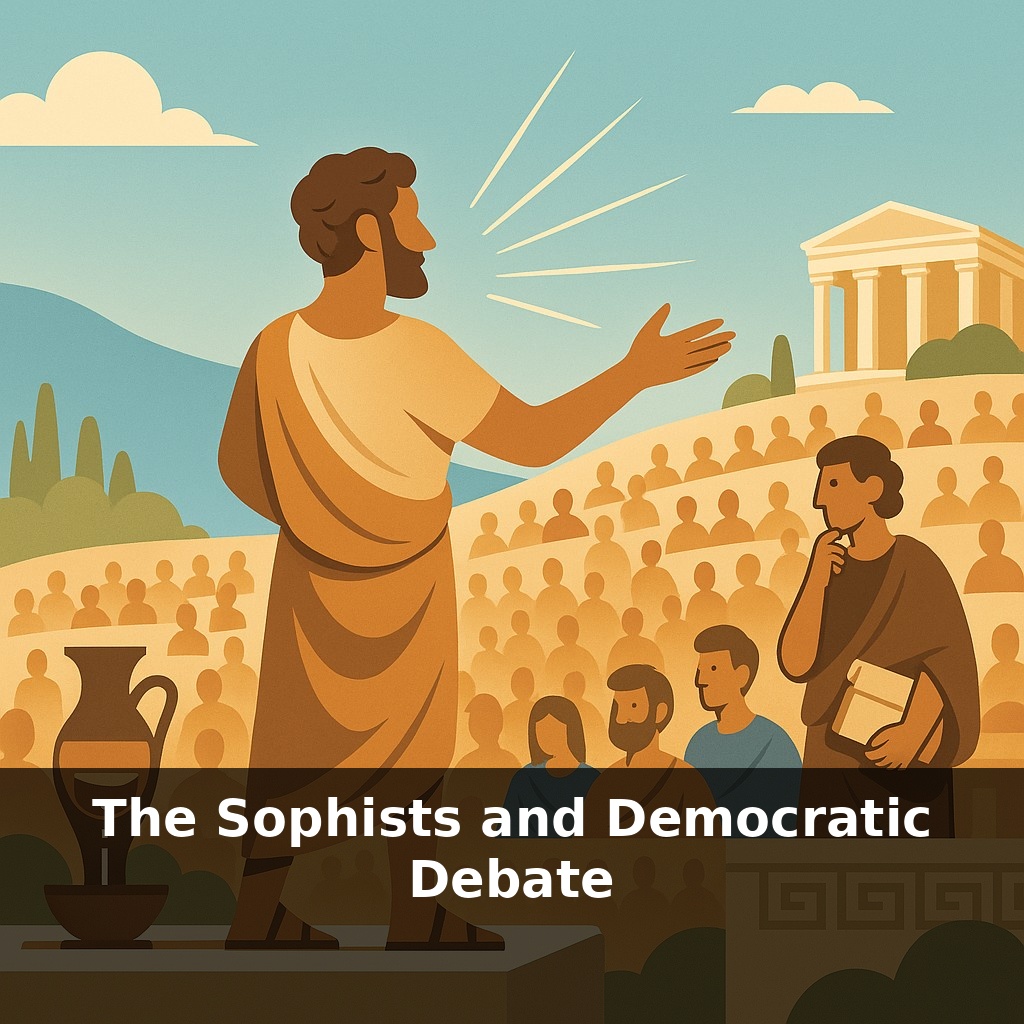
A few thousand men pack a hillside, waiting. Each has the right to speak—but only a handful can sway the vote before the water-clock runs dry. Now here’s the twist: the best voices in this radical democracy are being trained… by controversial teachers-for-hire.
In this crowded, time-pressured Assembly, the Sophists introduced something quietly revolutionary: they treated public speech as a skill set, not a birthright. Instead of relying on noble lineage or inherited charisma, you could pay to learn how to dissect an opponent’s claim, flip a hostile question, or compress a complex argument into six disciplined minutes. They broke arguments down the way a good coding tutor breaks down a complex function—into reusable, testable parts. Their workshops turned vague opinions into structured cases, complete with anticipated objections and polished comebacks. This didn’t make debates kinder, but it did make them sharper. A farmer, a craftsman, or a merchant could now contest an aristocrat not with louder lungs, but with tighter logic and cleaner phrasing. For some Athenians, this looked like empowerment; for others, it looked like weaponized cleverness.
Sophists didn’t just coach individual speeches; they altered the expectations of the entire civic game. Once Athenians knew some citizens had trained systematically, jurors and Assembly-goers began listening differently, like audiences who’ve learned to spot plot holes in a movie. Claims were probed for hidden assumptions, definitions challenged, and emotional appeals weighed against practical consequences. Payment also changed the stakes: if you’d invested hard-earned drachmas, you were likely to use those tools often—whether to defend yourself in court, pressure a rival, or push a policy through a skeptical crowd.
Athenian crowds didn’t just hear better-crafted speeches; they watched a new kind of intellectual performance unfold. In the courts, a defendant might begin not with pleas for mercy, but with a cool challenge: what, exactly, counts as “injury” or “justice” here? That move—redefining the key term before anyone else—was a classic Sophistic maneuver. Shift the definition, and you often shifted the verdict.
Some teachers specialized in this kind of conceptual pressure-testing. Protagoras, for instance, became famous for saying “man is the measure of all things,” a slogan later read as extreme relativism. But in a courtroom setting it worked more like a practical guideline: arguments should be judged in relation to human needs and perceptions, not cosmic absolutes. Gorgias, by contrast, dazzled audiences with rhythmic phrasing and emotional crescendos, constructing speeches whose sound and structure could carry a jury even when the facts were messy.
Inside paid workshops, students practiced arguing both sides of a case—what later critics called “making the weaker argument stronger.” That exercise horrified Plato, who saw it as training people to bend truth at will. Yet for many Athenians, it served as mental cross-training: if you could inhabit your opponent’s best case, you were harder to surprise in real debate and more cautious about your own blind spots.
The fee-for-teaching model also disrupted old social patterns. An ambitious shipwright’s son might save to study with a visiting star, then parlay that training into a career as a logographos, a speechwriter for citizens too nervous—or too busy—to craft their own defenses. Suddenly, influence in the Assembly could travel through written scripts and behind-the-scenes coaching, not just charismatic personalities standing on the bema.
Critics worried this new marketplace of words turned politics into a contest of style. If jurors rewarded verbal swagger, wouldn’t clever framers outmaneuver careful thinkers? Supporters replied that, in a system where thousands voted after brief hearings, clarity and impact weren’t luxuries; they were survival tools for good ideas. The unresolved tension between those views is what later philosophers, from Plato to modern media theorists, kept circling: when does teaching people to argue well strengthen a democracy, and when does it just upgrade the tools of manipulation?
Aristotle later turned some of their tricks into formal logic and rhetoric, but in the 5th century BCE the results already showed up in surprising corners of Athenian life. A small-time merchant, trained to spot contradictions, might challenge a powerful creditor’s contract before a massive jury of hundreds. A veteran defending himself against a charge of cowardice could methodically separate battlefield rumor from admissible evidence, forcing jurors to rethink what “bravery” meant in practice. Even religious disputes shifted tone: when a new cult was proposed, opponents no longer just cried “impious!”; they parsed whether its rituals actually threatened the city’s safety or laws. Over time, recurring patterns emerged—appeals to shared benefit, warnings about precedent, careful framing of risk—that look strikingly like the talking points of modern campaign strategists. In a sense, they were laying primitive “architectural plans” for public arguments: blueprints anyone with training could adapt, extend, or quietly subvert.
As AI begins to auto-generate campaign lines, legal briefs, even “off-the-cuff” interviews, the real power may shift from crafting messages to decoding them. Future citizens might need dashboards for arguments the way drivers rely on instrument panels—alerts for emotional overload, missing evidence, or cherry-picked data. Schools could treat rhetorical hygiene like digital hygiene, training students to notice when a claim feels smooth the way ultra-processed food tastes extra satisfying: engineered, not accidental.
In that sense, the quarrel over sophistic training never really ended; it just changed platforms. Today’s algorithm-tuned feeds quietly reward the same quick pivots and sharp framings, but at far greater speed and scale. The open question is ours to answer: can we cultivate citizens who treat every viral clip less as a verdict, and more as a case still on trial?
To go deeper, here are 3 next steps: 1) Read Plato’s *Gorgias* (start with the Penguin Classics edition) and, as you go, pause after each main speech to quickly compare Gorgias’ view of rhetoric with what the podcast said about Sophists and democratic persuasion. 2) Watch one full Oxford Union or Intelligence Squared debate on YouTube and, using the Sophists’ lens, track how each speaker uses emotional appeal, status, and clever wording to sway “the many,” then note which moves you think Protagoras or Gorgias would admire. 3) Pick up Patricia O’Grady’s *The Sophists: An Introduction* or George Kennedy’s *Classical Rhetoric and Its Christian and Secular Tradition* and read just one chapter tonight, underlining every passage that connects rhetoric to democracy, then bring one underlined idea into your next real-life group discussion (e.g., at work, class, or a community meeting).