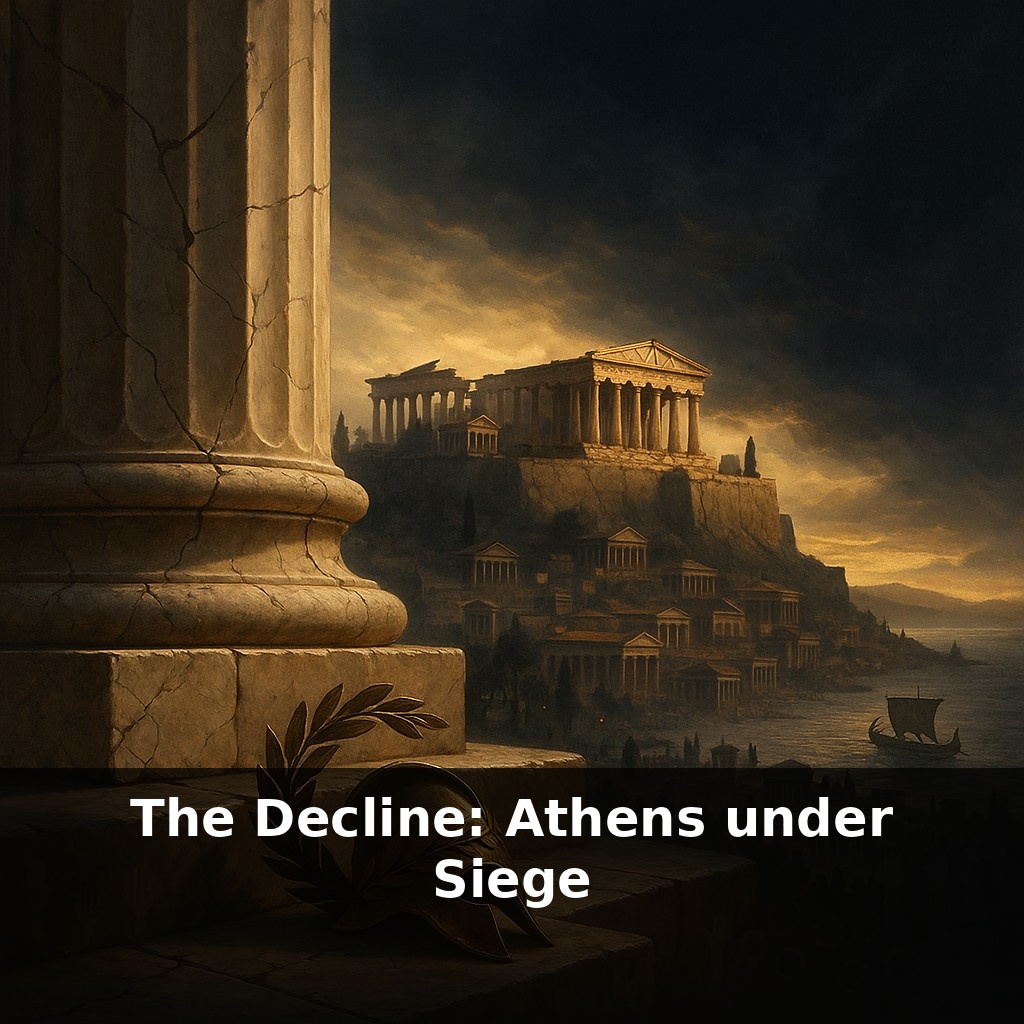
In a single summer, Athens lost so many people that whole political factions vanished. Now jump forward a few years: the city is sending its last savings and best ships on a distant gamble. The streets are busy, the theaters full—and yet, the foundations of its power are quietly collapsing.
By the late 420s BCE, Athens still looked impressive from the outside: dazzling temples, packed assemblies, festivals running on schedule. But step into the Council chamber and the strain shows. War decrees pile up like overdue bills. Generals cycle in and out of favor. Each new setback isn’t a knockout punch—it’s another weight added to a ship already riding low in the water.
The city’s empire, once its safety net, starts behaving more like a restless workforce that’s realized it can walk away. Allies delay payments, hedge their bets, or quietly reach out to Sparta. At the same time, inflation in expectations hits Athenian strategy: victories that once felt huge now barely seem enough to justify the cost.
In this episode, we’ll track how these pressures converged—war, disease, miscalculation, and foreign money—until Athens found itself cornered in a conflict it had seemed destined to win.
Outside the Council, daily life in Athens still ran on habit. Farmers tried to coax crops from fields raided one season and abandoned the next. Merchants adjusted prices as grain convoys from the Black Sea grew less reliable. Juries sat for pay that suddenly didn’t stretch as far as it used to. At the Piraeus, shipwrights kept working, but now contracts depended on whether distant cities still sent tribute—or quietly skipped a payment. Inside private homes, families weighed sons to send to sea against debts coming due, like a household juggling too many loans at once.
Athens had always treated risk like a renewable resource. Lose a fleet? Build another. Alienate a city? Replace its government. But after years of war, the margins for error thinned. The plague had cut into the pool of veterans and leaders; the treasury no longer refilled as quickly. Decisions that once would’ve been survivable experiments now carried the weight of all previous mistakes.
The Sicilian Expedition showed this shift brutally. Sicily was not a defensive necessity; it was a high‑stakes bet on expanding influence far from home. Debates in the Assembly circled familiar themes—honor, profit, pre‑empting rivals—but underneath was a quieter logic: big wins were increasingly needed just to stabilize a deteriorating position. When the expedition was wiped out, Athens didn’t just lose ships and soldiers; it lost experienced officers, political credibility, and the sense that the city could always recover.
Sparta adapted faster. Instead of trying to batter down Athens’ walls alone, its leaders rethought the map: if they couldn’t match Athenian seamanship, they could at least match its budgets. Persian gold and timber turned a regional land power into a serious naval challenger. Suddenly, sea routes Athenians had taken for granted became contested. Grain convoys grew riskier; garrisons in distant islands began to look like liabilities instead of assets.
Inside the city, this strategic squeeze sharpened arguments. Some politicians pushed for negotiation, others for doubling down. Generals were tried, acquitted, condemned, recalled. Policy lurched: harsh crackdowns on rebellious allies contrasted with desperate attempts to hold remaining partners close. You can track the anxiety in the way decrees multiplied rules and penalties, as if tighter wording could compensate for weaker leverage.
One comparison helps clarify what changed: Athens had built its dominance on steady streams of tribute moving inward. As those streams shrank and new ones flowed toward Sparta, the structure of the war flipped. By the final years, Athens was defending not a growing project, but the shrinking core of what it had already built. The city was still loud, crowded, argumentative—but its strategic options were quietly narrowing, corridor by corridor, until only a few dangerous exits remained.
Think of Athens’ war effort as a massive codebase that started clean and elegant, then accumulated “technical debt” with every emergency patch. Early in the war, quick fixes worked: a new decree here, an improvised alliance there. But by the 410s BCE, each new “update” risked breaking something else—an ally’s loyalty, a revenue stream, a vital sea route.
Consider Athens’ shift in naval deployments. Instead of rotating squadrons methodically, they began parking ships for long stretches at critical chokepoints like the Hellespont, overextending crews and hulls. Triremes built for rapid campaigns became floating garrisons, needing constant maintenance the city could barely fund. At the same time, local commanders had to freelance: cutting ad hoc deals with island communities, squeezing emergency cash from friendly ports, or granting trade exemptions just to keep supplies moving.
Even religious festivals, once stable fixtures, became tools of crisis management—moments to announce new levies, display captured tribute, or shame wavering allies in front of a full audience.
Food lines, not speeches, usually mark when a city is losing. Athens’ grain now depended on fragile sea lanes—cut a few, and the agora shrank from marketplace to ration queue. Think of supply like oxygen: invisible when abundant, instantly political when thin. Siege warfare moved from walls to shipping lanes, from hoplites to creditors. For modern cities, the lesson is blunt: if you can’t feed and power yourself under stress, your constitution is only as strong as the next convoy.
Athens’ collapse wasn’t a clean break but a slow unspooling, like a woven cloak losing threads until only the pattern remained in memory. What followed matters, too: veterans selling skills abroad, philosophers rethinking justice under foreign-backed regimes, young democrats studying failure the way engineers study bridge collapses—searching blueprints for warning signs we still miss.
Here’s your challenge this week: Pick one specific moment from the siege of Athens mentioned in the episode (for example, Pericles’ decision to keep everyone inside the Long Walls or the plague sweeping the cramped city) and create a **modern parallel** in your own life by mapping out a “Long Walls” diagram: two columns labeled “What I’m defending at all costs” and “What I’m sacrificing to defend it.” Then, choose **one** “sacrifice” from your list and deliberately reverse it for 24 hours—live that day as if Athens had made the opposite strategic choice, and note what actually happens. Finally, in two or three sentences, answer this: “What does Athens’ mistake warn me about in my own ‘siege’ right now—and what will I stop defending blindly?”