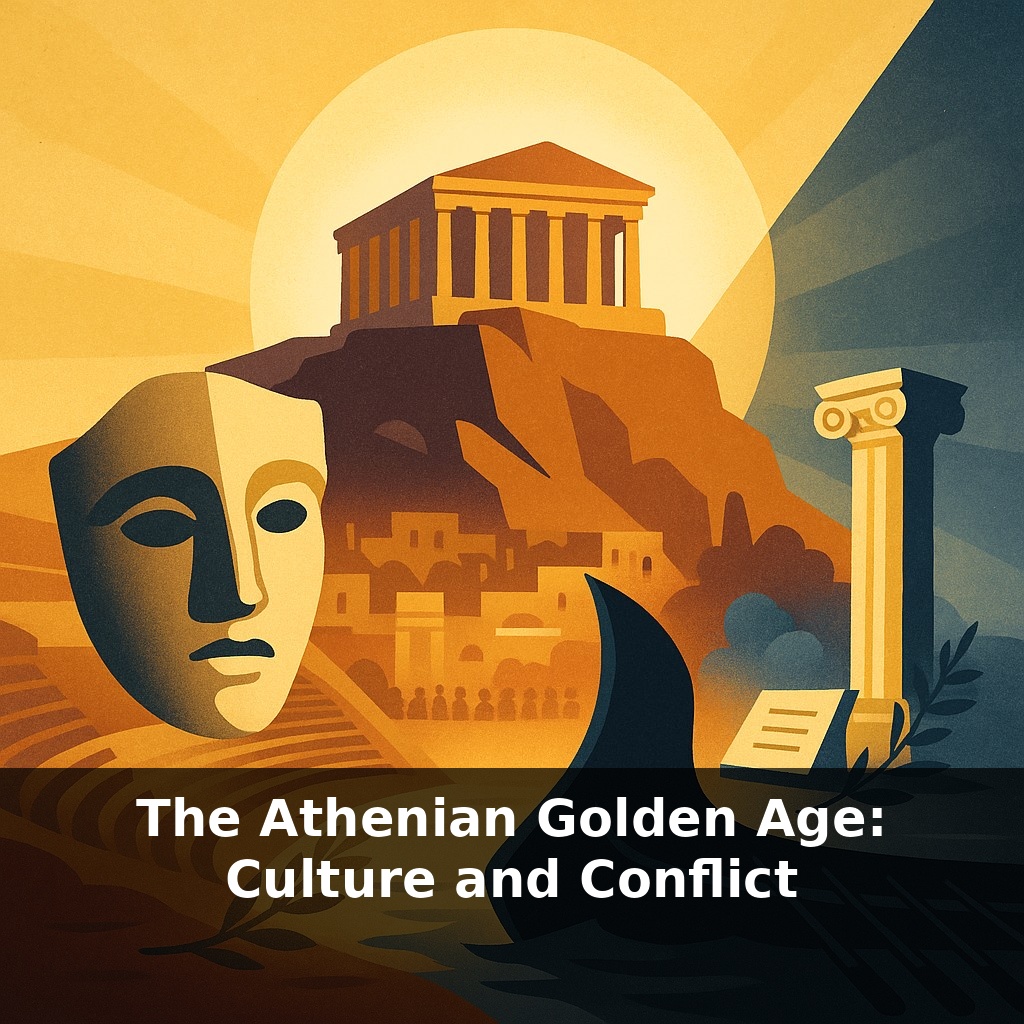
An entire city stops for a week—courts closed, ships idle—so tens of thousands can watch new plays, honor the gods, and argue about politics in the streets. How does a society that devoted itself to beauty and debate end up destroying its own golden age in war?
In this episode, we shift from the theater seats to the engine room of Athenian power. Behind the soaring temples and prize-winning tragedies stood ledgers, warships, and a hard calculus of risk. Athens sat atop a dense web of alliances and obligations: tribute ships arriving at Piraeus, jurors paid to sit in vast courts, architects and stonemasons hired for projects that reshaped the skyline. The same public funds that rewarded playwrights also bought oars, hulls, and bronze rams for a navy that could appear off any ally’s coast without warning. Democratic confidence at home translated into assertive leadership abroad, blurring the line between protector and ruler. As we trace how money, manpower, and maritime strategy intertwined, we’ll see why success made Athens richer—and made everyone watching more nervous.
Now shift the camera from the grand skyline to the street-level details. Each year, officials in Athens compiled thick assessment lists: who owed what, which island could afford ships instead of silver, which port might be late with payment. Local politicians in allied cities had to balance their own pride with Athenian expectations, knowing a misstep could bring auditors—or a squadron of triremes. Inside Athens, the same inflow of resources pulled more people into public life, as stipends for juries, council work, and festivals turned politics into a full-time occupation for thousands.
main_explanation: Follow one of those tribute ships into Piraeus and you see how deeply money, politics, and identity were fused. Officials inspect the cargo, scribes record figures on wooden tablets, and somewhere up on the Acropolis, stonecutters’ wages are effectively being guaranteed. The same revenue stream that steadies the pay of a dockworker or a juror also underwrites the marble blocks that will later impress visiting envoys.
Inside the city, this steady cashflow reshaped daily rhythms. A poorer citizen could spend his morning rowing in a training squadron, his afternoon in an assembly voting on a new decree, and his evening at a rehearsal for a chorus funded by a wealthy sponsor. Political participation, military service, and cultural production overlapped in a way that made “public” and “private” life harder to separate.
For the elite, the system cut both ways. Rich Athenians might complain about extraordinary taxes and the expectation to sponsor choruses or equip warships, yet these liturgies bought prestige. Inscriptions proudly immortalized who had funded which festival or vessel, turning generosity into a competitive sport. One man’s expensive “victory” in a drama contest could spur his rival to outdo him with a sleeker trireme or a grander dedication.
Beyond Athens, the incoming tribute also reordered local politics. In an island city debating whether to keep paying, factions formed: one side arguing that Athenian protection kept trade routes open, the other grumbling that autonomy was slipping away. A single decree from Athens could force them to change coinage, tear down defensive walls, or accept a new council dominated by local allies of Athenian leaders.
Military realities sharpened these choices. A city that tried to defect had to ask: how many hoplites can we field, how many ships can we man, and will Sparta or Persia really come if we call? Meanwhile, in Athens, strategoi weighed how hard to squeeze an ally without driving them into open revolt. Every punitive expedition consumed the very resources it was meant to secure.
Over time, the balance tilted. What began as a network justified by fear of Persia increasingly looked, from the outside, like Athenian rule in all but name. Yet for many ordinary Athenians whose livelihoods now depended on these flows, scaling back was almost unthinkable—the city’s grand projects, and their own daily bread, were entangled.
Consider the Delian League’s finances like a kind of enforced operating system update for the Aegean. Once Athens installed itself at the center, every “user” city had to run compatible settings: standardized measures, shared coinage, ports open to Athenian ships. That made trade faster and contracts clearer; a merchant sailing from Lesbos to Naxos could trust weights, currency, and procedures more than in the fractious past. But the same standardization also meant local traditions—old silver types, ancestral law codes—were quietly deprecated, sometimes by decree. Cultural exports piggybacked on this infrastructure. Touring actors, philosophers-on-the-move, and skilled artisans followed the same sea lanes as tribute and grain. An island that hosted an Athenian garrison might suddenly see a theater remodeled to Athenian taste, or new philosophical clubs meeting in its agora. Over a generation, elites who learned to speak, dress, and argue “like Athenians” often prospered most, deepening both admiration and resentment.
Some historians now treat this moment as a laboratory for our future. Governance researchers mine Athenian records to design digital “mini-publics” where randomly chosen citizens review AI policy or climate plans, like pop-up juries for complex tech. Conservation teams, armed with laser scans of the Acropolis, test how to shield stone from rising heat and pollution. Strategists dissect Thucydides to stress-test modern rivalries, probing how misread pride can derail careful planning.
So when the lights dimmed on this era, what stayed lit was a pattern we still wrestle with: how shared projects slip into control, how pride in common victories turns to score‑keeping. The Athenians left us a kind of cracked mirror: look closely and you can see your own city’s budgets, alliances, and arguments faintly reflected in its shards.
Start with this tiny habit: When you sit down with your coffee or tea, recite just one line of Pericles’ Funeral Oration out loud (even if you’re reading it from your phone). Then whisper one word that captures what you admire about Athens in its Golden Age—“curiosity,” “courage,” “debate,” or “art.” If you feel up for one more tiny step, spend 60 seconds looking up a single image of the Parthenon or a Greek vase scene and ask yourself, “What problem were they trying to solve or story to tell here?”