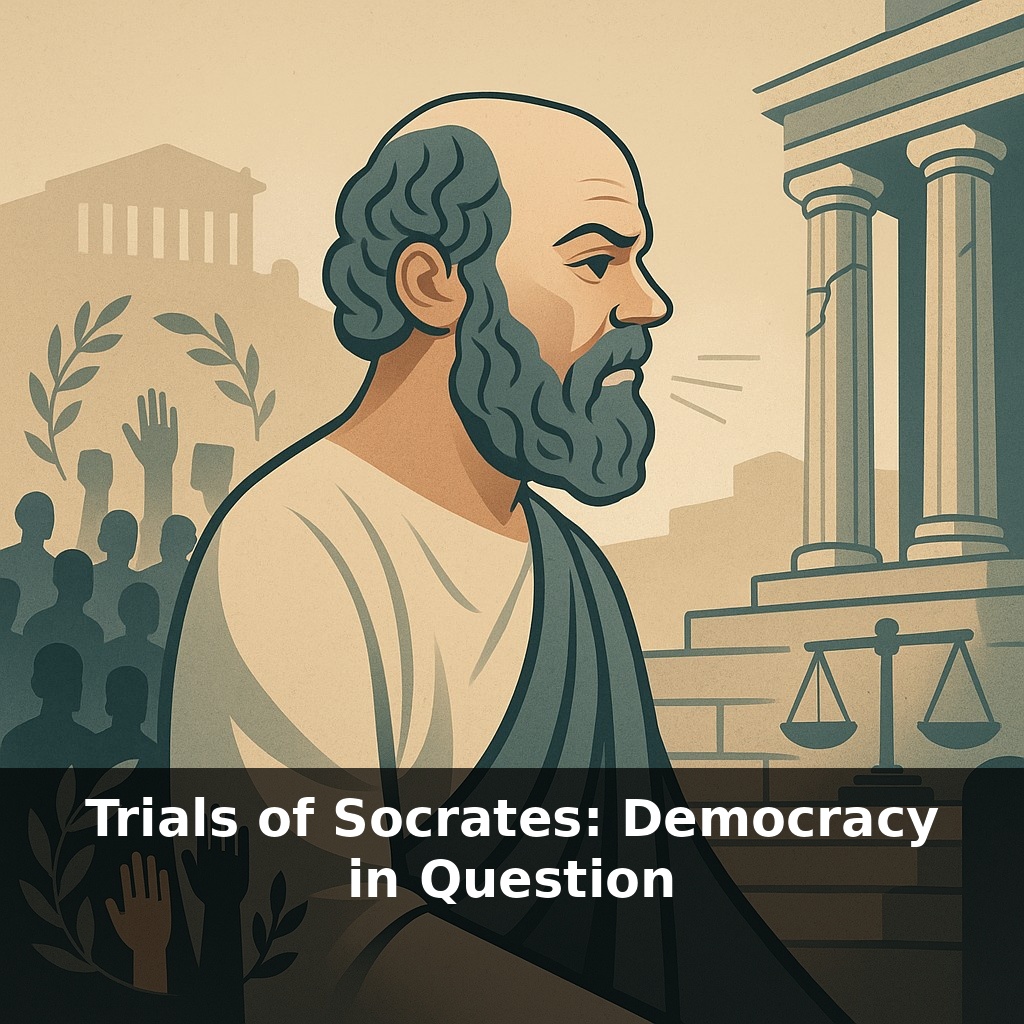
A philosopher walks into court—charged not with murder or theft, but with “corrupting the young” and questioning the gods. Hundreds of fellow citizens sit as his jury. Democracy isn’t just on display that day in Athens; it’s on trial right beside Socrates.
Socrates’ trial doesn’t come out of nowhere; it erupts from a city still bruised from war, plague, and political whiplash. Within a few decades, Athenians had watched their empire crumble, buried a third of their population, and endured not one but two oligarchic takeovers. Some of the very men who’d helped dismantle their democracy had once sat beside Socrates in conversation. That connection, however loose, made him look less like a harmless questioner and more like a suspicious acquaintance in a neighborhood that had just lived through a string of break-ins. When the city finally restored its democratic institutions, citizens were determined to protect them—yet the tools they used were the same civic courts that would now decide whether Socrates’ unsettling questions were a safeguard for freedom, or a risk they could no longer afford.
By 399 BCE, Athenians weren’t just tired; they were jumpy. The city had lost a war to Sparta, seen its navy broken, its treasury drained, and its confidence shaken. A deadly plague had carried off friends, leaders, and the famous Pericles himself. Amnesties after the oligarchic regimes meant former enemies now stood beside you in the assembly line, like co‑workers rehired after a bitter strike. In this uneasy calm, public cases became a kind of civic stress test: each prosecution a way to ask, “Who really stands with the city—and who might break it again if we let our guard down?”
The formal charges against Socrates sounded straightforward enough: not recognizing the city’s gods, introducing new divine beings, and leading the young astray. But in 399 BCE, every word of that indictment carried extra voltage.
“Not recognizing the gods” wasn’t a neutral theological complaint; it pressed on a sore spot. Athens blamed some of its disasters on offended deities. Sacrifices, omens, and traditional rituals were seen as civic insurance policies. A man publicly known for asking, “How do you *know* that’s what the gods want?” could look, to nervous ears, less like a clarifying voice and more like someone poking holes in the city’s last safety net.
“Introducing new divine beings” targeted something more specific: Socrates’ talk of a personal “daimonion,” an inner sign that warned him away from certain actions. To philosophically minded Athenians, that might sound like conscience or intuition. To others, it sounded uncomfortably like a private pipeline to the divine—exactly the sort of religious novelty that had gotten people in trouble during earlier sacrilege scandals.
And “corrupting the young” wasn’t just about morals in the abstract. Some of the young men who had clustered around Socrates—Alcibiades, Critias—had later played starring roles in failed adventures abroad and brutal rule at home. Even if Socrates never endorsed their worst decisions, the pattern looked damning: bright, ambitious youths spend years in his company, then emerge as men willing to betray or dominate their fellow citizens. In a city rebuilding trust, that pattern felt less like coincidence and more like a warning sign, the way repeated data breaches would make you question a software firm’s security culture even if you couldn’t trace each hack to one specific line of code.
Inside the courtroom, these anxieties met Socrates’ own unusual strategy. Instead of begging for mercy, he doubled down on his lifelong mission, arguing that questioning was a service to the city. He refused to flatter the jurors, wouldn’t parade weeping relatives, and proposed as his “penalty” that he should be maintained at public expense like a benefactor. To jurors primed to see arrogance in elite circles, this sounded less like principled courage and more like proof that he hadn’t learned a thing from recent crises.
The outcome—guilty by a relatively narrow margin, then death approved by a wider one—suggests some jurors might have been persuadable at first, yet hardened once they heard his defiant counterproposal. It’s here the case becomes a lens on collective decision‑making under pressure: a citizen body capable of fine‑grained judgment, but also capable of snapping when it feels its authority is being tested too far, too fast.
A modern parallel might be a whistleblower inside a powerful tech company, raising alarms about data misuse just after a massive cyber‑attack. Shareholders and regulators, still rattled, might see that internal critic as either a vital safeguard or a dangerous source of instability. In Socrates’ case, some Athenians likely saw his probing questions as intellectual “penetration testing” for the city’s beliefs—stress‑testing weak arguments before real enemies could exploit them. Others, remembering recent betrayals, saw his influence on ambitious students as a risk factor they could no longer discount.
We can also look at how other thinkers fared in tense moments. After the failed oligarchy of the Thirty, some associated with them were quietly sidelined or exiled without headline trials. Socrates, by contrast, was dragged into the spotlight, his case turning into a referendum on how far frank criticism could go. The mixed vote totals suggest a split city: not a mob acting in unison, but a community disagreeing, in real time, over whether uncomfortable questions were still a strength—or had become a liability.
Socrates’ fate warns that who asks hard questions can matter as much as what they ask. Today, viral outrage and instant polls can turn a single dissenter into a lightning rod overnight. When platforms reward speed and certainty, slow, probing dialogue becomes harder to defend. Yet without spaces where people can challenge leaders, metrics, and even cherished stories, public judgment risks becoming like code no one audits—efficient, elegant, and quietly exploitable by those who shout the loudest.
Socrates leaves us with an unresolved homework assignment: who gets to be the “constructive critic” and who gets labeled a threat? In crowded feeds and comment threads, it’s easy to mute the gadfly and amplify the chorus. The hard task is building habits and institutions that can tell loyal friction from sabotage before the next crisis hits.
Start with this tiny habit: When you hear or read a strong political opinion (online, news, or from a friend), quietly ask yourself: “What would Socrates ask this person first?” Then, out loud or in your head, add just one gentle question, like “What makes you so sure?” or “Could a reasonable person disagree with this?” Make it a game for the rest of the day: each time politics comes up, you don’t argue—you just add one Socratic question and notice how it changes the conversation in your mind.