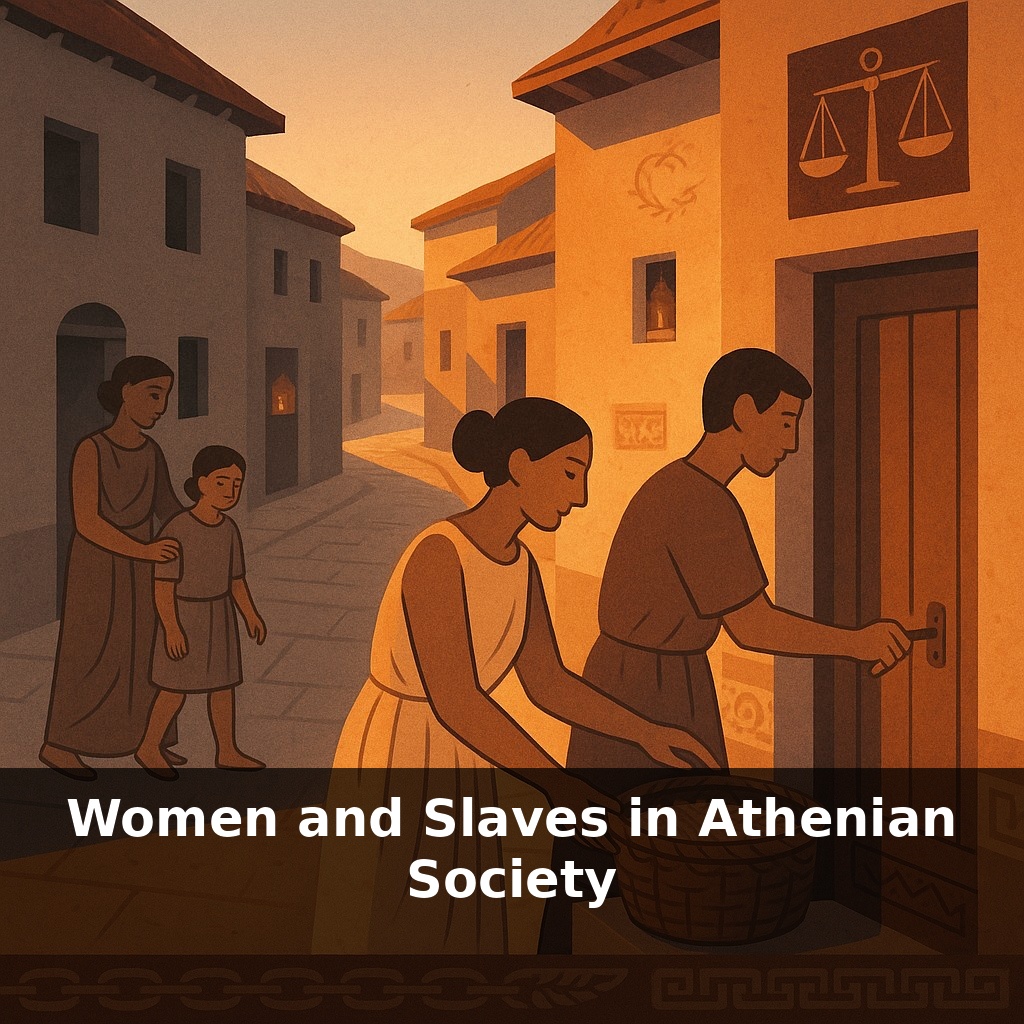
Legally, most people in Athens had fewer rights than a modern teenager. Women couldn’t vote, slaves were property—yet both quietly shaped the city’s money, marriages, and gods. In this episode, we’ll step into their houses, workshops, and rituals to see how.
Walk through an Athenian street at dawn and the “official” citizens are still asleep. What you actually hear and see first are the people the law barely acknowledges: a woman bargaining for grain, a slave unlocking a shop, a nurse soothing a citizen’s child. Their signatures never appear on decrees, yet their choices quietly redirect wealth, forge alliances, and even decide which gods feel closest to home. To follow their traces, we have to read sources sideways—court speeches that suddenly hinge on a wife’s dowry decision, account lists where a single named slave manages huge sums, temple inventories that suggest which priestess pushed for which dedication. It’s like examining the scaffolding around a famous temple: the building gets the glory, but the hidden framework tells you how it actually stood.
To set the scene, we need three overlapping maps of Athens in our heads. One is legal: who could appear in court, sign contracts, or be beaten without penalty. Another is spatial: who slept behind the inner courtyard door, who lived above a shop, who never entered a private home except to work. The third is emotional and reputational: whose honor could spark a feud, whose testimony counted only under torture, whose rumored behavior could wreck a family’s standing as fast as a bad credit score can sink a modern business.
Stand inside that mental map of Athens and zoom in on one household. On a property line document, it’s represented by a man’s name. In practice, it runs more like a small, tightly controlled startup, with overlapping roles and limited transparency.
The official “founder” is the male citizen. But the day‑to‑day operations are split. A wife might control the wool room and storerooms, deciding how much grain to keep back, how much cloth to sell, which neighbor’s girl to hire as help. Those choices ripple outward: a slightly larger surplus of woven cloth this year might mean cash for a new slave, a loan to a cousin, or a contribution that keeps an ally loyal. You’ll never see her listed on a treaty, yet her judgment subtly nudges the family’s future political options.
Slaves, too, become part of this management system. A trusted household slave can be sent repeatedly to the same banker or wholesaler, building a reputation on behalf of his owner. Over time, Athenians start recognizing the slave himself as reliable or shifty. Reputation, which the law pretends belongs only to citizens, clings to these other bodies anyway. A single rumor about a nurse’s carelessness or a concubine’s influence can change how neighbors treat the entire house.
Move to a different neighborhood—closer to the agora—and you find women and slaves more visible. A poor widow selling ribbons, a metic woman running an inn, a public slave recording verdicts: all technically marginal, yet each a node in webs of information. The widow overhears price trends, the innkeeper listens to travelers’ gossip, the clerk sees which lawsuits are filed and dropped. Their knowledge isn’t “official,” but it is actionable. A relative warned about an impending grain shortage, a litigant tipped off about a hostile witness, a trader alerted to a new route—all based on conversations that will never enter the historical record.
Even in sacred spaces, influence sneaks in sideways. A procession route adjusted to pass a particular workshop, a festival schedule tweaked so women can finish harvest tasks first, a dedication worded to thank a specific healing. None of this looks like power when written in stone; it looks like logistics. But patterns of logistics, repeated over decades, decide which families prosper, which neighborhoods thrive, and which gods feel indispensable.
When we trace individual lives, those abstract structures turn concrete. Take an enslaved man hired out as a metalworker: he might quietly build a private tool‑lending network, letting neighbors “borrow” in exchange for favors—introductions, recommendations, warnings about risky partners. None of this appears in ledgers, but it can decide who gets a crucial contract. Or picture a citizen’s daughter managing her jewelry and small savings like a micro‑investment fund, discreetly backing a brother’s side deal or cushioning a future widowhood. One failed voyage hurts less if you’ve diversified your support.
A useful way to think about this is like the operating system on a computer: you see the apps—the assembly, the courts—but most of the real coordination happens in the background, through processes you don’t directly notice. Women and slaves often ran those “background processes”: arranging credit in whispers, testing a suitor’s reliability, timing when bad news reached a household. Switch out a few of those quiet decisions, and the visible “apps” of politics and war would have looked very different.
Future work treats those “background decisions” as data. Digital models already test how small shifts—say, different dowry strategies or manumission rates—might have changed alliance networks or voting blocs. New bioarchaeology may soon map slave mobility like tracking devices on shipping containers, revealing hidden trade corridors. And gender‑aware economic models push policy makers to treat unpaid care and coerced labor as structural variables, not historical footnotes.
Follow those faint footprints further and new tools appear: isotope tests tracing where a nurse was born, soil chemistry hinting which cooks reused foreign spices, network maps clustering names like constellations. Each method is a fresh lens, less like closing a case than opening side doors into lives Athenian law tried to keep offstage.
Start with this tiny habit: When you hear or read the word “democracy” in your day (news, social media, conversation), pause and name one specific group left out of Athenian democracy—either women, enslaved people, or metics. Then whisper to yourself one concrete thing they couldn’t do in Athens, like “vote,” “own property independently,” or “speak in the Assembly.” Over time, this 5-second pause will train you to automatically see who’s missing from any story about freedom or political rights.