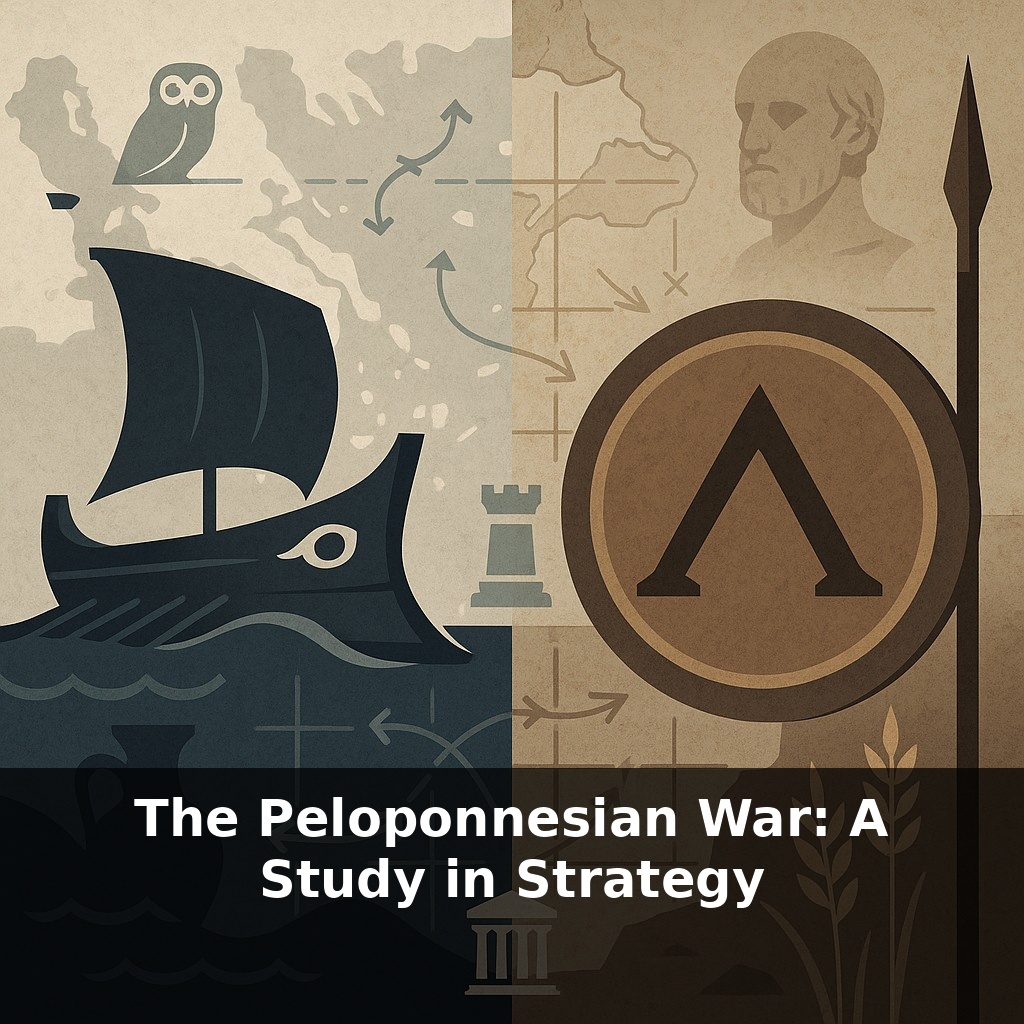
A democracy built on sea power chose a war it didn’t need to win—and nearly erased itself from the map. An empire that taxed islands and controlled trade routes found that grain, not glory, would decide its fate. This is the story of when strategy mattered more than strength.
Thucydides, the Athenian general turned historian, watched this war unravel from the inside—and then tried to decode it. He wasn’t writing a patriotic epic; he was performing an autopsy. His question was brutally practical: how did two Greek coalitions, starting from such different strengths, both come perilously close to ruin?
To answer that, he followed decisions rather than just battles. Why did leaders double down on failing plans? How did fear of appearing weak push cities into disastrous campaigns? Why did alliances designed for security become traps that forced escalation?
Across 27 grinding years, we see a pattern that feels eerily modern: leaders chasing short-term advantage, underestimating logistics, and trusting that past success guaranteed future survival. In this episode, we’ll trace how grand strategy can quietly mutate—from calculated risk to lethal overreach.
Athens and Sparta didn’t just clash; they bet on different answers to the same question: how do you turn what you’re best at into something war-winning? One side leaned on ships, money, and distant allies; the other on disciplined infantry and tight regional ties. Each assumed the other would break first if pressured in its weak zone. That assumption is where strategy becomes dangerous. Like software pushed beyond its original design, both coalitions kept bolting on new features—sieges, revolts, Persian subsidies, even attacking Sicily—until their core systems began to strain and corrupt from within.
Strategy in this war began with one crucial asymmetry: only one side thought time was on its side. Pericles argued Athens could absorb invasion after invasion as long as its walls, fleet, and revenue held. Sparta’s hoplites might burn fields, but they couldn’t storm stone. So the Athenians pulled their people inside the Long Walls, turned the countryside into a buffer, and tried to strangle their enemies indirectly—raiding coasts, backing revolts, and leaning on tribute to keep the war chest full.
Sparta read that as weakness. Its leaders believed war was settled in the open field by men in armor, not by accountants and admirals. Their opening strategy was brutally simple: invade Attica, wreck crops, dare Athens to come out and fight. When the Athenians refused, the Spartans faced a problem their system wasn’t built for: a long conflict that couldn’t be finished with a single decisive battle. Their alliance, used to short, seasonal wars, started to fray under the pressure of stalemate.
Then contingency crashed into design. The plague hit Athens early, turning its apparent advantage—a packed, protected population—into a vulnerability. Confidence in the strategy wobbled, but the basic logic held: keep the fleet active, avoid pitched land battles, wait for Spartan allies to get tired. And for a long stretch, that worked well enough to prevent defeat without ever making victory inevitable.
Over the next decade, both coalitions kept “upgrading” their approach. Athens experimented with deeper raids into the Peloponnese and more aggressive use of allied manpower. Sparta tested helot-heavy armies and bolder fortifications in Athenian territory, like the outpost at Decelea. Each adaptation solved one problem and created another: strains on finances, restive subjects, commanders with enough clout to bend policy around their own ambitions.
This is where the war starts to look less like a test of fixed doctrines and more like a contest in improvisation under stress. Choices about where to deploy a fleet, when to back a revolt, or whether to risk a distant expedition weren’t mere tactics; they were bets on what kind of power would matter most when the conflict finally tipped.
A strategist today might read this war the way an engineer reads a post-incident report. Corinth, for instance, behaved like a mid-tier partner terrified of platform lock-in: it pushed Sparta to act early, not from confidence, but from fear that Athenian dominance would soon be irreversible. Smaller poleis behaved more like anxious customers than loyal allies—constantly probing for better terms, switching sides when tribute, autonomy, or security tipped the balance. When Mytilene gambled on revolt and failed, the debate in Athens wasn’t just about punishment; it was about what signal that punishment would send to every other “client” in the network.
On the Spartan side, the decision to court Persia meant accepting external capital at the price of internal leverage. Once Persian gold underwrote the fleet, Spartan leaders had to align campaigns with Persian interests in Ionia, not just with their own hoplite instincts. That trade-off—between strategic purity and resource dependence—echoes whenever a modern state outsources key logistics or intelligence to a more powerful patron and discovers that funding always comes with a roadmap attached.
Rival powers today still wrestle with timing, signaling, and narrative. The Peloponnesian War hints that the real contest is often over how each side *interprets* moves: is that naval exercise routine, or rehearsal? Is a cyber probe mere theft, or mapping for future strikes? As AI war games model such chains of perception, they may expose “dark corridors” of escalation—paths no one intends but systems drift toward, like autopilot slowly steering off a safe flight path.
In that sense, the war reads less like a single tragedy and more like a design manual for power under stress. It shows how victory can hinge on who learns faster, who bears losses longer, and who adjusts when the board changes. Like debugging a live system, strategy never really ends; it’s a continuous rewrite under pressure, with history as the commit log.
Start with this tiny habit: When you sit down with your coffee or tea each morning, reread just one short Thucydides quote or passage about a key decision (like Pericles’ defensive strategy or the Sicilian Expedition). Then ask yourself one quick question: “What’s my ‘Sparta vs. Athens’ choice today—slow, disciplined strategy or flashy, risky move?” Take 20 seconds to jot a single word in your notes app—“Pericles” for disciplined patience or “Alcibiades” for bold gamble—so you start spotting your own strategic patterns over time.