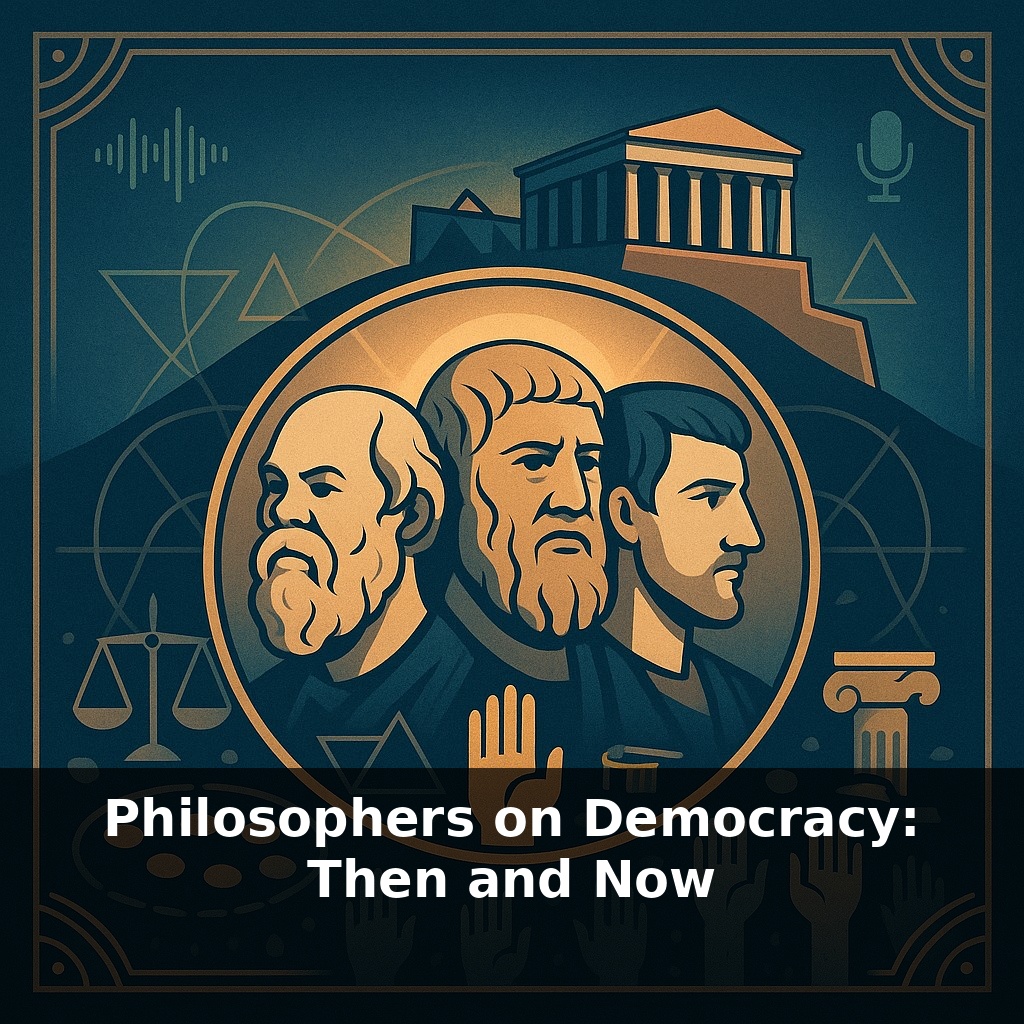
“In Athens, most adults could never vote—yet that tiny slice of citizens shaped how we argue about democracy today. Socrates in the courtroom, Plato in the Academy, Aristotle comparing constitutions: three voices, still whispering in our debates on truth, power, and who should decide.”
“Democracy,” wrote Aristotle, “is when the free and poor, being a majority, are in control.” Yet he immediately added conditions, warnings, escape hatches—as if he trusted the ingredients but not the recipe. That tension runs through the Athenian philosophers: they help invent a language for popular rule, then spend their lives putting it on trial.
In this episode, we follow them not as dusty monuments, but as working critics: Socrates in conversation, Plato designing regimes on a wax tablet, Aristotle revising a draft after glancing at yet another city’s laws. Their questions are uncomfortably current: How far can persuasion go before it becomes manipulation? When does participation turn chaotic? And what kind of institutions can keep collective decisions from wobbling like a table built on three uneven legs?
So why did these philosophers care so much about how a city makes up its mind? Partly because Athens was running a risky experiment: thousands of voices arguing, voting, changing course in real time. The Assembly was less like a modern ballot box and more like a live, open-ended workshop, where any citizen could stand, propose, and be challenged on the spot. Poets, generals, craftsmen—all shared the same stage. In that setting, Socrates’ questions, Plato’s blueprints, and Aristotle’s case studies weren’t abstractions; they were stress tests on a system being rewritten every time the crowd raised its hands.
Socrates starts our story by refusing to play expert. When Athenians treat political judgment as a talent you “just have,” he needles them: would you trust a ship to passengers who never learned navigation? He does not offer a rival blueprint; he undermines unearned confidence. His trial is the sharpest case study. A large jury—hundreds of citizens—listens to hours of speeches. Socrates declines emotional appeals, declines to weep with his family beside him. The jury votes to kill him anyway. For Plato, this is not just a tragic verdict; it is data about how a mass of decent people can be steered toward a disastrous choice.
In the Republic, Plato dissects that pattern. He treats the city’s political order as the outward shape of its dominant character type. Oligarchies produce anxious, money-obsessed citizens; democracies, pleasure-hunting ones. In Book VIII he lines up a sequence of regimes, each decaying into the next. Democracy appears late in the chain: vibrant, permissive, allergic to constraint—then, when frustration with disorder peaks, it begs for a strong hand. The tyrant arrives as the champion of “the people,” then locks the door behind him.
Aristotle pushes back. Unlike Plato, he lived through the Athenian defeat and the rough experiments that followed in other cities. Instead of deducing politics from psychology, he goes empirical. He and his students compile 158 constitutions: who can hold office, how decisions are made, what happens in crises. From this survey he extracts a schema—rule by one, few, or many—then evaluates each by whether it serves the common advantage or a narrow interest.
This is where his notorious line about democracy as a “deviant” form sits. Left unchecked, rule by the many drifts toward serving only the poor citizens present in the room. Yet he also notices that when you mix elements—elect some officials, rotate others by lot, anchor everything in written law—you can harness the many without letting any single faction dominate. His favorite arrangement is a broad, property-owning middle layer that blunts extremes above and below, more like a well-balanced sports team than a star-and-spectators model.
Fast‑forward. Madison studies those Greek failures to justify a large, filtered republic; Habermas reworks the Athenian street-corner argument into a norm for modern public spheres; citizens’ assemblies revived by OECD democracies quietly borrow Aristotle’s love of sampling the many through sortition. The Athenian classroom keeps grading our experiments.
Think of Aristotle’s comparative project less as a library and more as an early “political analytics dashboard.” Each constitution he collected was a datapoint, letting him spot patterns modern researchers still chase: which combinations of councils, courts, and leaders survive war, famine, or sudden wealth without snapping. A contemporary echo is Ireland’s 2016–18 Citizens’ Assembly, where 99 randomly chosen people worked through abortion law, climate policy, and more. Their recommendations weren’t binding, yet they reshaped national debates and fed directly into referendums.
Plato’s worry about charismatic “friends of the people” finds a modern test case in leaders who win landslides and then rewrite electoral rules—Hungary under Orbán, for instance—invoking popular backing even as future competition narrows. And Socrates’ insistence on slow, uncomfortable questioning shows up in formats like long‑form podcasts or extended parliamentary inquiries, where the goal isn’t just a yes/no decision but forcing claims to survive hours of probing rather than a 30‑second clip.
Aristotle might ask how today’s “digital constitutions” are written: not just formal law, but platform rules, ranking algorithms, even ban appeals. As AI tools curate feeds or suggest policies, they quietly shape which arguments surface—like an invisible stage manager deciding who gets the spotlight. Philosophers now probe whether these systems should be treated more like public infrastructure than private malls, with rights of access, transparency, and avenues for contesting design.
Those Athenian arguments now spill onto timelines and into encrypted chats, where trending posts feel like mini‑elections and viral outrage can tilt policy faster than any vote. Your challenge this week: treat each heated thread as a micro‑city. Ask: who’s setting the rules here, and what kind of regime are we quietly rehearsing?