A political system run partly by lottery. Courtrooms packed with hundreds of ordinary citizens deciding life and death. Leaders paid a modest daily wage so even the poor could rule. This wasn’t a thought experiment—it was Athens, and its fingerprints are all over your politics today.
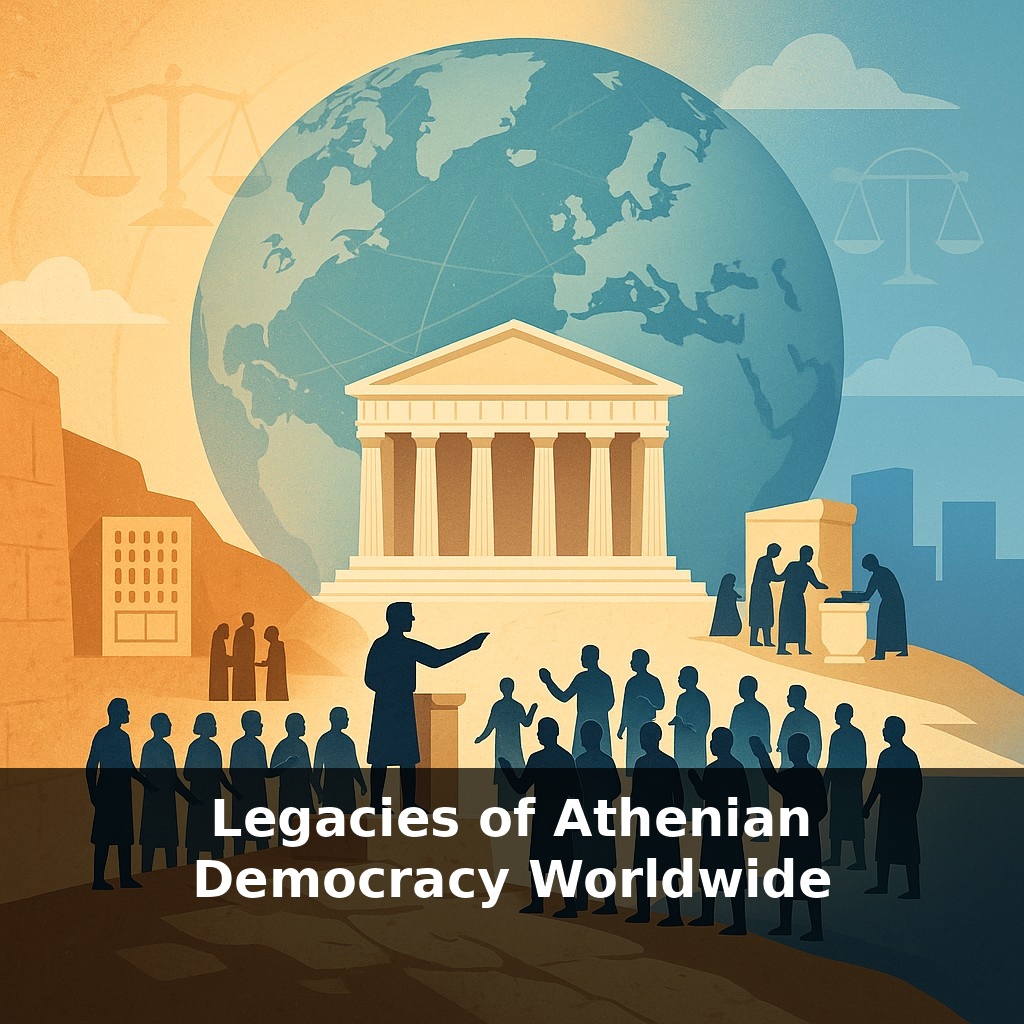
In most countries today, you’ll never stand in the same room as your head of state—yet the logic behind their power runs straight through a noisy Athenian assembly 2,400 years ago. Back then, a radical claim took root: authority should flow upward from citizens, not downward from gods, kings, or party bosses. That claim outlived the city that invented it. Whenever a constitution starts with “We the people,” or a court insists that rich and poor face the same law, it’s echoing an Athenian argument. Modern systems scale that idea differently—packing it into parliaments, ballots, and activist networks—like software rewritten for bigger hardware. And just as code can be forked, countries have copied, patched, and customized those old democratic features, from juries to citizens’ assemblies, to fit new political operating systems.
Yet that “We the people” logic has always traveled with baggage. In Athens, “the people” excluded women, enslaved persons, and resident foreigners, even as it inspired bolder participation than most neighbors thought sane. When later thinkers revived the term dēmokratía, they cherry‑picked its elements: Romans liked the legalism, early modern republics borrowed checks and balances, revolutionaries seized the slogan. Today, reformers mine Athens for specific tools—like sortition or term limits—while trying to fix its blind spots about who counts as a full member of the community.
Stand in a modern courtroom and you’ll spot one of the clearest Athenian echoes: the jury box. Today it seats 6, 12, maybe a few dozen people. In classical cases, it might hold 501. The point wasn’t efficiency; it was to drown out the influence of wealth and status by sheer numbers and diversity. That same instinct now underpins everything from U.S. juries to Brazilian participatory budgeting panels and Irish citizens’ conventions on same‑sex marriage and abortion.
What really traveled from Athens wasn’t a specific institution so much as a set of design principles. One is that public decisions should be argued out in the open. The Athenian habit of structured, time‑limited speeches survives in parliamentary rules, courtroom procedure, and even the “pro and con” formats of editorial pages and televised debates. Another is that formal equality before the law should bind elites and non‑elites alike. Modern constitutions that ban special courts for the powerful are channeling that old obsession with isonomia, even if they never use the Greek word.
There is also the idea that office should not become a lifetime possession. Rotating responsibility—through term limits, age limits, or mandatory retirement—has become a quiet norm from Mexico’s single‑term presidency to term‑limited local councils across Africa and Asia. In technical terms, it’s a safeguard against any one node in the system becoming too central, the way network architects avoid single points of failure.
Perhaps the most surprising Athenian export is sortition, long dismissed as a quirky antique. Yet random selection now chooses jurors on multiple continents and is being revived to tackle thorny questions where elections do badly: climate policy in France, electoral reform in Canada, urban planning in South Korea. Hundreds of thousands of people have already taken part in such “deliberative mini‑publics,” testing whether a small, representative group can think more clearly than a polarized electorate.
None of these adoptions are pure copies. Each society tweaks the old tools to fit different scales, rights frameworks, and social conflicts, layering ancient ideas into constitutions, courts, and civic experiments that Athenians would barely recognize but might still understand.
Look at where constitutions actually begin. “We the people” in the U.S., “All power emanates from the people” in Germany, “Sovereignty belongs to the people” in Kenya: different histories, same claim about where power starts. You can watch that claim in motion when a constitutional court strikes down a law passed by an elected majority—not as anti‑democratic, but as enforcing the people’s own higher rules against their momentary impulses. Or take how some cities now handle gridlock over housing or climate. In Paris, a stratified random sample of residents spends weekends hearing experts, arguing, drafting proposals; later, elected officials must publicly respond, accept, or justify rejection. That back‑and‑forth is increasingly common from Bogotá to Brussels. It’s less about copying a lost city than about borrowing a design habit: treat ordinary residents as co‑authors of the rules, not just as periodic voters or spectators. Your passport’s promise of equal civic standing quietly rests on that habit.
Your challenge this week: Notice every time a public decision in your city or country claims to speak “for the people.” Is it a court citing a constitution, a minister announcing a policy, a local council approving a project? For three of those moments, ask: Who actually had a hand in shaping this—elected representatives, judges, experts, randomly selected residents, a protest movement? Then look for the missing voice. Is there a group obviously affected that had no structured way to be in the room? Don’t just note the gap—sketch one concrete mechanism (a panel, forum, or review process) that could bring that voice into the next similar decision.
As digital tools spread, the next wave may treat participation like upgrading software: patching flaws, adding options, stress‑testing systems in real time. Secure IDs, AI translators, and live‑streamed forums could pull in voices once blocked by distance, disability, or language. But scaling up raises tensions: who audits algorithms that set agendas, or filters experts? Experiments in “citizen juries” on AI ethics and pandemic rules hint that future legitimacy may hinge on how visibly human judgment stays in the loop.
Democracy’s next chapter may hinge on how bravely we redesign its “user interface.” Instead of treating ballots as the only control panel, societies can layer in juries on tech policy, youth climate councils, or migrant advisory boards. Like adding new sensor arrays to a spacecraft, each channel widens what our shared navigation system can detect—and correct in time.
Start with this tiny habit: When you scroll past a political headline today, pause and spend 30 seconds looking up how a similar issue was handled in ancient Athens—was there an assembly vote, a citizen jury, or a public debate? Then, say out loud one way that Athenian practice was different from what you see in your own country. Over time, this quick compare-and-contrast will train you to see modern democracy as something people actively shape, not just something that happens to you.