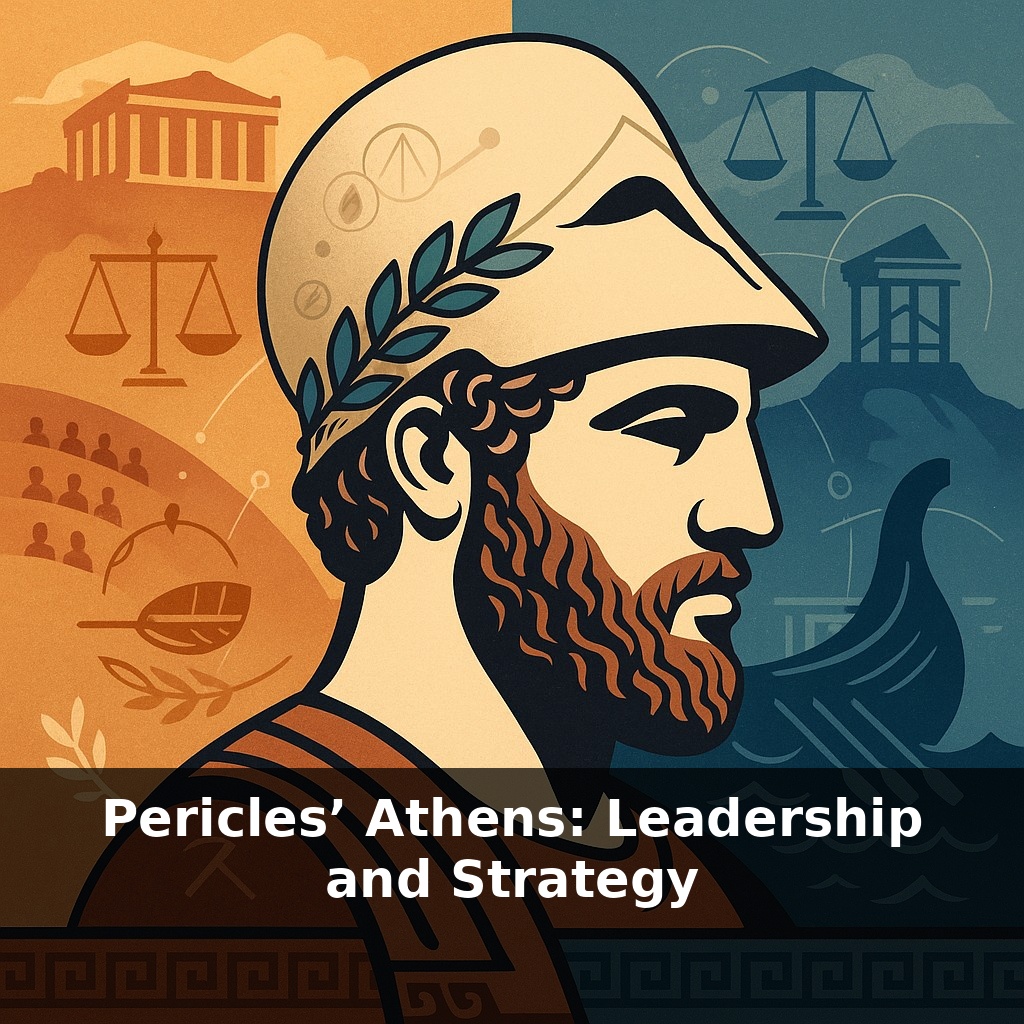
An elected general in Athens kept his job for 15 years straight—while claiming to defend democracy. On one side, he paid citizens to join juries. On the other, he used allied money to build temples and warships. Was this leadership, or a slow-motion coup in plain sight?
Pericles didn’t just win votes; he rewired what power looked like in Athens. Instead of relying on a rigid aristocratic network, he stitched together a coalition that ran from poor rowers in the fleet to skilled artisans carving marble on the Acropolis. Think of him less as a lone “strongman” and more as the architect of a system that made thousands of ordinary Athenians feel invested in imperial success.
He pushed a radical idea for the time: if citizens were going to rule, they had to be paid enough to show up. Court service, council duty, naval campaigns—these became paid public “gigs,” turning participation into both a civic obligation and a livelihood. At the same time, Pericles quietly reoriented where the money flowed. Tribute from dozens of allied cities no longer just funded joint defense; it underwrote Athenian festivals, stipends, and stone. The result was a city that glittered—and a league that slowly realized it was footing the bill.
Pericles’ real innovation was strategic, not just political. He looked at the map of the Aegean and saw lanes, not borders: sea routes that could move grain, silver, and soldiers faster than any hoplite army on land. So he doubled down on ships and sailors, turning the Athenian fleet into a mobile shield and battering ram. At home, stone answered strategy. The Long Walls stitched city to harbor, creating a single fortified organism that could breathe by sea even if choked by land. In crisis, Athens could retreat behind these ribs of masonry and still reach out with its navy.
Pericles’ real gamble was to weld internal politics to external strategy so tightly that success in one sphere justified risk in the other. Start with the numbers. Out of a population around a quarter of a million, only some 30,000 adult male citizens could vote and serve as hoplites or rowers. Yet this relatively small body claimed the right to direct an alliance stretching across the Aegean. To make that claim stick, Athens had to look and feel unstoppable.
That’s where scale came in. The Parthenon wasn’t just piety in stone; it was a labor engine. Up to 15,000 workers could be employed on the Acropolis project—stonemasons, carpenters, metalworkers, haulers—many of them metics or freedmen whose fortunes now depended on Athenian prosperity. Grand architecture turned abstract imperial income into tangible jobs and contracts. When almost half of public revenue flowed from allied tribute, every block of marble was a reminder that empire paid.
At the same time, Pericles leaned into a specific military geometry. Athens could send out 200 triremes on short notice, each requiring roughly 170 trained crew. That meant mobilizing tens of thousands of men—mostly poorer citizens—as a floating workforce. With a 400‑nautical‑mile operating radius, these ships could strike Corsica‑distance targets from home within days. Grain from the Black Sea, timber from Thrace, silver from Laurion, all depended on those sea lanes staying open.
The Long Walls made this viable under pressure. By fusing city and port into one defensible unit, Pericles accepted a brutal trade: let the countryside burn if necessary, but never risk the core. Rural landowners would watch farms ravaged while urban workshops hummed and the fleet sailed. That tension—between inland estates and harbor‑linked trades—mapped directly onto political fault lines that later orators would exploit.
Strategically, Pericles was conservative on land and radical at sea. He anticipated that Sparta’s strength lay in pitched battles and devastation of fields. His answer was to deny them the decisive clash they wanted while patiently bleeding their allies’ morale and resources with raids, blockades, and displays of naval reach. Critics accused him of cowardice or arrogance, but the logic was consistent: as long as the walls held and the ships rowed, Athens could outlast superior infantry.
The risk was that everything became dependent on two fragile assets: the confidence of citizens who suffered occupation of their fields, and the continued flow of tribute from allies who saw their payments funding splendor they themselves would never own.
Pericles’ Athens worked like a high‑risk, high‑growth venture that had quietly changed its business model. Early on, allies could still walk away; by the mid‑400s BCE, exit was expensive. When cities like Naxos and Thasos tried to leave the Delian League, Athens responded with sieges, installed garrisons, and sometimes confiscated fleets. “Membership” looked voluntary on paper but coercive in practice.
Inside the city, the same funds that paid for marble and rowers also underwrote cultural exports. Playwrights like Sophocles staged dramas at festivals partly financed by imperial income; winning a tragic competition became another way to advertise Athenian prestige. Philosophers and sophists gravitated to this environment, drawn by stipends, students, and patronage.
Pericles also tinkered with who counted as Athenian. His citizenship law of 451 BCE tightened access by requiring both parents to be citizens. That move protected the value of the franchise but created a sharper line between insiders benefiting from empire and everyone else supplying labor, taxes, or tribute.
Pericles’ Athens nudges us to ask how far a community can stretch shared purpose before it snaps. When visible gains cluster in one group—urban traders, cultural elites, defense planners—others start to feel like spectators funding someone else’s project. Modern alliances face a similar strain: if some capitals look like gleaming headquarters while partners feel like distant branches, consent erodes quietly, then suddenly, as crises hit.
Pericles’ system proved brilliant yet brittle: once plague, stalemate, and revolt hit, the same mechanisms that had bound Athens together amplified stress. The city learned that you can scale influence faster than resilience. Your challenge this week: study a modern alliance or trade bloc and ask—where is its “Periclean” overreach quietly growing?