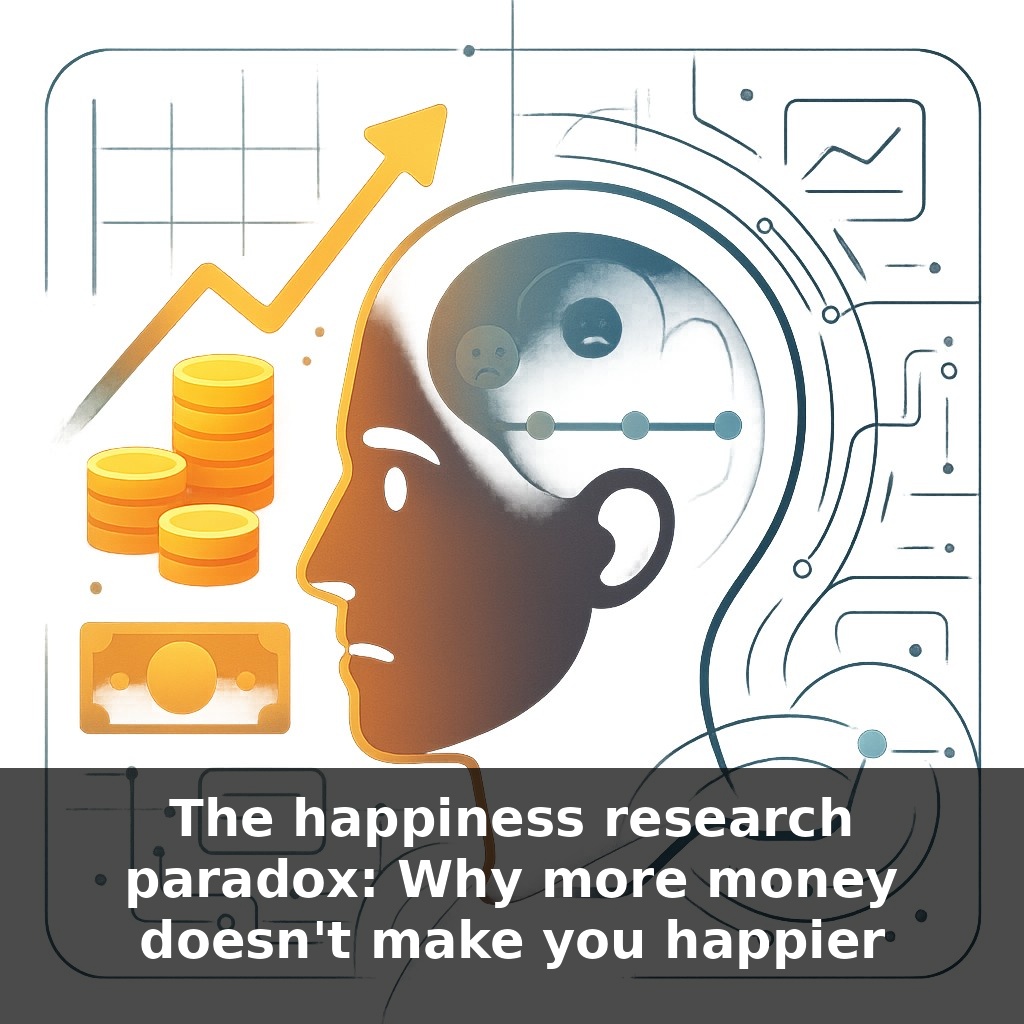
You get the raise, the bonus, the higher title… and three months later, your mood feels strangely familiar. Here’s the paradox: incomes have climbed dramatically in rich countries, but day-to-day happiness hasn’t kept pace. So where, exactly, is all that extra money failing us?
Economists once expected happiness to rise like a straight profit line with national income: more GDP, more well-being. Yet decades of data quietly refused to cooperate. As countries grew richer, people reported owning more, travelling more, consuming more—while average life satisfaction charts barely twitched. The mystery deepened when researchers started zooming in on individuals. Big income jumps—promotions, windfalls, startup exits—did move the needle, but the effect was oddly fragile, fading faster than anyone predicted. That pushed scientists to ask a sharper question: if “how much” you earn isn’t the main driver after a certain point, could “what money actually does in your life” be the missing piece? The trail of evidence began pointing away from paychecks themselves and toward something less obvious: the patterns of attention, time, and relationships that money quietly reshapes in the background.
Researchers started dissecting the puzzle by separating *how much* money people had from *what changed around them* when income rose. Three forces kept showing up. First, adaptation: the upgrade that once felt thrilling quietly becomes background noise. Second, comparison: we don’t just notice what we have, we track where it places us in our social “league table.” Third, use: spending that buys time, deepens relationships, or reduces daily hassles behaves very differently from spending that only adds another item to an already crowded shelf. Together, these forces turn raw income into very uneven emotional returns.
A useful starting point is to separate *what money technically allows* from *what your mind actually registers*. At lower incomes, each extra dollar often removes a concrete strain: overdue bills, unstable housing, skipped medical appointments. That’s why global data show such steep gains when people cross basic security thresholds. Above that zone, the same dollar usually buys upgrades, not safety—nicer options within a life that already basically works. Psychologically, those two kinds of change land very differently.
To see how, researchers zoom in on concrete events rather than abstract income brackets. One line of work tracks people around salary changes or financial shocks using experience-sampling apps. The pattern is striking: on days when economic stressors disappear—no debt calls, no rent panic, no need to juggle shifts—people report fewer negative emotions rather than huge surges of joy. Relief, it turns out, is less intense but more stabilizing than excitement.
Another stream of evidence studies what people actually do with extra money. In longitudinal panels, households that channel raises into cutting commute time, outsourcing chores, or securing childcare report larger emotional gains than households that lean on status purchases. The financial headline may look identical—“income up 20%”—but the psychological headline depends on whether time and mental bandwidth were freed or just re-colored.
Social context quietly rewrites the story too. Income doesn’t rise in a vacuum; it repositions you inside a web of norms and expectations. In workplace surveys, employees whose earnings climb *faster* than their peer group show modest upticks in perceived autonomy and respect. When everyone’s pay rises together, those social signals barely move. That helps explain why living in a booming city can feel strangely flat: the collective baseline keeps chasing you upward.
Methodologically, these findings are surprisingly robust. They appear in smartphone ping studies, national panels, even experiments where participants are randomly assigned cash transfers. Across designs, the same picture emerges: the route from money to mood runs mostly through reduced insecurity, reclaimed time, and shifts in social standing—not the raw number on the payslip.
Consider two colleagues who each get a $10,000 raise. Alex upgrades their apartment, leases a nicer car, and adds a few streaming services. For a month, everything feels “next level.” Then deadlines creep back in, the commute is still draining—only now there’s a higher baseline of what “normal” looks like, and more pressure to maintain it.
Jordan uses most of the raise differently: hires a cleaner for two afternoons a month, pays for grocery delivery, and sets aside money for a weekly dinner with close friends. The visible lifestyle change is smaller, but Jordan’s evenings open up and social life becomes more reliable. In follow-up surveys, people like Jordan tend to report fewer rushed days and more genuinely restorative breaks.
At a larger scale, firms that offer employees options like compressed workweeks or childcare subsidies often see bigger well-being gains than companies that only increase salaries. The paycheck size might be similar, yet one path quietly reshapes how days feel, while the other mainly repaints the backdrop.
If that plateau is real, the frontier shifts from “How do I earn more?” to “What is this for?” Cities might design budgets the way great hosts plan a party: less fussing over how big the cake is, more care for lighting, music, and seating so guests actually connect. On a personal level, the question becomes experimental: Which uses of my time and money make tomorrow feel lighter, not just tonight more intense—and how can I structure my life so those uses become the default, not the exception?
So the real experiment isn’t “Can I climb higher?” but “What feels worth protecting once I’m here?” Notice which uses of cash leave a pleasant aftertaste days later—like a song that keeps replaying in your head instead of a jingle that vanishes. Over time, those quiet, durable notes can guide smarter financial bets than any salary target ever will.
Before next week, ask yourself: 1) “If my salary magically doubled tomorrow but my daily routine stayed exactly the same, which parts of my day would still feel empty or stressful—and what does that reveal about where money actually isn’t the problem?” 2) “Looking at my last 10 non‑essential purchases, which (if any) genuinely made me feel happier a week later, and what patterns do I notice about experiences vs. stuff, or time-saving vs. status-driven spending?” 3) “If I had to ‘buy back’ 2 hours of my week using money I already have (by outsourcing, simplifying, or saying no), what would I change first—and what tiny experiment could I run this week to test whether that trade-off boosts my actual day-to-day happiness?”