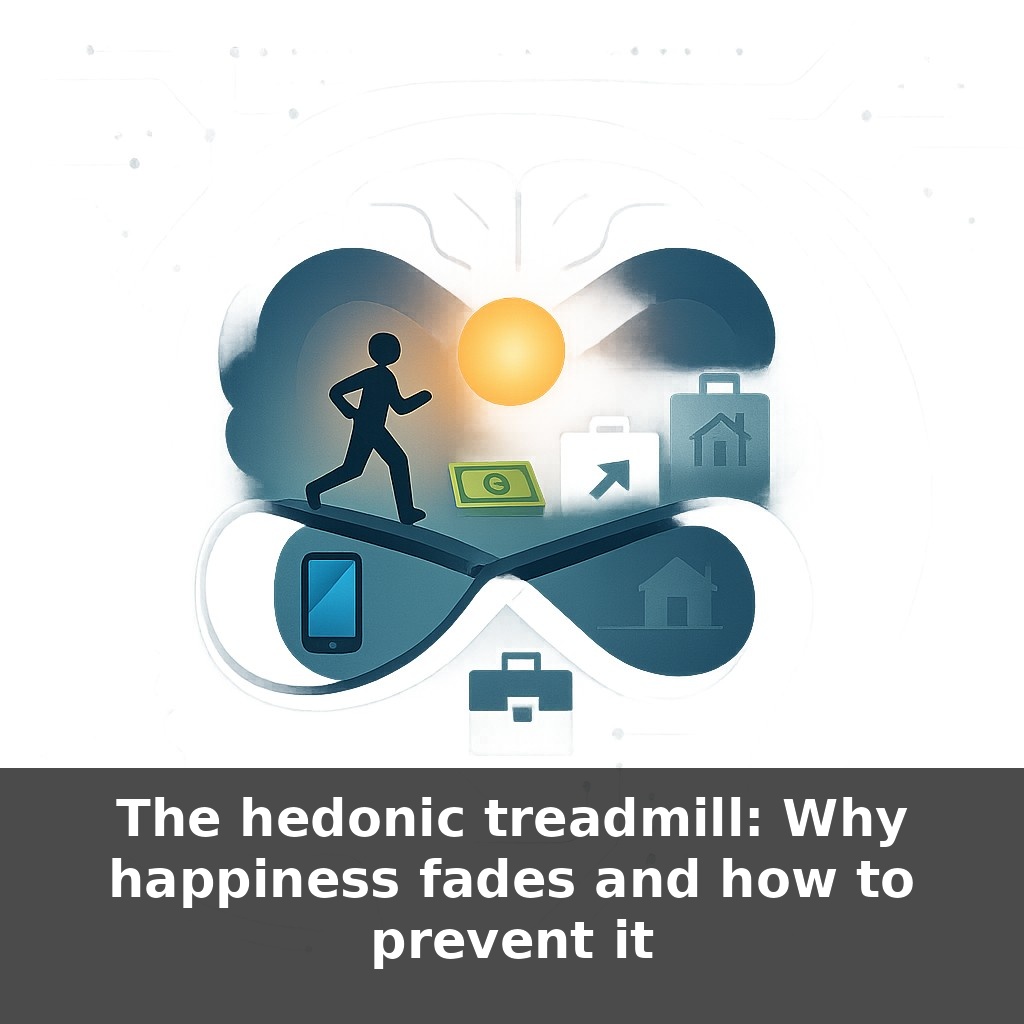
Most lottery winners return to their usual level of happiness within a year. A promotion, a new phone, even a dream apartment—each feels life‑changing, then slowly turns normal. In this episode, we’ll unpack why your brain keeps resetting your joy, and how to quietly change that setting.
If external upgrades fade so fast, what actually *sticks*? Long-running studies following thousands of people show a pattern: after marriages, moves, or big raises, day‑to‑day mood drifts back toward its old average, but certain choices reliably bend the curve. People who invest at least 2 hours per week in close relationships, 45–60 minutes a day in moderate movement, and even 5–10 minutes in daily gratitude or reflection report higher life satisfaction years later—not days or weeks. In one study, people who deliberately practiced kindness just once a week showed measurable boosts in well‑being even a month later. Another found that those who spent as little as $20 on experiences with others felt happier than those who spent $200 on things. In this episode, we’ll translate findings like these into concrete experiments you can run on your own life.
Researchers call this constant emotional “reset” hedonic adaptation, and it’s faster and stronger than most people expect. One study tracking over 24,000 Germans found that even after life‑changing events like marriage or divorce, happiness typically drifted back toward baseline within 1–2 years. Another analysis of more than 150,000 people worldwide suggests that only about 10–15 % of long‑term happiness differences come from circumstances like income, housing, or where you live. That means most of the leverage sits in how you structure ordinary weeks: what you pay attention to, how you spend time, and which habits quietly repeat.
Most people are running three “programs” that quietly keep them stuck on the hedonic treadmill:
**Program 1: Chasing “more” instead of “enough.”** Kahneman and Deaton’s work suggested that in the U.S., day‑to‑day emotional well‑being flattened around **$75,000** (in 2010 dollars). Adjusted for inflation, that’s roughly **$100,000–$110,000** today, depending on region. Past that, higher income is still linked to life satisfaction, but the extra happiness per extra dollar shrinks fast. A 30 % raise might only give you a few percent bump in reported well‑being—and even that typically fades within a year. Yet many people keep trading time, health, and relationships for tiny, short‑lived gains.
**Program 2: Buying things instead of redesigning time.** Across multiple studies, people who spent **at least 60 %** of discretionary money on experiences (trips, classes, shared meals) reported higher average happiness than those who spent the majority on material goods. One experiment gave participants either **$20** to buy an item or to buy an experience with someone else. Weeks later, experiential spenders still reported more satisfaction, partly because they **replayed** the memory and talked about it. Objects quickly blend into the background; experiences keep paying psychological “dividends.”
**Program 3: Treating happiness as fixed instead of trainable.** Twin and longitudinal studies estimate that genes explain around **40–50 %** of why some people are happier than others. Circumstances (income, location, appearance) account for maybe **10–15 %**. That leaves roughly **40 %** tied to patterns of attention and behavior—how often you ruminate, connect, help, learn, or pause. Over months and years, these repeated actions act less like mood hacks and more like long‑term investments, compounding into a higher personal average.
Think of this as reallocating your “happiness portfolio.” If right now 80–90 % of your effort goes into changing circumstances—income, status, stuff—you’re over‑invested in the least efficient asset class. Shifting even **20–30 %** of that effort into trainable habits can move the needle more, and more reliably, than another small raise or upgrade.
A team at UC Riverside followed adults who added just **10 minutes** of daily “savoring” — deliberately noticing good moments — for **6 weeks**. Compared to a control group, they showed significantly higher life satisfaction even **3 months** later. Another study asked people to write a brief gratitude note to someone once a week for **4 weeks**; happiness scores rose by about **one full point on a 5‑point scale**, and many participants were still above their starting level after **12 weeks**, even if they’d stopped writing.
In workplace research, employees who scheduled a **15‑minute** weekly check‑in focused on progress and purpose (rather than targets and problems) were **twice as likely** to report being “thriving” three months later. And when newly retired adults deliberately joined **one** recurring group activity—like a class or club—within the first **90 days**, they reported up to **20 %** higher life satisfaction at the one‑year mark compared with those who simply filled time ad hoc.
Governments and companies are already testing what happens when you design *around* adaptation instead of fighting it. The U.K.’s “social prescribing” pilots now refer patients to community groups, not just pills, cutting doctor visits by up to 28 %. In workplaces, firms that rotate people into stretch projects for 3–6 months see engagement bumps of 15–20 %. Expect AI tools to track mood data and adjust your goals and recovery time in real time.
Your challenge this week: run a mini “anti‑treadmill” trial. For 7 days, change just 5 % of your schedule—about 70 minutes in a 24‑hour day. Use it for one activity that research links to lasting gains, like skill‑building or volunteering. Note your mood at the same time daily; after a week, keep the single activity that moved your average up.