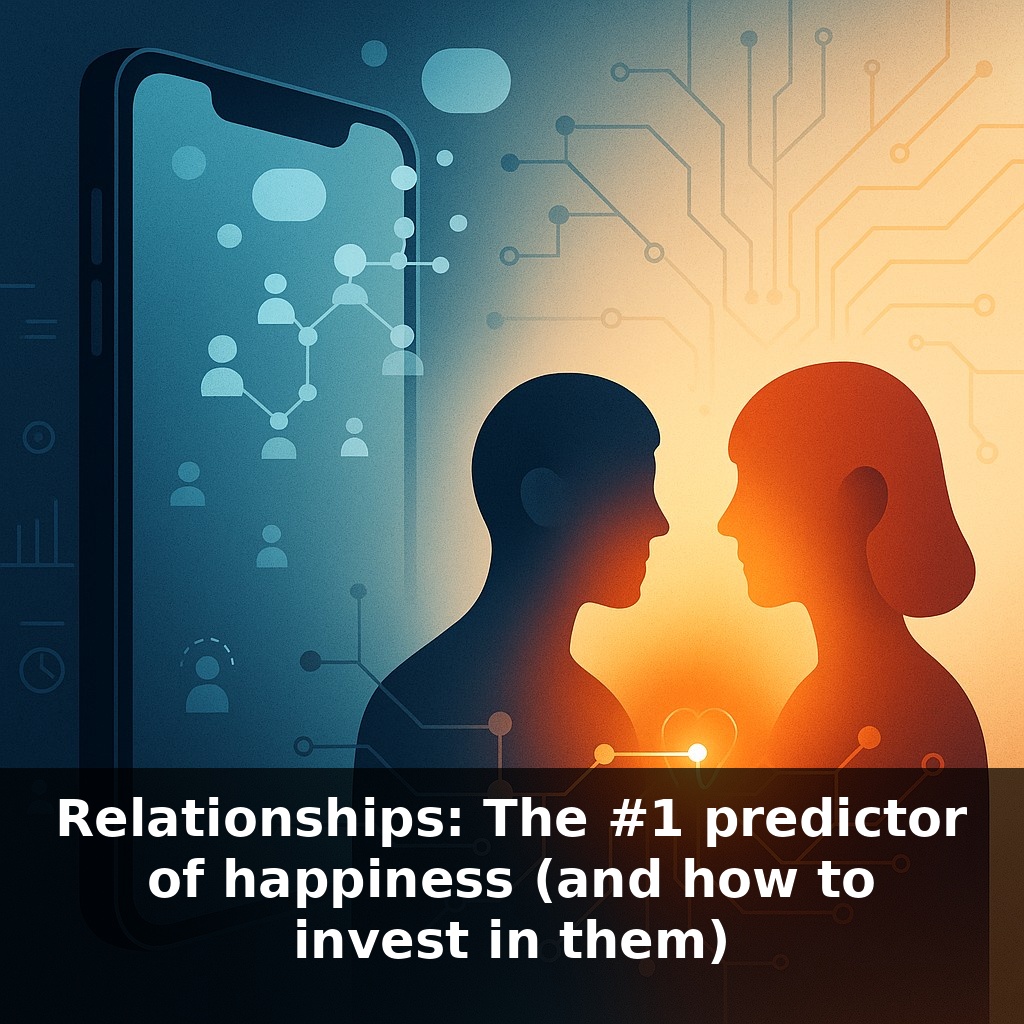
“Loneliness can be as harmful to your health as smoking many cigarettes a day—yet most of us guard our inbox more carefully than our closest friendships. You’re commuting, cooking, scrolling… but who, specifically, is in your corner? And when did you last truly invest in them?”
Here’s the uncomfortable truth: most people *think* they prioritize relationships, but their calendar and screen-time reports say otherwise. The data is stark. Over the last two decades, Americans have shaved off roughly **one full day per week** of in-person time with friends. Yet, during that same period, work hours, side hustles, and digital distraction have crept steadily upward. It’s not that we don’t care about people; it’s that our default settings now funnel our attention elsewhere. This episode is about taking that control back—on purpose. You’ll learn how to audit where your social energy actually goes, how to identify the 3–5 people who most affect your mood and decisions, and how to create simple, repeatable rituals that turn good intentions into regular contact—without adding “another chore” to your life.
Most people don’t consciously choose this tradeoff. It creeps in through defaults: endless feeds, flexible work that quietly stretches to 60 hours, and notifications that slice evenings into 30-second fragments. The result? Relationships end up living in the margins of your day—five rushed texts, two memes, and a “we should catch up soon.” The research is blunt: feeling *known* requires depth, not just contact. In this episode, you’ll design a tiny, practical “relationship budget”: who gets your best attention, when they get it, and how you’ll protect that time from everything else trying to claim it.
Think of this section as moving from “I should see people more” to “Here is exactly who, when, and how.”
Start with **clarity over wishful thinking**. Open your calendar and screen-time stats from the last **14 days**. Count how many *waking* hours you had: roughly 16 hours × 14 = **224 hours**. Now, categorize them into 4 buckets: 1) survival (sleep, hygiene, commuting, chores) 2) paid work 3) solo leisure 4) time with specific people (name them).
Most people discover that fewer than **25 of 224 hours**—about **11%**—are spent in deliberate, unrushed contact with anyone they care about. That gap between what you *say* matters and what you *do* is where your “relationship budget” lives.
Next, identify your **Top 5**: the people whose mood, advice, or criticism reliably affects you. Don’t overthink it; list the first names that come to mind. For each person, quickly answer on a 1–10 scale: - How close do you *want* to feel this year? - How close do you feel *now*?
Any gap of **3 points or more** is a signal: that relationship needs either more time, more honesty, or both.
Now assign a **minimum contact rhythm**: - Inner circle (1–3 people): one meaningful interaction **weekly** (20–60 minutes) - Middle circle (5–10 people): at least **monthly** - Outer circle (wider friends, mentors, neighbors): at least **quarterly**
“Meaningful interaction” has three ingredients: 1) **Undivided attention** (no second screen) 2) **Mutual update** (both people talk about what’s real, not just logistics) 3) **Emotional temperature check** (“How are you *really* handling X?”)
You can hit this via a **25‑minute call**, a **40‑minute walk**, or a **60‑minute meal**. Three such interactions per week add up to about **2 hours**—less than **2%** of your waking time.
To make this automatic, pre‑decide two “relationship slots” in your week, e.g., Tuesday evening 8:00–8:30 and Sunday morning 10:00–11:00. That’s **3 slots × 52 weeks = 156 chances** each year to deepen ties, scheduled *before* other tasks crowd in.
Finally, track three numbers for the next month: - people in your Top 5 - meaningful interactions per week - average closeness rating (1–10).
If that last number inches up by even **1 point**, you’re not just “being social.” You’re systematically increasing the strongest known predictor of long-term happiness.
Lori, a 39‑year‑old project manager, realized she talked to her team more than to her sister. She ran a quick “relationship audit” and found that out of roughly **112 waking hours** in a week, only **3** went to the people she said mattered most. She chose **three 30‑minute slots**—Wednesday lunch, Friday commute, Sunday walk—and assigned names in advance. After **4 weeks**, she’d logged **10 meaningful interactions** with her Top 5. Her self‑rated closeness with her sister went from **4 to 7**, and her reported weekly stress dropped from **8/10 to 6/10**.
Or take Kareem, 27, who felt his friendships were “dying by group chat.” He picked just **two friends** and set a simple rule: no week without at least **20 minutes** of real conversation. He tied calls to existing habits—every second coffee and one weekly gym session became “with a person.” Within **6 weeks**, they’d shared **5 workouts** and **7 calls**, and one friend later became a co‑founder in a side business that now brings in an extra **$600/month**.
If strong ties drive happiness, the next step is designing systems around them. Clinics in the UK already issue “social prescriptions,” and early pilots cut GP visits by up to 28%. Cities that expand walkable, mixed‑use blocks by just 10% see measurable boosts in local participation. Teams that budget at least 4 in‑person days per month report higher trust and 20–30% lower turnover. Treat this as infrastructure: schedule, measure, and protect relationship time the way you would core work.
Treat this as real data, not vibes. Over the next 30 days, notice how even **10 extra minutes** of focused connection shifts your mood, sleep, or motivation. If you see even a **5–10%** bump in energy or fewer nights of doom‑scrolling, you’ve found leverage. Your challenge this week: protect **2 specific hours** on your calendar and put names in those slots.