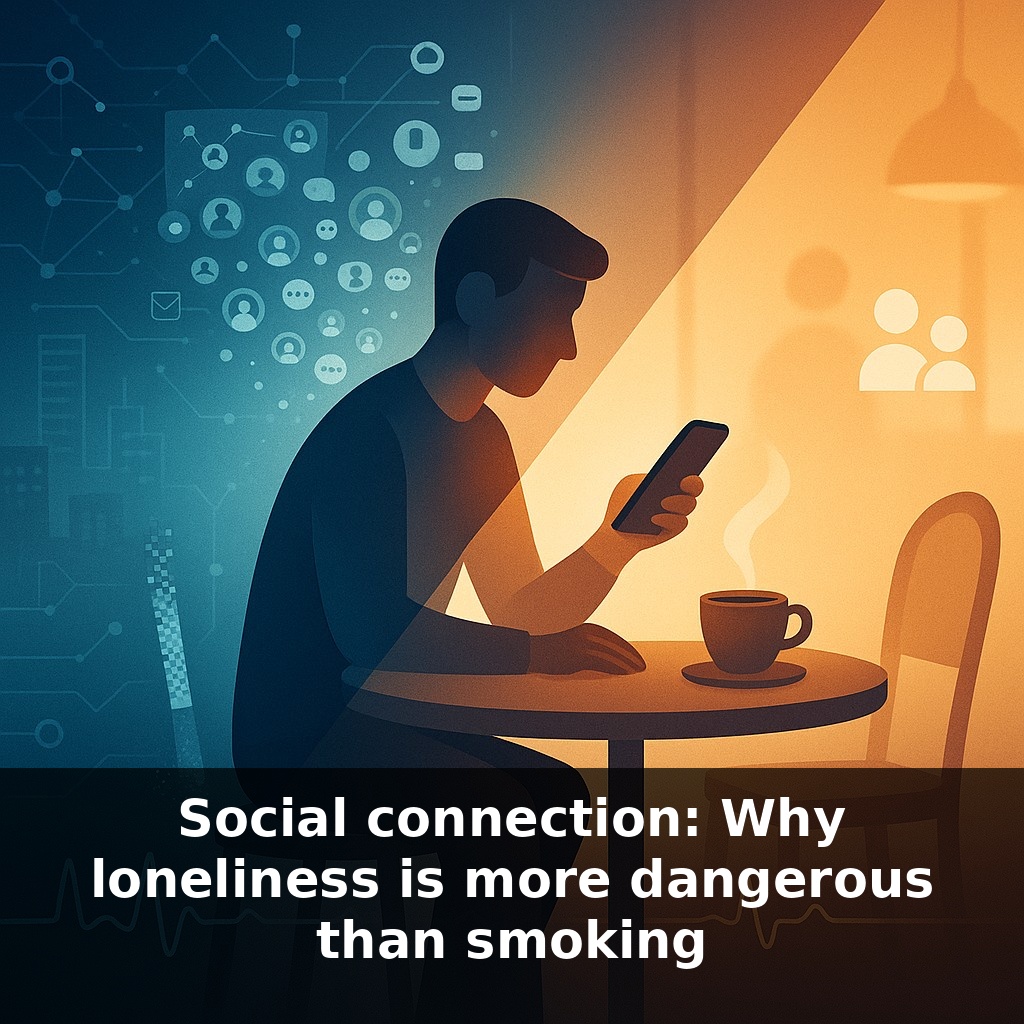
Being lonely for years can shorten your life as much as a pack-a-day habit—yet no doctor prescribes “two close friends and call me in the morning.” You scroll, you post, your feed is full of faces… and still feel unseen. How can we be so connected, and yet so profoundly alone?
A 20‑minute coffee with someone you trust can lower your blood pressure, calm stress hormones, and even help your next vaccine work better. That’s not poetry, that’s lab data. Social contact reliably tweaks the same biological systems doctors try to adjust with pills: inflammation, heart rate, sleep cycles, immune defenses. When those systems stay dysregulated for months or years, risk stacks up quietly—more colds that linger, wounds that heal slower, fatigue that doesn’t match your lab results. What’s tricky is that these changes are mostly invisible in the moment; a lonely week feels “just emotional,” not biomedical. Meanwhile, your brain—wired to treat disconnection like danger—keeps you on subtle high alert, making rest less restorative and stress more toxic. The paradox: the very state that makes it hardest to reach out is the one where your body needs other people the most.
On population graphs, this shows up brutally: curves for people with steady, caring relationships peel away from those without, like two train lines quietly diverging over decades. One line has fewer heart attacks, better recovery after surgery, slower cognitive decline. The other has more ER visits, longer hospital stays, higher risk of dying in the years after a major stressor like job loss or bereavement. And it isn’t just “having a partner” that matters. Warmth, reliability, and feeling genuinely known predict health far better than living status or follower counts. Your body tracks quality, not optics.
Here’s the twist most people miss: your body doesn’t wait for “extreme” loneliness to start changing. Biology responds to *patterns*, not drama. The research signal shows up when low-level disconnection drips through weeks, months, years—when “I’m fine, just busy” becomes a lifestyle.
In lab studies, people who *feel* consistently left out shift into a subtle “self‑protection mode.” They scan more for social threat, remember negative interactions more vividly, and interpret neutral faces as slightly more hostile. That bias isn’t a character flaw; it’s an ancient safety tactic. But it has a brutal side effect: you become more likely to pull back, misread messages, or assume others don’t really want you there. Over time, you’re not just lonely—you’re *loneliness‑shaped* in how you think.
Technology turbocharges this loop. When you’re already feeling marginal, social feeds become a 24/7 comparison engine. Everyone else’s group photos, trips, and couple selfies land on a nervous system primed to detect exclusion. Studies find that passive browsing—scrolling, lurking, consuming—correlates with more envy and more perceived isolation, even if your actual number of interactions hasn’t changed. You start believing a story: “I’m the only one without a real tribe.”
Yet the same tools can nudge the system the other way when used differently. Direct messages, small group chats, voice notes, even short video calls that include disclosure (“I’ve had a rough week”) predict feeling more supported and less alone. It’s not the app; it’s whether the interaction carries risk, reciprocity, and some rough edges of real life.
This is why quick fixes backfire. Buying followers doesn’t move health curves; neither does collecting hundreds of shallow check‑ins. The strongest data points toward a small core of relationships where you could text at 2 a.m., where you can be unpolished, where conflicts get repaired instead of ignored. Think of it less as “building a network” and more as tuning a few reliable instruments in a band so they can keep you in rhythm when life gets loud.
Your challenge this week: run a seven‑day “social nutrition” experiment. Each day, do *one* thing that increases depth, not breadth: call someone and ask one question you’ve never asked before; send a voice message instead of a like; invite one person to do something specific at a specific time; or tell a trusted friend one thing you’re genuinely worried about. At the end of the week, notice not just how you *feel*, but how you’re sleeping, how tense your body is, how quickly you snap or soften with others. You’re testing, in real time, how small relational shifts echo through the rest of your life.
A tech founder once treated his calendar like a lab bench. For a month, he swapped “networking” events for recurring one‑on‑one walks with two old friends. Same total hours with people, completely different outcomes: his migraine days halved, his resting blood pressure dropped, and his therapist noted faster progress—because those walks became a place he could be blunt, not branded. A nurse in night shifts ran her own mini‑trial: instead of doomscrolling during breaks, she joined a tiny group chat with three colleagues where they shared “one honest thing about tonight.” Within weeks, she reported fewer post‑shift spirals and found it easier to fall asleep after adrenaline‑heavy cases. Think of these moves less as grand life overhauls and more like adjusting medication dosage: small, regular tweaks, observed over time, to see what combination and frequency of contact actually stabilizes your mood and energy in the messy reality of your own days.
Some cities now treat “relational health” like public infrastructure, funding friendship benches, shared meals, even trained “connectors” who link neighbors with similar interests—more like librarians than therapists. Tech experiments are emerging too: apps that cap passive scrolling and instead surface three people you could meaningfully check in with today. If these trends scale, the question shifts from “Are you lonely?” to “Who’s built into your everyday routes?”
The next step isn’t a grand reinvention; it’s tweaking tiny habits so they favor real moments over background noise. Treat your week like a playlist: a short call as the opening track, a shared meal as the chorus, a check‑in text as the bridge. Over time, those small, repeated choices can shift your baseline from “getting by” to quietly, steadily, doing better.
Before next week, ask yourself: 1) “Whose face or voice do I actually miss—and what’s one concrete way I could reach out to them this week (a 10‑minute call, a short walk together, or a quick ‘thinking of you’ voice note) instead of waiting to ‘have more time’?” 2) “In the moments I usually numb loneliness (scrolling, binge‑watching, overworking), what would it look like—very specifically—to replace just one of those slots with real connection, like joining a recurring group, eating one meal with someone, or staying five extra minutes to chat after a class or meeting?” 3) “If social connection is as critical to my health as the episode says—on par with smoking in impact—what is one ‘non‑negotiable’ connection ritual I’m willing to protect this week (for example, a standing weekly call, a no‑phones dinner with someone, or a daily text check‑in with a friend) and when, exactly, will it happen?”