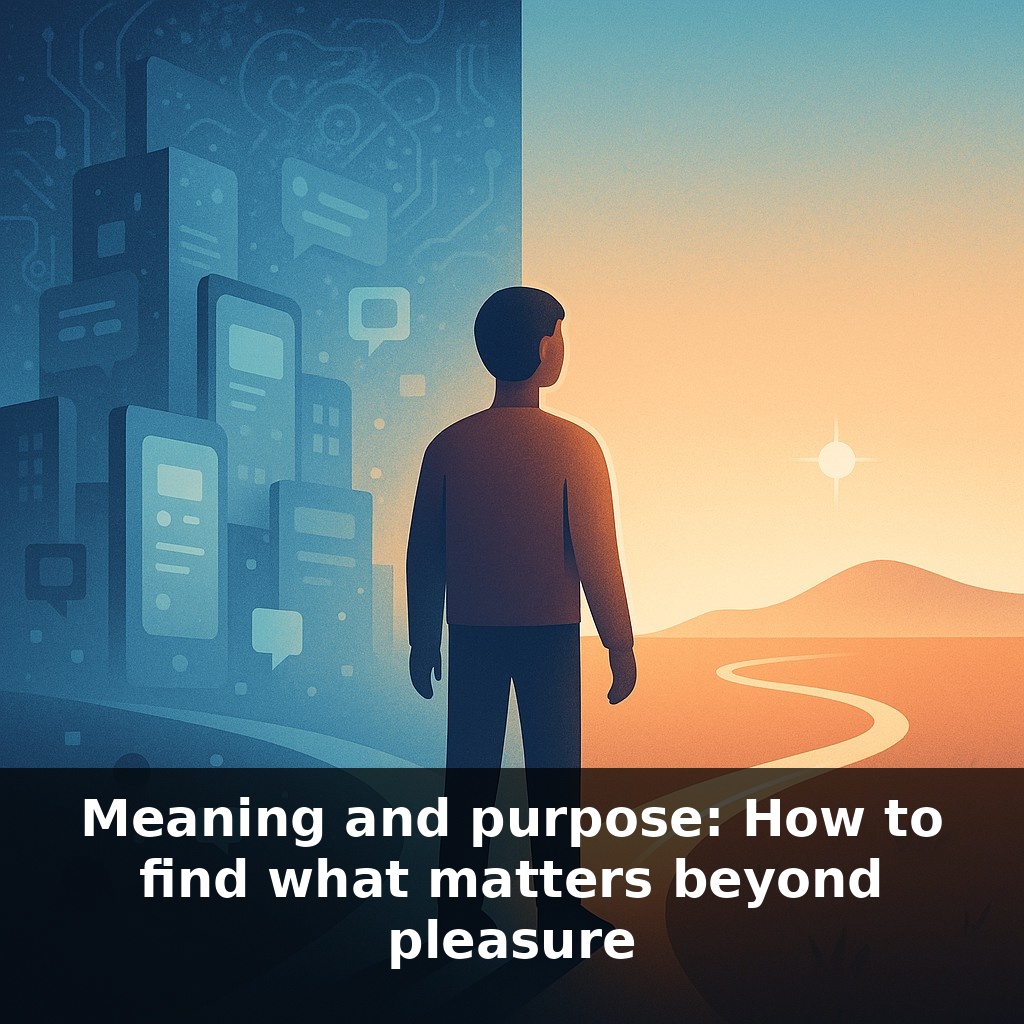
About a third of people say their lives feel “busy but empty.” You wake up, scroll, rush to work, chase small rewards, crash in front of a screen… yet something feels off. Today, we’ll press pause on pleasure and ask a harder question: what actually makes any of this worth it?
Here’s the uncomfortable truth: you can “feel fine” and still be quietly drifting. In large surveys, most people rate their daily mood around 6–7/10, yet only about 40% say they have a clear sense of purpose that guides their choices. That gap matters. Long-term studies tracking thousands of adults show that people who can answer “What is my life actually for?”—even roughly—are more likely to change jobs that drain them, leave unhealthy relationships sooner, and stick with hard habits like exercise, savings, or therapy. Purpose doesn’t mean having a grand mission or a perfect five-year plan. It means having a direction sturdy enough that you’re willing to trade short-term comfort for it. In this episode, you’ll learn how to move from vague “I should do better” feelings to a concrete, testable direction you can act on this month.
Researchers call this deeper “why” eudaimonic well-being, and it behaves differently from day‑to‑day happiness. In large samples, two people can report the same mood but diverge sharply in health, decisions, and persistence depending on how clearly they can answer questions like: “Who benefits from the way I spend my time?” and “What am I willing to struggle for?” One study following over 6,000 adults found that those scoring in the top purpose tier were more than twice as likely to reach major goals they’d set 10 years earlier. In this episode, you’ll translate that abstract idea into a concrete, personal experiment.
Here’s where the science gets very practical. When researchers unpack what people with strong meaning actually do differently, three patterns show up again and again: they clarify what they care about, they connect it to someone beyond themselves, and they embed it into specific roles and routines.
First, values. In one study of over 400 adults, those who could name at least three “non‑negotiable” values—and give a recent example of living each one—scored about 40% higher on measures of meaning than those who spoke in vague generalities. So instead of “I care about helping people,” think: “I care about honesty, learning, and being a reliable friend.” That shift from slogans to specifics is measurable: participants who wrote concrete value statements were 27% more likely to change a misaligned habit within a month.
Second, beyond‑the‑self focus. Analyses of large data sets show that people who regularly invest at least 2 hours a week in activities that clearly benefit others—mentoring, caregiving, community work—report meaning levels roughly 20–30% higher than those who don’t, even when controlling for income and personality. This isn’t about sainthood. Teaching your younger cousin algebra every Saturday for 60 minutes counts.
Third, narrative. When researchers ask people to describe their lives as if they were chapters in a book, those who can point to “turning points” where they grew through difficulty show stronger purpose scores and lower depressive symptoms. In one sample of college students, simply spending 20 minutes a week for 4 weeks rewriting a stressful event as a “learning chapter” increased their sense that their life had direction by about 15%.
These three levers—values, contribution, and narrative—form a kind of mental framework you can update over time. None of them require quitting your job or discovering a hidden passion. They require doing three things that can be counted: naming a small set of values, scheduling recurring acts of contribution, and telling your story in a way where challenges are linked to growth rather than random misfortune.
Think of this less as a hunt for a single calling and more as building a portfolio. A portfolio can be rebalanced: 10% from hobbies, 30% from work, 25% from relationships, and so on. The question becomes, “What tiny adjustment this month would shift that portfolio toward what actually matters to me?”
A concrete example: a 32‑year‑old nurse in a burnout study cut one weekly overtime shift and used those 4 hours for a standing dinner with two friends plus a Sunday skills course. Within 8 weeks, her self‑rated “life is on the right track” score rose from 4/10 to 7/10, without any change in salary or relationship status. Another case: a laid‑off engineer in a career program set a rule of “1 bold reach‑out per day” to people doing work he respected. After 30 days, he had 11 informational interviews, 2 freelance projects, and reported a 25% jump in motivation to get up in the morning. On a smaller scale, a student in a study habits trial picked one 20‑minute “most meaningful task” block right after lunch each weekday. After 3 weeks, they weren’t studying more hours overall, but their completion rate on long‑term assignments jumped from 40% to 70%, and they described their days as “coherent” instead of “random.”
Future implications: As health systems notice that people with clear direction use up to 30% fewer high-cost services, “meaning checkups” may be added to annual physicals. Workplaces could track “mission-fit hours” and tie 10–15% of bonuses to them. In schools, pilots where students run 1 real community project per term already show 8–12% better attendance. Expect apps that suggest weekly “alignment tweaks,” raising questions about who controls the goals they optimize you toward.
Your challenge this week: run a “meaning audit” on your calendar. Count how many hours in the next 7 days clearly point toward something you want your 80‑year‑old self to remember—skills, people, causes. If it’s under 10 hours, move just 2 hours: 120 minutes from low-impact scrolling or errands into one bolder, more deliberate commitment.