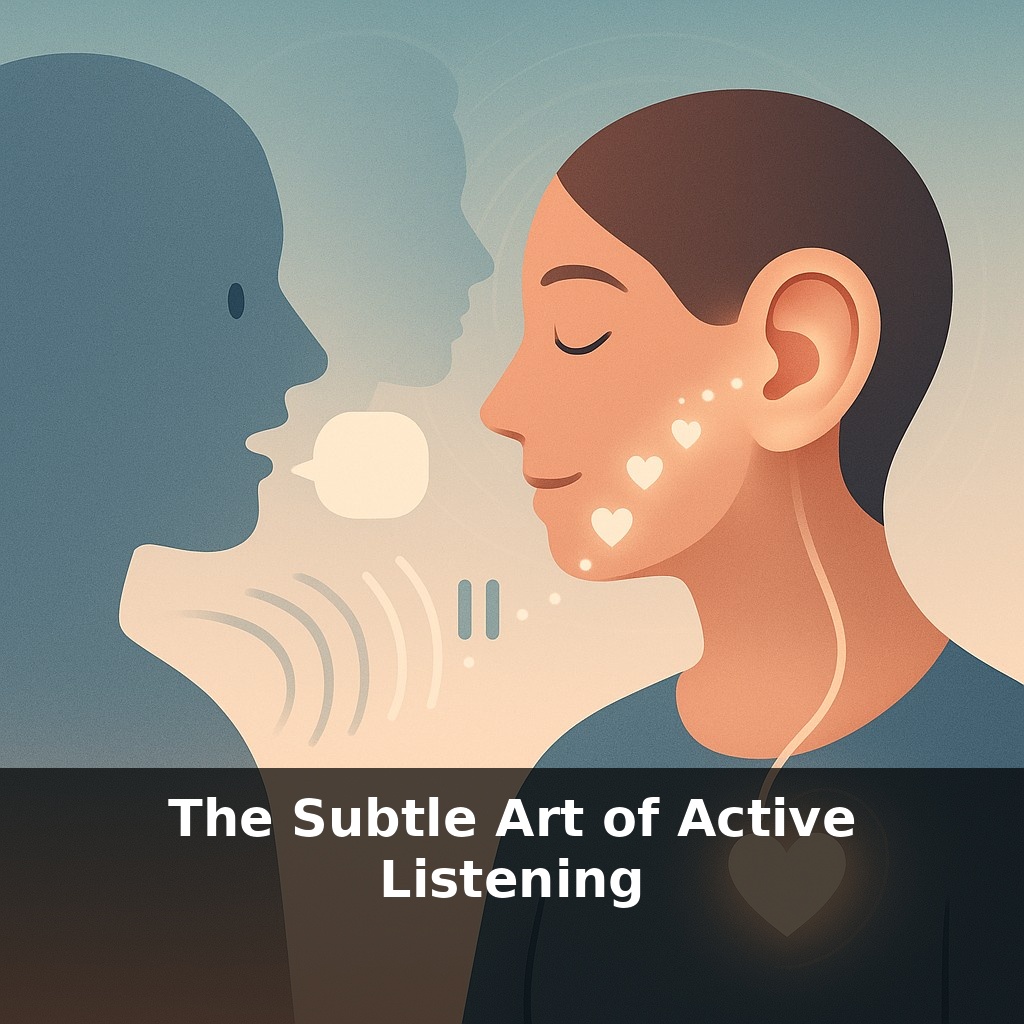
The Subtle Art of Active Listening
📝 Transcript
A single skill can raise medical students’ empathy in just ten minutes—and most of us never practice it on purpose. You’re mid-conversation, nodding, “uh‑huh‑ing,” but later you realize you missed what mattered. If your ears are open, why does the other person still feel alone?
Most of us think we’re “pretty good listeners” because we stay quiet while the other person talks. But under the surface, something else is usually running the show: rehearsing our reply, silently fact‑checking, or scanning for our turn to jump in. The result isn’t a conversation; it’s two monologues politely taking turns. Active listening interrupts that autopilot. It’s less about perfectly worded responses and more about how you manage your own attention in real time. Do you notice when your mind drifts? Can you set aside the impulse to fix, defend, or impress—just long enough to really register what’s being said and why it matters to them? In a world of half-read messages and 2x‑speed podcasts, this is oddly rare. Yet it’s precisely this rare quality of attention that makes people feel seen, softens defensiveness, and turns everyday talks into moments where real change becomes possible.
Active listening sounds simple, but in practice it collides with three forces: speed, stress, and stories. Speed: most of us process language faster than others speak, so our mind fills the gap by jumping ahead or drifting away. Stress: when stakes feel high—a tense meeting, a late‑night relationship talk—our nervous system quietly shifts from “curious” to “protective,” narrowing what we can take in. Stories: we’re constantly running quick inner captions about what this means, who’s right, who’s wrong. The catch is, those captions are often louder than the actual words in front of us.
At the brain level, something remarkable happens when you truly tune into another person: your neural activity starts to sync with theirs. Researchers call it “neural coupling,” and it’s not just poetic—how closely your patterns match can predict how much you’ll actually understand. That syncing doesn’t come from passively absorbing words; it comes from actively working to grasp the meaning and emotion behind them.
Consider what’s going on inside you when someone talks about a bad day at work. One track might be quietly judging (“That doesn’t sound so bad”), another is game‑planning your response, a third is wandering to your own calendar. Active listening means you deliberately reassign those mental resources. You’re still thinking, but the thinking is in service of the other person: “What are they really trying to say? Where did their energy spike or drop? What might they need from me right now?”
That shift shows up in tiny behaviors. You notice specific words they repeat—“overwhelmed,” “ignored,” “stuck”—and you feed them back: “Ignored, huh? By whom?” You track changes in pace or volume and get curious instead of barreling past: “You sped up there—what happened at that point?” These micro‑reflections signal that you’re not just hearing sounds; you’re tracking their inner logic.
There’s also a subtle timing skill. Jump in too fast with a summary and people feel cut off; wait too long and they feel you’re not with them. The sweet spot is often at natural commas in their story: a sigh, a pause, a “so yeah…” That’s your cue to briefly mirror what you heard and invite more: “So your manager praised the project, but you still came home feeling flat—what made it land that way?”
Nonverbal choices matter just as much. On video, it can be as simple as looking into the camera when they share something vulnerable, then glancing at notes only when they’re on safer ground. In person, it might mean angling your body slightly toward them during key moments, then relaxing back when they shift to lighter topics, so your posture matches the emotional weight of the moment.
In group settings, active listening scales differently. You’re not only tracking the speaker; you’re also tracking how their words land with others. Naming that can transform the room: “When you said the deadline felt unrealistic, a few people nodded—can we hear those perspectives too?” Now you’re listening on behalf of the group, not just yourself.
In a one‑on‑one, try this: when someone vents about a “messy project,” treat their words like a search bar. Instead of typing your opinion, you enter short clarifying “queries”: “When you say messy, do you mean the timeline, the people, or the goal?” You’re not interrogating; you’re narrowing in on what actually hurts or matters.
With a partner at home, you can borrow a trick from product teams: run a “mini‑retro” after a tense moment. Once things cool a bit, ask, “If you had to name the one thing I didn’t get just now, what would it be?” Then reflect it back in a single sentence, no defense, no backstory. Often, they relax not because you agree, but because the core of their experience finally has words.
In a group, imagine you’re moderating an online forum. When two people talk past each other, you “summarize the thread”: “I’m hearing Alex worried about risk and Jordan focused on speed. Does that sound right?” That simple move often turns a pending argument into a shared problem you can actually solve.
In coming years, “how you listen” may quietly shape careers the way “what you know” once did. Teams are starting to treat conversations like dashboards: measuring talk time balance, interruption rates, even the emotional “temperature” of meetings. Think of it as moving from gut‑feel communication to something closer to A/B testing. The upside: you’ll be able to iterate on your default reactions, not just your products—turning every hard conversation into data for the next, better one.
Each time you really stay with someone’s words, you also train how you relate to yourself. Patterns you notice in others—dodging conflict, minimizing needs, rushing to solutions—often mirror your own. Your challenge this week: spot one of those echoes, and treat it like a quiet notification inviting you to update how you show up in every relationship.
From this course
The Secret Language of Conversations
6 episodesUnlock all episodes
Full access to 6 episodes and everything on OwlUp.
Subscribe — $1.99/monthLess than a coffee ☕ · Cancel anytime