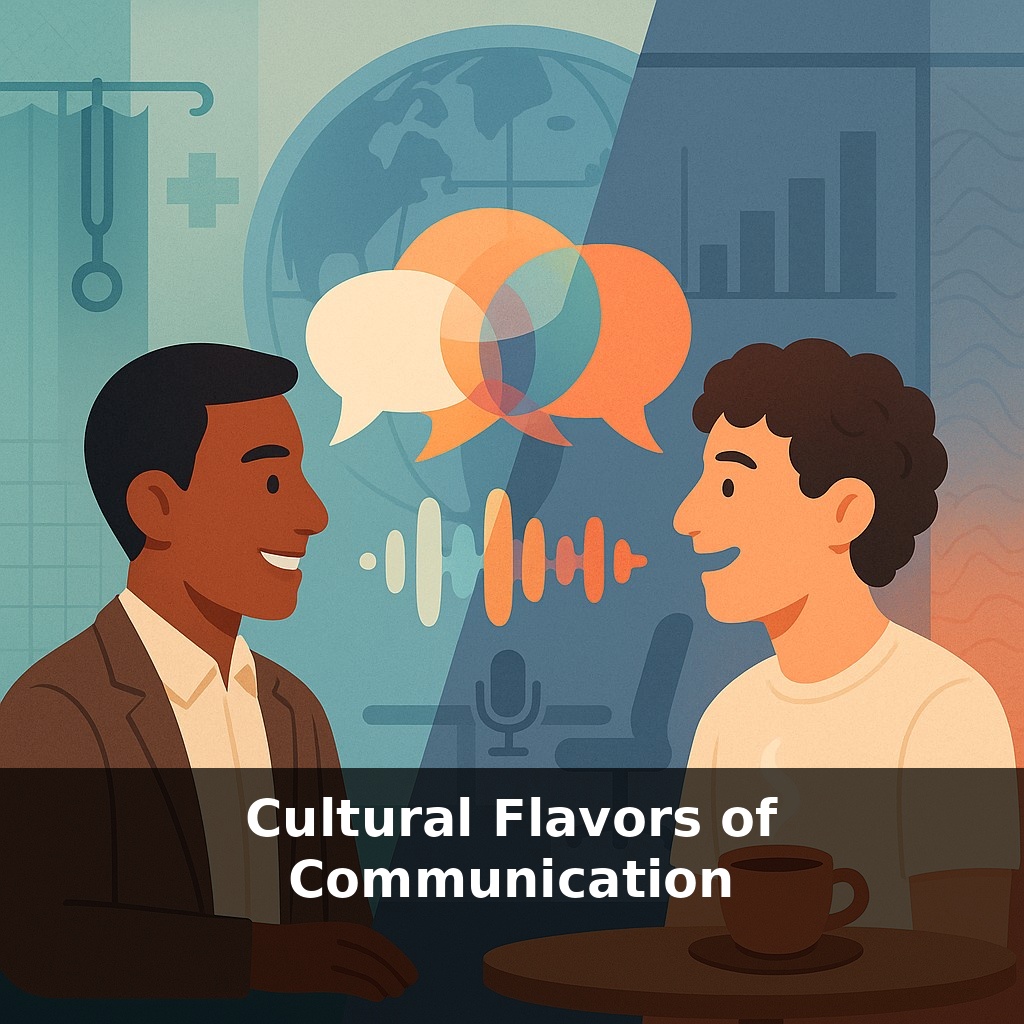
A third of international business deals fall apart not because the numbers don’t work, but because the people can’t talk to each other effectively. In today’s episode, we drop into three rooms—a hospital, a boardroom, and a first date—and listen for the cultural “accent” beneath the words.
“Why didn’t you say anything?” “I thought I was being polite.”
Both people used clear words; both walked away confused. That gap—between what we say and what others *think* we meant—widens dramatically across cultures, even when everyone shares a common language.
Today we zoom in on those hidden “settings” beneath our conversations: how long pauses feel respectful in one culture but uncomfortable in another; how a softened “maybe” in one country is actually a firm “no”; how direct eye contact can signal confidence in one place and aggression in another.
We’ll step inside everyday moments—a performance review, a negotiation, a family dinner—and watch how tiny differences in timing, tone, and gesture can quietly steer trust, tension, or agreement, long before anyone notices a problem. Then we’ll ask: how do you start hearing these differences in real time, and what can you do about them?
Some of these differences are systematic enough that researchers can map them like a city’s transit lines. One “line” separates cultures that pack meaning into the shared situation from those that spell everything out in words—shaping how contracts are written, how feedback is given, even how much backstory a simple request requires. Another line tracks how power and hierarchy seep into conversations: who may interrupt, who must soften disagreement, who is expected to speak first or last. As we follow these routes, we’ll see how they quietly reroute trust, initiative, and who feels truly heard.
A Japanese manager presents a proposal to a U.S. team. She finishes, lets a long pause hang in the air, and reads the silence as thoughtful respect. Her American counterparts, growing uneasy in the gap, jump in with rapid-fire questions to “keep things moving.” She quietly concludes: *They don’t like it.* They conclude: *She’s not confident.* The numbers on the slides were the same for everyone in the room; the “communication algorithms” underneath were not.
Researchers sometimes describe three big “dials” that vary across cultures and subtly rewire moments like this.
The first dial: **how much context does a message assume?** In some places, “We’ll consider it” is a polite way to close the door without saying no. In others, it means the discussion is still alive. The words are identical; the *default expectation* attached to them isn’t.
The second dial: **what counts as polite friction?** In many German or Dutch offices, open disagreement in meetings can signal engagement: “We’re taking the idea seriously enough to push on it.” In many East Asian or Latin American settings, the same level of blunt pushback, especially in front of others, can feel like undermining group harmony or status. So one side thinks, *Why won’t they be honest?* while the other thinks, *Why are they attacking me publicly?*
The third dial: **how visible should emotion be?** Some cultures treat animated facial expression and emphatic voice as signs of passion and warmth; others associate composure and restraint with maturity and trustworthiness. That’s one reason the “93% of meaning is nonverbal” claim is so misleading: the *type* of nonverbal signal that carries emotional weight differs dramatically.
These dials show up in small, practical places. In healthcare, a patient who nods along may be showing respect, not understanding. In cross-border M&A, a local team’s reluctance to say “no” outright can lead the acquiring firm to massively misread risk. Even in friendships, a person who rarely interrupts may be offering space, not distance.
Culture, in this sense, works like seasoning in a dish: the same sentence can “taste” like support, rejection, curiosity, or defiance, depending on which norms flavor it. The skill we’ll build next is learning to notice which dials are turned up—or down—in the conversations you care about most.
In one study of cross-cultural negotiations, U.S. managers marked “We’ll try” as a 60–70% commitment; their counterparts in parts of East Asia marked the same phrase below 30%. Same sentence, different probability field. The “dials” show up in who is *allowed* to touch them, too. In a high power-distance team, a junior engineer may spot a flaw but wait for the manager to raise it; in a flatter culture, that same engineer is expected to flag it immediately—and judged negatively if they don’t.
Even silence has flavors. A Scandinavian executive often tolerates long, data-heavy pauses in meetings but may answer personal questions with economical replies. A Brazilian or Nigerian counterpart might reverse that pattern: brisk on spreadsheets, expansive in small talk. One treats relational warmth as the default channel, the other treats task focus as the safest ground.
Culture is like reconfigurable software: the interface—words, smiles, pauses—looks familiar, but the underlying code routes signals in ways that can surprise you until you learn to read the system.
Future implications
As AI begins drafting emails, leading meetings, even mediating conflicts, it will need something like “cultural plugins” to avoid tone misfires. Hybrid teams may start treating communication norms like version-controlled code: documented, updated, and shared so newcomers can “pull” the latest settings. Cities absorbing large climate‑driven migrations will face a similar task—designing schools, courts, and hospitals that can switch conversational styles as fluidly as a bilingual speaker.
Treat each interaction like tuning an unfamiliar radio: instead of turning up your own volume, scan for the station they’re on—pace, pause length, candor, deference. The more you notice, the more options you gain. Over time, pattern‑spotting becomes portable wisdom you can bring into new teams, cities, and relationships without losing your own voice.
Try this experiment: For the next 24 hours, deliberately “code-switch” your communication style three times with the same person—first using your natural style, then a more direct/low-context version (clear requests, explicit opinions), and then a more indirect/high-context version (more hints, softening language, extra context). After each interaction, quickly rate (in your head) how understood you felt on a 1–5 scale and how comfortable the other person seemed. Notice which “cultural flavor” of communication led to the smoothest exchange, and what specific words, tone, or pacing seemed to make the difference.