Journey Into a Living Cell — Your First Microscale Adventure
📝 Transcript
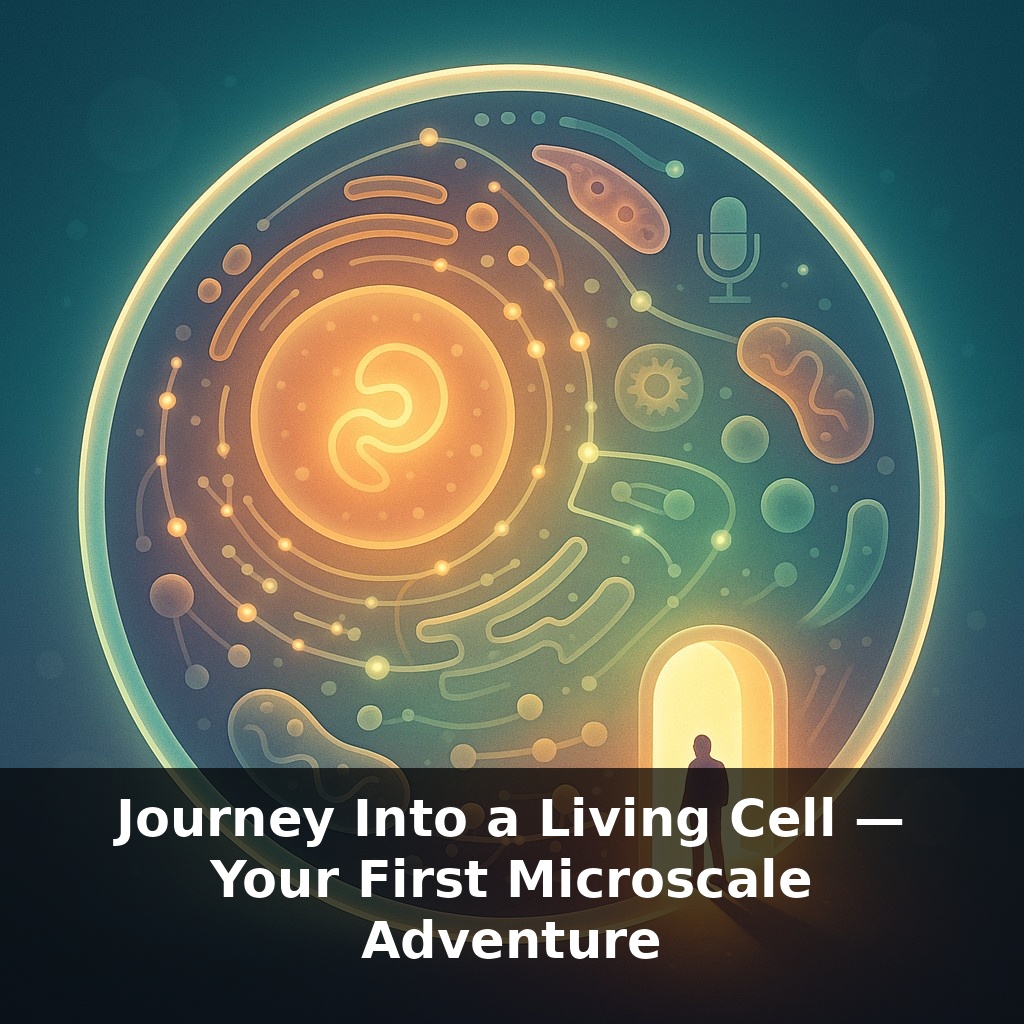
Right now, inside you, trillions of tiny rooms are running a nonstop show—copying blueprints, burning fuel, hauling cargo—yet you never feel a single gear turn. In this episode, we’ll shrink down and step through the doorway into just one of those living rooms.
We’ll begin at the membrane, the flexible boundary that decides what gets in, what stays out, and what must be escorted under guard. Cross that threshold and the cell stops feeling like a “blob” and starts to look more like layered weather systems: calm regions, stormy fronts of activity, and powerful currents of molecules drifting or rushing along. Some areas are dense with folded surfaces, others are open corridors patrolled by proteins scanning for damage or misdelivered cargo. As we move inward, we’ll pass clusters of ribosomes rattling through new instructions, encounter pockets where raw materials are stockpiled, and trace the paths of signals that tell each part when to speed up, slow down, or shut down entirely. By the end of this first journey, you’ll know the basic landmarks well enough to navigate a typical eukaryotic cell on your own.
Here’s where our scale shift gets serious. If you shrank yourself down until a single cell were the size of a small park, many of its most important machines would still be smaller than grass blades around your feet. Within that park, mitochondria cluster like warm clearings where energy use quietly spikes, while stacks of ER and Golgi membranes form dense groves where new molecules are modified and routed. Nearby, acidic pockets break down worn‑out parts, freeing raw materials that reappear elsewhere as fresh structures you’ll meet later in the series.
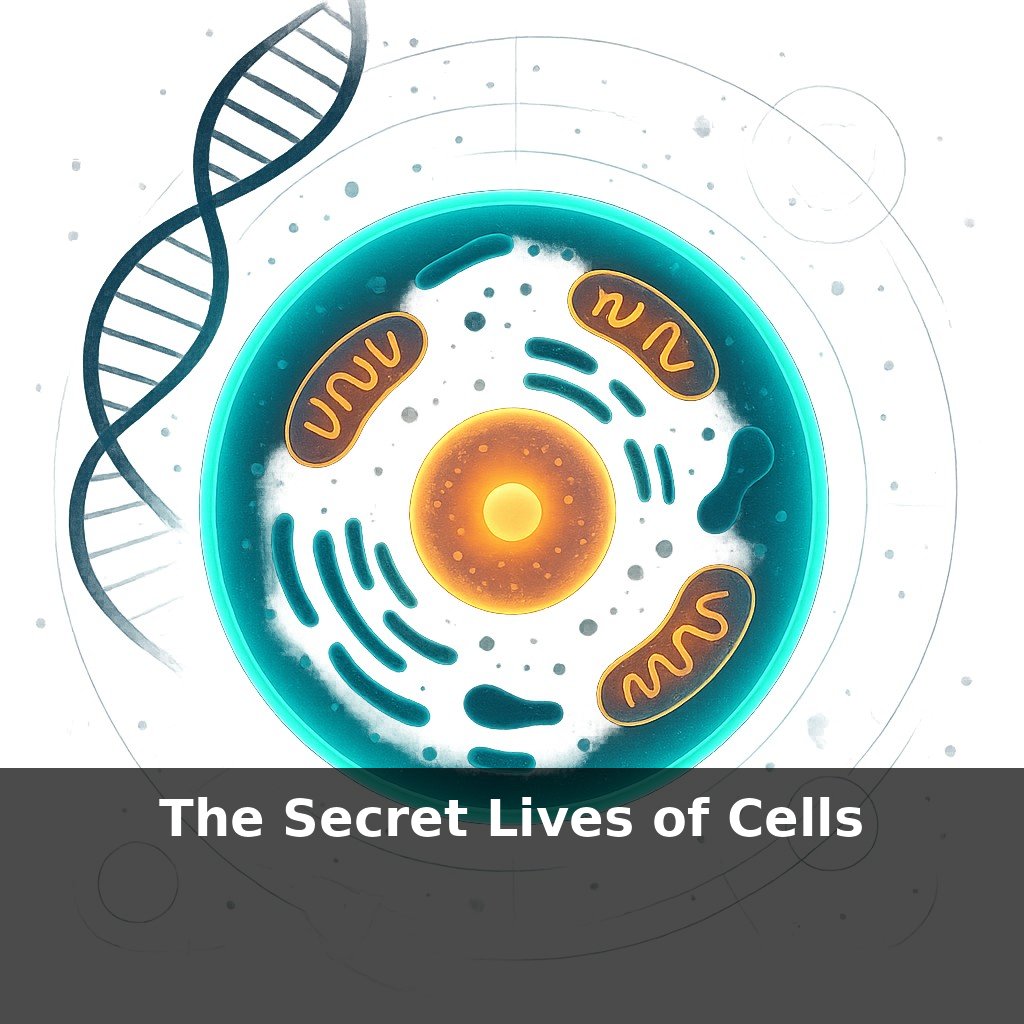
Step past the busy outer regions and the cell’s layout starts to feel less like a park and more like a mapped territory with distinct districts. One of the most striking landmarks is the nucleus. Its double membrane doesn’t just wall off DNA; it’s studded with nuclear pores that behave like highly selective gates. Only RNAs with the right “export tags” and proteins with specific “passport” sequences can move through. This traffic is constant but controlled, and during most of a typical 24‑hour cycle the barrier holds firm—except for a brief window in mitosis when the envelope disassembles and chromosomes are exposed and sorted.
Close to that central hub, you’ll notice zones where DNA is packed differently. Loosely wound regions are busy, accessible stretches where genes are actively read into RNA. Densely packed zones are quieter, with genes largely silenced. Cells remodel these patterns in response to signals—tightening or loosening access—to shift identity, adapt to stress, or, when things go wrong, slip toward cancer.
Out beyond the nuclear neighborhood, different cells customize their interior in radical ways. A typical liver cell devotes up to a quarter of its space to mitochondria, supporting intense metabolic work. In contrast, a mature human red blood cell has no nucleus at all; it has traded long‑term information management for maximum oxygen‑carrying capacity and a short, efficient life.
Not every cell follows the same playbook for internal compartmentalization. Bacteria lack membrane‑bound organelles, yet many still partition chemistry with remarkable finesse. Some build protein‑based microcompartments that concentrate certain reactions; others shape their internal membranes to harvest light or handle toxic intermediates. Calling them “primitive” misses how finely tuned these systems can be.
Threading through everything is the cytoskeleton: not just static support, but a dynamic network that assembles, disassembles, and generates force. It positions the nucleus, helps divide the cell, and provides tracks along which cargoes move with directional bias, turning random thermal jostling into purposeful motion. The overall effect is less like a bag of ingredients and more like a choreographed piece of music, with distinct motifs—energy, information, recycling—entering and fading in time, yet all staying in sync.
Even inside one cell, “typical” barely exists. A neuron stretches its membrane into cables that can run a meter long, yet all its traffic still converges on the same tiny control center. A white blood cell, by contrast, stays compact and mobile, constantly reshaping itself as it hunts bacteria. Zoom in further and diversity continues: some algae cells pack in light‑capturing structures so densely they tint whole ponds green, while certain parasites streamline away anything they can safely outsource to their host.
To get a feel for this variety, think of different cells as musical genres built from the same notes. Skin cells are steady percussion, forming layered, protective rhythms. Intestinal cells race through turnover like a fast‑tempo track, replacing themselves every few days. Heart muscle cells keep a relentless beat for decades, coordinating contractions through tightly linked junctions.
Our journey in later episodes will follow these style choices down to the nanoscale, where small tweaks in layout decide whether a cell heals, adapts, or fails.
As we map this inner terrain in finer detail, cells stop being black boxes and start looking more like editable storylines. Shift a boundary here, reroute a reaction there, and you’re revising how a cell ages, resists infection, or repairs tissue—more like tweaking recipes than replacing the whole kitchen. Future therapies may tune a single neighborhood instead of the whole cell, quietly steering outcomes long before symptoms ever surface.
Each of your cells also carries a history book: scars from past infections, tweaks from diet, even traces of ancient viral DNA. Much of it is still undeciphered, like marginal notes in a language we’re just learning. Your challenge this week: whenever you feel a heartbeat or take a breath, pause and ask which unseen cell stories are turning that moment into motion.
From this course
The Secret Lives of Cells
10 episodesUnlock all episodes
Full access to 10 episodes and everything on OwlUp.
Subscribe — $1.99/monthLess than a coffee ☕ · Cancel anytime