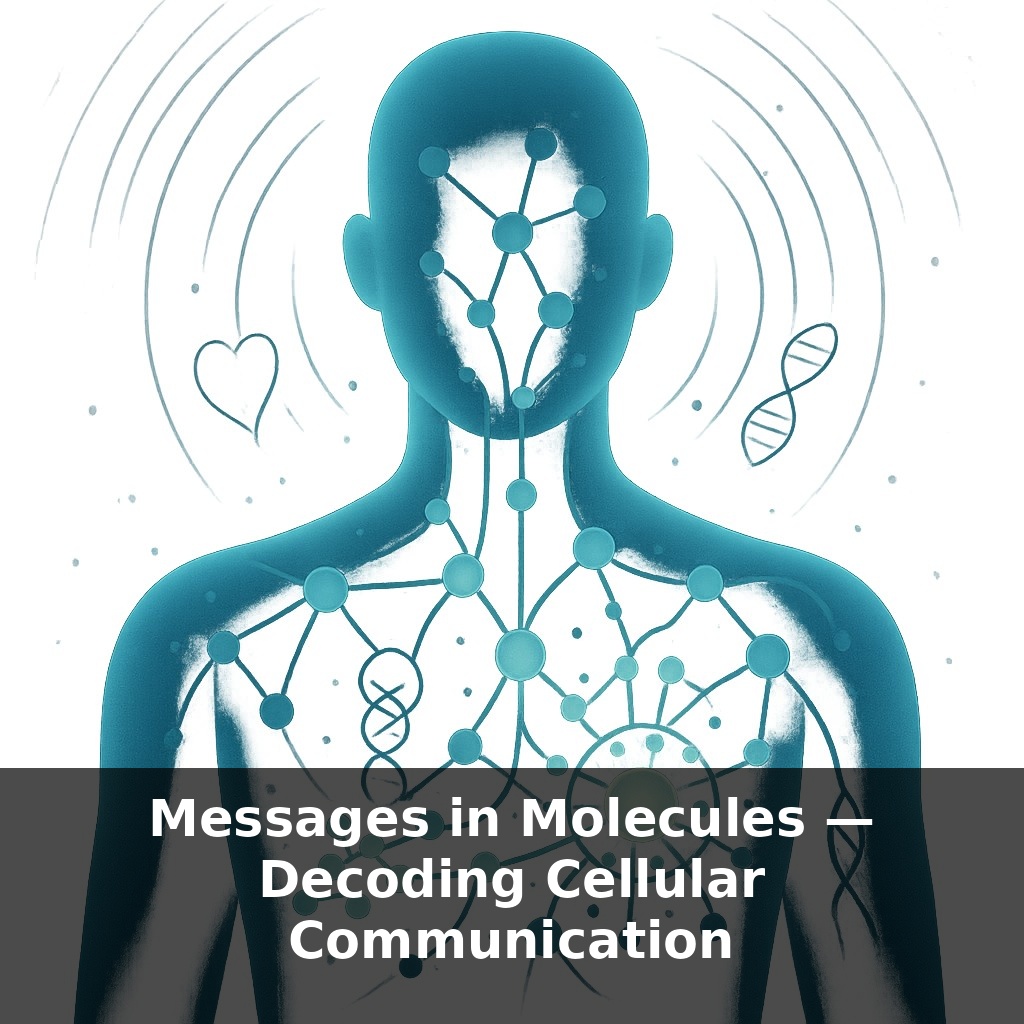
Right now, trillions of cells in your body are having conversations you will never hear. A single stress hormone can race through your bloodstream, tap on just the right cellular “doors,” and within moments your heart, muscles, and even genes all get the same urgent memo.
More than 800 different GPCR “antennae” are embedded in your cells, each tuned to a distinct chemical signal—from light in your retina to adrenaline in your heart. That diversity lets your body run thousands of overlapping conversations at once without crossing wires. But receptors are only the front desk. The real spectacle happens inside, when a single bound receptor unleashes second messengers like cAMP or Ca2+ that rush through the cytosol, turning a local event at the membrane into a whole-cell announcement in under a second. One activated β‑adrenergic receptor can set off over a hundred adenylyl cyclase enzymes, multiplying the original cue roughly ten thousand–fold. Sometimes, as with HER2 in certain breast cancers, turning the “volume knob” too high on one receptor channel can drive disease—unless a drug like Herceptin steps in to quiet that signal.
Inside the cell, those incoming cues don’t just flip a single switch; they choreograph entire sequences. A tiny rise in Ca2+ can tug on contractile proteins in your heart one moment and, in another tissue, nudge enzymes that reshape metabolism. cAMP bursts might tweak how responsive a neuron is, subtly changing what “counts” as a strong signal. IP3 and DAG often act together, like two sections of an orchestra reading the same score but playing different parts—one opening Ca2+ stores, the other awakening kinases that march toward the nucleus to adjust which genes will be heard next.
When biologists talk about “signals,” they don’t just mean hormones drifting through blood. Cells can be triggered by neurotransmitters at synapses, fatty molecules in membranes, dissolved gases, even the tug of a neighboring cell or the stiffness of the tissue they’re sitting in. A heart cell “feels” stretch with each beat; a bone cell “notices” when weight-bearing exercise increases mechanical load and adjusts growth accordingly.
Those incoming cues converge on a surprisingly small toolkit of core pathways. One huge class runs through enzyme-linked receptors such as receptor tyrosine kinases (RTKs). When their outside domains bind a growth factor, their inside tails cluster and cross‑phosphorylate, turning the membrane into a landing strip for relay proteins. That’s the launch point for cascades like MAP kinase pathways, which can walk a signal stepwise from membrane to nucleus, editing which genes get turned up or down for hours or days.
Even within a single cell, the same pathway can send different “messages” depending on timing and location. A sharp, brief pulse of activity might tell a cell to move; a slow, sustained rise in the very same pathway might tell it to divide. Neurons lean heavily on this logic: repeated, spaced pulses of neurotransmitter can strengthen a synapse for weeks, while a single burst fades in minutes. The information isn’t just in the molecule—it's in the rhythm.
Spatial patterns matter just as much. Some signals stay near the membrane, tweaking nearby ion channels or cytoskeleton. Others penetrate deep, riding scaffolding proteins that hold multiple enzymes together so the message doesn’t dissipate. There are even micro‑domains where certain reactions run hotter than in the general cytosol, creating tiny “hotspots” of information processing inside one cell.
Of course, with so many overlapping conversations, cells need ways to keep channels separate and prevent crosstalk from causing chaos. One solution is to reuse the same second messenger but in distinct compartments or time windows. Another is feedback: kinases that, once activated, switch off the upstream receptor, or phosphatases that erase phosphate “flags” to reset the system. Drugs like sildenafil exploit this clean‑up step by blocking degradation of particular messengers, effectively lengthening how long one channel stays loud while others proceed normally.
Your challenge this week: treat common medicines as clues to hidden conversations. Each time you or someone close takes a drug—an inhaler, a painkiller, an antihistamine—look up (once) which receptor it targets and whether it’s mimicking a ligand, blocking one, or altering a downstream enzyme. Then, for just that case, sketch the rough path in your mind: from the drug’s first contact at the cell surface or inside, to one concrete effect (slower heart rate, opened airway, reduced inflammation). By the end of the week, see how many distinct “message routes” you’ve mapped.
In real tissues, messages rarely travel alone. A single immune cell, for example, can release dozens of cytokines that nearby cells read as a shifting “chord” rather than a solo note, adjusting survival, migration, and repair in subtly different combinations. In the brain, one neuron may receive inputs from thousands of partners, each using its own mix of transmitters and receptors so that the postsynaptic cell can “vote” on whether to fire. Even gases like nitric oxide briefly diffuse through smooth muscle, quietly relaxing vessel walls and redirecting blood flow without ever binding a classic membrane receptor.
Sometimes, location rewrites meaning. A kinase activated at the membrane might stiffen the cytoskeleton, while the same kinase switched on near chromatin tweaks memory-related genes. Development leans hard on this nuance: gradients of morphogens whisper positional information so that one patch of cells becomes retina while a neighboring patch commits to jawbone. Like weather fronts meeting over a landscape, overlapping signals define what each region will become.
Soon, decoding these molecular messages may feel less like reading tea leaves and more like checking a live transit map. Biased agonists could nudge one “track” of a pathway while leaving side‑routes quiet, reshaping treatment of heart failure, depression, or autoimmune flare‑ups. AI models trained on your tumor’s own signaling “weather patterns” might predict which drug combos corner it fastest, while engineered T cells patrol like adaptive storm chasers, intensifying only where danger clouds gather.
As tools sharpen, we’re edging toward “listening in” on live signaling, almost like watching city traffic from orbit: patterns, jams, shortcuts. Future checkups may read your signaling profiles the way weather apps track shifting fronts, spotting early storms in heart, brain, or immune cells long before symptoms appear—and suggesting routes to steer them.
Before next week, ask yourself: 1) “If I treated my own body like a tightly coordinated signaling network, which ‘signal’ would I change first today—sleep, nutrition, stress, or movement—and what’s one concrete tweak I can make so that downstream ‘messages’ (like focus, mood, or energy) improve?” 2) “Thinking about how cells filter noise from real signals, what’s one source of ‘signal noise’ in my day (constant notifications, multitasking, late-night screens) that I’m willing to mute or remove for the next 48 hours to let the important messages in my life come through more clearly?” 3) “Cells constantly sense and adapt to their environment—where in my current environment (desk setup, lighting, routine) can I make one small, specific change today that would help my brain and body ‘communicate’ better, like improving my ability to concentrate or unwind?”