Right now, inside a single cell, millions of tiny “packages” are being shipped, received, and recycled—without a single one getting lost on purpose. In this episode, we’ll jump straight into that microscopic logistics network, where wrong deliveries can mean real human disease.
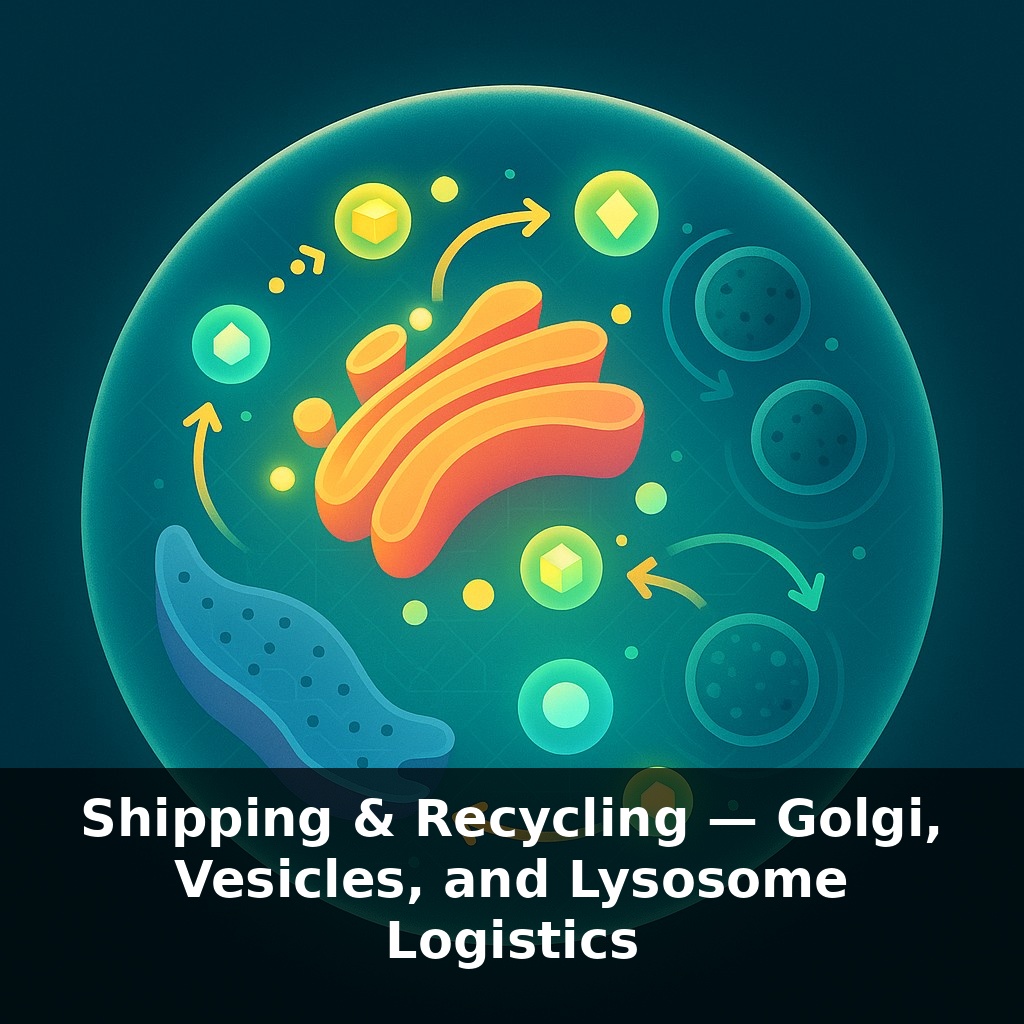
Inside an animal cell, newly built proteins don’t just drift toward their destination—they’re actively sorted, labeled, and dispatched with almost ridiculous precision. Fresh from the rough ER assembly line (Episode 4), many of them enter the Golgi apparatus: a compact stack of 3–8 flattened sacs that somehow manages the traffic for an entire cell while occupying only about 2% of its volume. Here, enzymes tweak sugars, add molecular “tags,” and decide whether a protein will become part of the cell surface, be secreted, or sent for breakdown. That decision matters: vesicle budding costs GTP, fusion events can top a million per minute, and in some cells, like macrophages, keeping lysosomes acidic for recycling can burn through ~20% of available ATP. Across this high‑energy maze, more than 30 Rab GTPases and cycling receptors like the mannose‑6‑phosphate receptor help keep routes distinct—and errors rare.
Inside this traffic system, timing is everything. Some cargos sprint straight from one cisterna to the next; others pause, getting remodeled like songs under remix. Sugars can be trimmed, swapped, or extended, subtly changing how long a protein survives or which neighbors it prefers at the membrane. Meanwhile, motor proteins haul vesicles along microtubule “tracks,” so direction isn’t left to chance. That motion shapes big‑picture events you feel: a burst of insulin after a meal, neurotransmitters released in a thought, or antibodies launched during infection—all depend on flawless routing through this crowded hub.
In this maze, the first quiet decision happens as cargo leaves the rough ER: keep or lose the “export ticket.” Certain proteins deliberately *stay* in the ER or Golgi because they carry retention or retrieval signals—short amino‑acid codes like KDEL. If they escape, retrieval receptors grab them in later compartments and haul them back. So even “mistakes” become part of a controlled back‑flow that constantly tunes each station’s toolkit.
As cisternae mature from cis to trans, their identities flip like stages in a relay race. Early enzymes ride backward in vesicles, late enzymes move forward with the maturing cisterna. That moving‑target architecture lets the same physical stack handle very different jobs over time: early trimming, mid‑stage remodeling, and late‑stage packaging. It also makes the system surprisingly adaptable—cells can expand specific zones during stress, like boosting glycosylation capacity in secretory cells.
Routing decisions at the trans‑Golgi network split cargos into several high‑stakes paths. One leads to regulated secretion: hormones, neurotransmitters, and digestive enzymes are packed into dense‑core granules that wait near the plasma membrane. An arriving signal—calcium spike, action potential, or hormone—triggers synchronized fusion. Another path is constitutive: a steady drip of vesicles that refreshes the plasma membrane and continuously exports proteins like extracellular matrix components.
A third route targets endosomes and, eventually, lysosomes. Here, mannose‑6‑phosphate is just one of several sorting features; hydrophobic segments, lumenal domains, and even cargo crowding can bias which coat complexes engage. Downstream, endosomes act as decision checkpoints: recycle receptors back, send some membrane to the surface, and commit selected cargos to lysosomal degradation.
These choices are not only about disposal. Lysosome‑derived signals feed back to metabolic pathways, helping cells decide whether to build, store, or burn resources. In neurons, for instance, defects in this degradative branch can let damaged proteins accumulate, contributing to disorders like Parkinson’s and some dementias.
Your challenge this week: whenever you read about a drug, vaccine, or antibody therapy, look up where in this shipping pathway it must travel—ER, Golgi, secretory granule, endosome, lysosome—and notice how much of its success depends on logistics, not just chemistry.
In real cells, this routing system gets pushed to extremes. A pancreatic beta cell, for instance, spends its day filling and dispatching waves of insulin‑loaded granules after each meal; under chronic high sugar, its Golgi stack swells and secretory traffic rewires long before the cell actually dies. In fast‑firing neurons, the timing is even harsher: mis‑timed delivery of ion channels or receptors by just minutes can subtly change how a circuit learns. Immune cells go further, treating the pathway like a pop‑up weapons factory—B cells rapidly expand their secretory architecture when they switch on mass antibody release during infection. Biotech quietly hacks all this: monoclonal antibodies are “glyco‑engineered” by tuning Golgi enzymes so the same protein backbone gains sugar decorations that alter half‑life or immune potency. The whole network behaves a bit like a responsive forest canopy: pathways expand, thin, or reroute as local “weather” in the cell’s environment changes.
As we decode this traffic, medicine shifts from blunt interventions to route‑aware tuning. Therapies might one day steer individual cargos like a navigation app suggests side streets—diverting toxic proteins into faster breakdown, or giving fragile hormones “priority lanes” during stress. On a larger scale, engineers already borrow these routing principles to design factories where waste streams loop back like smart recycling, hinting at cities and supply chains that heal rather than drain their surroundings.
As tools sharpen, we may not just observe this traffic but draft new routes—guiding vaccines to linger longer, rerouting misfolded proteins, or timing secretion like a conductor shaping a symphony’s finale. The same design rules could influence soft robots or self‑healing materials, where internal “cargo flows” respond to stress and quietly restore function.
Try this experiment: Grab two different colored sticky notes and label them “Golgi” and “Lysosome,” then pick a recurring task you “ship” (like sending reports) and a recurring problem you “recycle” (like fixing the same mistake). For one week, every time you do the shipping task, add a note under “Golgi” describing what you sent, to whom, and in what “packaging” (email, doc, message), and every time you fix a repeat problem, add a note under “Lysosome” describing what you broke down and what you salvaged (templates, checklists, shortcuts). At the end of the week, look at your two clusters: tweak one “Golgi” process to make it smoother (like pre-building a template) and one “Lysosome” process to prevent the problem earlier (like adding a trigger or reminder before the error usually happens).