Right now, one tiny cell in your body is running millions of microscopic machines at once—quietly building you, molecule by molecule. In this episode, we’ll step onto that invisible factory floor and follow a single protein from its first blueprint to its final launch.
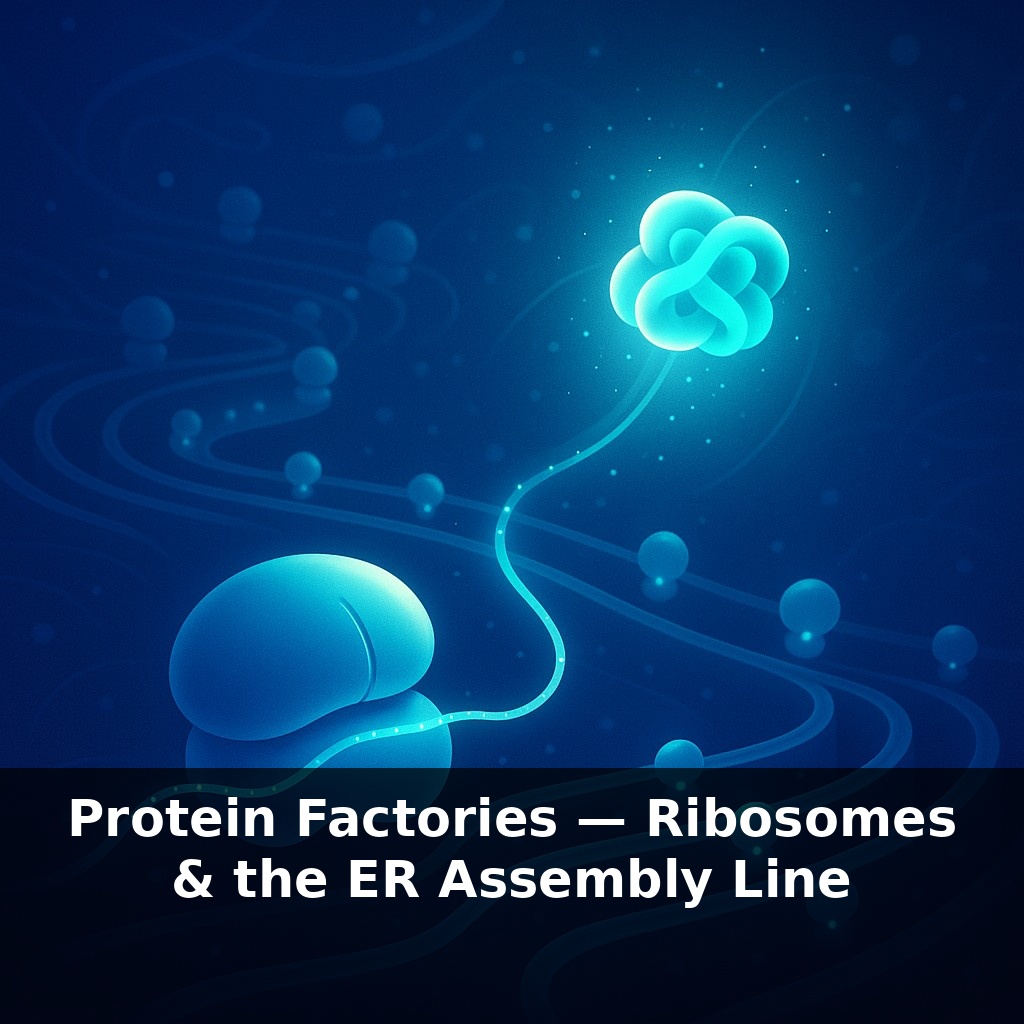
Ten million. That’s how many ribosomes are packed into a single human cell—more “workstations” than people in a megacity, all busy turning genetic text into working parts. And for many of the proteins that keep you alive, those parts don’t stay where they’re made. They’re shuttled to a sprawling inner maze: the endoplasmic reticulum, or ER, where shape, polish, and routing are decided in seconds.
In earlier episodes, we traced how energy is minted and borders are patrolled; now we watch what that energy actually *builds*. A ribosome may commit up to 80% of a fast‑growing cell’s energy budget to stitching one chain, only to halt mid‑task as a signal sequence appears and an escort complex yanks the whole operation to the ER surface.
Here, timing is ruthless. Within 2–5 seconds, the chain must thread into the membrane‑bound channel or risk misfolding, triggering alarms that can reshape the cell’s priorities—or, if stress mounts, its fate.
Some of the most familiar molecules in your life start their journey here. The insulin that steadies blood sugar, antibodies after a vaccine, clotting factors that stop a cut from bleeding—all began as raw chains on those ribosomes, then were shaped and routed through the ER’s maze. A typical liver cell can push out millions of such proteins every minute, constantly refreshing blood chemistry you never notice. This system is so central that many modern drugs, from monoclonal antibodies to some COVID‑19 vaccines, are designed by first mastering these same intracellular assembly lines.
Every second, that packed megacity of ribosomes is making a strategic choice: keep going where it is, or commit to the ER route. The deciding factor is the destination of the emerging chain. If its future address is the cytosol, nucleus, or mitochondria, the workstation stays “free” in the fluid interior. If the chain is destined for export, membranes, or certain organelles, the machinery bolts itself to the ER and feeds the growing strand directly into the interior or into the surrounding membrane.
That routing decision silently shapes your physiology. Hemoglobin in red blood cells is built away from the ER; it needs to stay soluble, ready to roam with oxygen. By contrast, hormones like insulin, digestive enzymes, and many neurotransmitter receptors all commit early to the ER path because they must be secreted or embedded in membranes. A single mutation that alters a signal segment can reroute—or strand—an entire class of molecules, leading to disease.
Once a chain crosses into the ER network, it doesn’t just curl up and leave. Specialized helpers called chaperones bind and release sections in sequence, steering the chain toward precise shapes. Sugar groups are attached in distinctive patterns; these act as molecular barcodes that later tell the Golgi apparatus where to send each finished product. Slight variations in this decoration can determine whether an antibody lingers for weeks in your bloodstream or disappears in hours—one reason biopharmaceutical companies obsess over cell culture conditions.
Embedded in the ER membrane, other complexes clip, crosslink, or assemble multiple chains into larger structures. Antibodies are a good example: multiple subunits must pair correctly, disulfide bonds must form in the right places, and any mistake risks triggering inflammation if released. Quality‑control checkpoints sample each batch; failures are earmarked for disassembly, and their parts are recycled back into the amino‑acid pool.
When that rejection rate creeps above roughly one in ten, the unfolded‑protein response starts rewriting priorities: dialing down new synthesis, boosting chaperone production, even reshaping the ER network itself. In chronic stress conditions—such as diabetes, viral infection, or certain neurodegenerative diseases—this same safeguard can become a tipping point between cellular adaptation and self‑destruct.
Think of the whole scene like a piece of music unfolding in real time: each amino acid added is another note, and the timing of when that signal segment appears can shift the “melody” toward hormone, receptor, or enzyme. In pancreatic beta cells, for instance, long bursts of glucose stimulation don’t just “ask for more” insulin—they reshape how the ER allocates capacity to that particular score, favoring secreted chains over others. Viral infections hijack the same system: some coronaviruses load their own “tracks” onto these workstations and even remodel nearby membranes into special replication niches, subtly choking normal output. In biotech, engineers push this balance on purpose. Chinese hamster ovary (CHO) cells, used to make blockbuster antibody drugs, are tuned so their ER can tolerate unusually heavy traffic without tripping emergency responses. Small shifts in temperature or nutrient mix during a production run can nudge folding helpers, altering which forms dominate and, ultimately, how well a therapy performs in patients.
Ribosomes and the ER are quietly sliding into the center of high‑tech medicine. Lab‑grown “mini‑organs” already use them to test drug toxicity before human trials. Future gene therapies may not just fix DNA, but retune this whole assembly line—like rewriting an orchestra’s sheet music mid‑performance—to boost protective antibodies, mute rogue inflammatory signals, or even let your own cells print replacement tissues on demand.
In the next decade, tuning this inner assembly line may matter as much as editing genes. Researchers are probing how stress, sleep, even diet subtly retime these reactions, nudging which molecules rise or fade. Your weekly rhythms—like tides—may already be shaping when certain repairs peak, and when cells are most ready to respond to new therapies.
Before next week, ask yourself: 1) “If my ribosomes are literally the ‘protein factories’ of my cells, what’s one concrete change I can make to my meals today (like adding a palm-sized serving of complete protein at lunch or pairing beans with rice) to better support that machinery?” 2) “Looking at my sleep, stress, and caffeine habits, where might I be overtaxing my endoplasmic reticulum ‘assembly line,’ and what’s one specific tweak—such as a 10-minute evening wind-down or cutting caffeine after 2 p.m.—I’m willing to experiment with this week?” 3) “If my cells only build with the amino acids I give them, what’s one processed, low-protein snack I can swap today for something that actually supplies building blocks (like Greek yogurt, edamame, or a boiled egg) so my internal factory isn’t running on scraps?”