The Seeds of Conflict
📝 Transcript
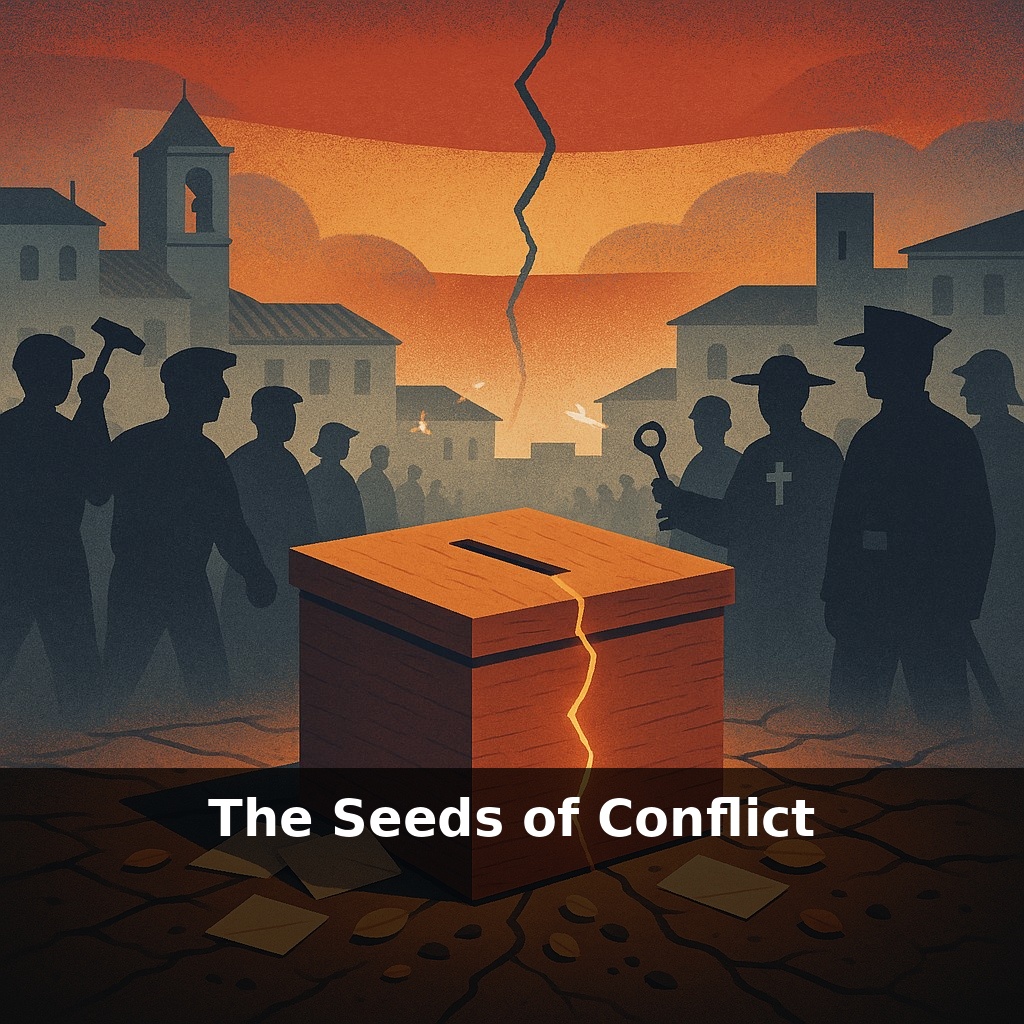
Gunshots echo across a Spanish town square—not from a battlefield, but from rival political rallies gone violently wrong. A new democracy is on paper, but in the streets landlords, priests, generals, and workers are all convinced: if they lose now, they lose everything.
By 1931, Spain was a country where the wallpaper kept being changed while the walls themselves were cracking. Beneath the noisy clashes in plazas and parliament sat problems no slogan could plaster over. In the countryside, millions of landless labourers survived on seasonal work, staring across fences at sprawling estates idle for much of the year. In classrooms, children recited prayers under crucifixes while new textbooks quietly questioned the Church’s grip on knowledge. Army officers, trained to see themselves as guardians of the nation, watched civilians redraw borders of power and wondered if they would soon be treated like obsolete machinery. In Catalonia and the Basque Country, regional leaders pushed for autonomy, not as a fashionable cause but as a shield against a state they did not fully trust. The Republic inherited all of this—and tried to fix everything, almost at once.
The Republic’s leaders walked into this storm carrying blueprints, not weapons. Reformers saw Spain as a house long lived-in but never truly renovated: wiring from the 1800s, pipes patched after every leak, whole rooms kept locked. Their agenda reached into places politics had rarely touched—school timetables, courtroom procedures, military pensions, municipal budgets. Suddenly, village priests found their influence questioned, generals faced forced retirement lists, and big landowners watched tax proposals that treated idle acreage like a luxury car parked forever in the driveway. Each change created winners and losers—and the losers had newspapers, parties, and guns.
The Republic’s first big gamble was land. In huge swathes of the south, two numbers defined daily life: a tiny minority of owners held most arable soil, and thousands of labourers lined up at dawn hoping to be hired for a single day. Reformers in Madrid wrote laws to break up vast estates, settle peasants on plots, and tax idle land more heavily. On paper, it was a direct attack on rural misery. In practice, it moved slowly, tangled in courts and local obstruction. For many hungry workers, promises felt like another season of waiting; for landowners, even delayed expropriation looked like the first crack in a dam.
At the same time, the Republic plunged into schooling. New secular schools sprang up, particularly in cities, staffed by teachers who talked less about sin and more about citizenship. With literacy already far higher in towns than in the countryside, this shift widened a cultural fault line: urban children absorbed republican values quickly, while rural areas often lacked buildings, books, or trained staff to match the ambition. Reformers were not simply teaching reading; they were altering who had the authority to say what counted as truth.
Then came the army. A force sized for an empire Spain no longer had still carried too many officers for its troops. Trimming ranks through early retirement and restructuring commands looked like fiscal common sense from the treasury; from officers’ clubs, it looked like humiliation. Many who had built careers in colonial wars felt pushed aside by civilians they considered inexperienced, even unpatriotic.
Overlaying all of this was the question of who really spoke for the “nation.” Regional statutes debated in Catalonia and the Basque Country were framed as legal texts, but they were received elsewhere as emotional verdicts on unity and history. Conservative circles saw decentralisation less as administrative tidying and more as a step toward dismemberment.
None of these conflicts exploded immediately. Instead, they layered. Each reform that moved too slowly frustrated its intended beneficiaries; each one that moved at all frightened those who felt targeted. The result was a political climate in which every negotiation seemed to carry a hidden weapon, and every concession looked like proof of weakness.
Think of Spain’s social order as a massive, legacy software system written in incompatible languages. Each “module” had its own logic and bug list. The agrarian module ran on feudal-era assumptions: local bosses informally decided who ate, who starved, and who dared to organise. The education module still carried old code—catechism, deference—while new secular routines were suddenly patched in, often without testing how they’d run on rural hardware. The military module, oversized and expensive, constantly pinged for higher priority and special permissions. Regionalists tried to upload autonomy statutes that looked like custom plugins to some, malware to others. When the Second Republic tried a simultaneous system-wide update, every interest group watched nervously for where new privileges would be written—and where old ones would be deleted. Each partial rollout produced logs of perceived “abuses,” feeding a narrative that the entire operating system was either under assault or fatally timid.
Asturias and the 1936 uprising hint at a darker lesson: when opponents stop seeing rivals and start seeing threats, every law feels like a countdown. Today, researchers track similar warning lights—media echo chambers hardening into “us vs. them,” online crowds cheering punitive crackdowns, local grievances framed as existential tests of loyalty. Like hairline fractures in a dam, each sign looks small alone; together, they show where pressure is silently building.
Seen up close, Spain’s slide was less a sudden fall than a staircase of missed exits: each crisis closed options the way doors click shut in a narrowing corridor. The lesson isn’t that reform is dangerous, but that pacing and trust matter. When every ballot feels like a verdict on survival, compromise stops being a bridge and starts looking like a trap.
Before next week, ask yourself: 1) “In my closest relationship, where do tiny annoyances (tone of voice, timing of texts, how we divide chores, etc.) quietly pile up, and what’s one specific example from this week where I felt a ‘small sting’ but said nothing?” 2) “If I assume that beneath this repeated friction there’s a ‘seed’—like feeling unappreciated, controlled, or ignored—what might that seed be for me, and when did I first start feeling it?” 3) “What is one concrete, low-stakes moment coming up (a walk, a shared meal, a car ride) where I can gently name this pattern using ‘I feel… when… because…’ and stay curious about their story instead of proving I’m right?”
From this course
The Spanish Civil War: Stories from a Divided Nation
8 episodesUnlock all episodes
Full access to 8 episodes and everything on OwlUp.
Subscribe — $1.99/monthLess than a coffee ☕ · Cancel anytime