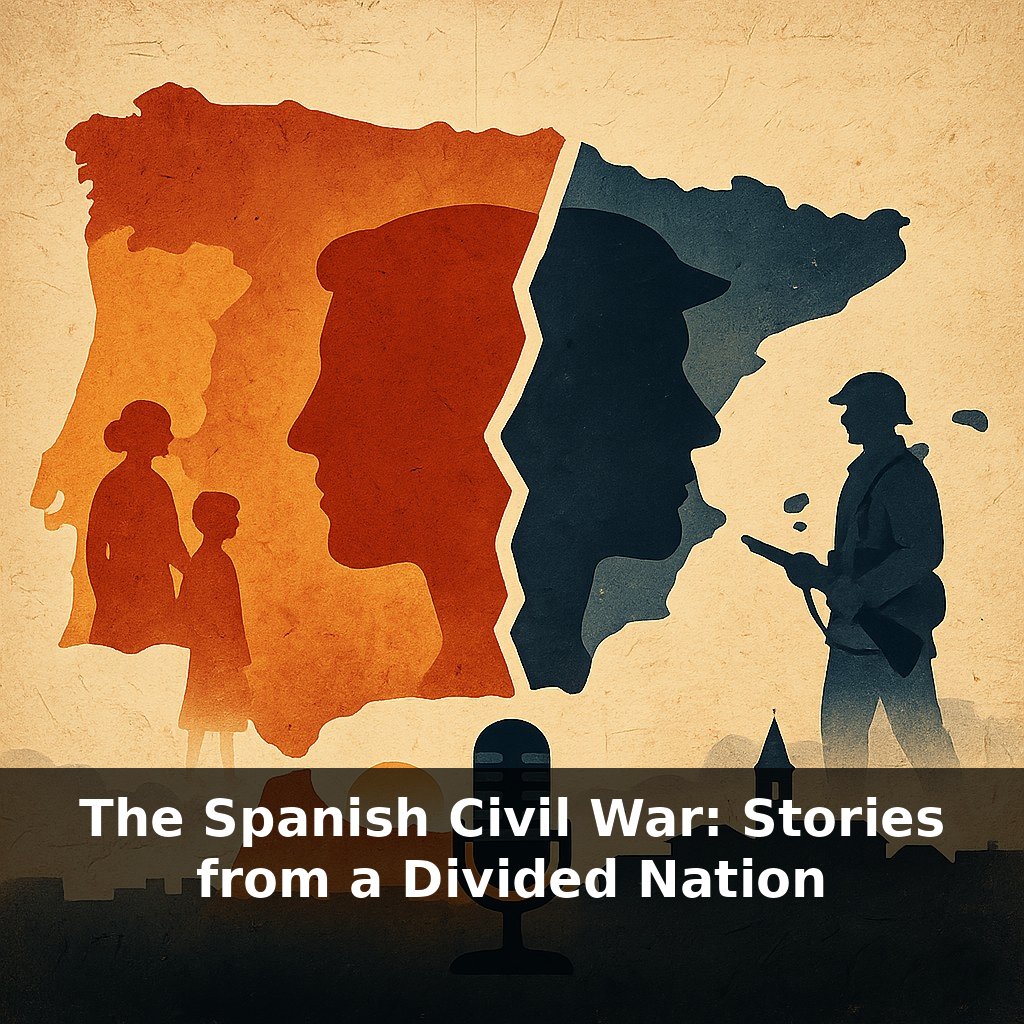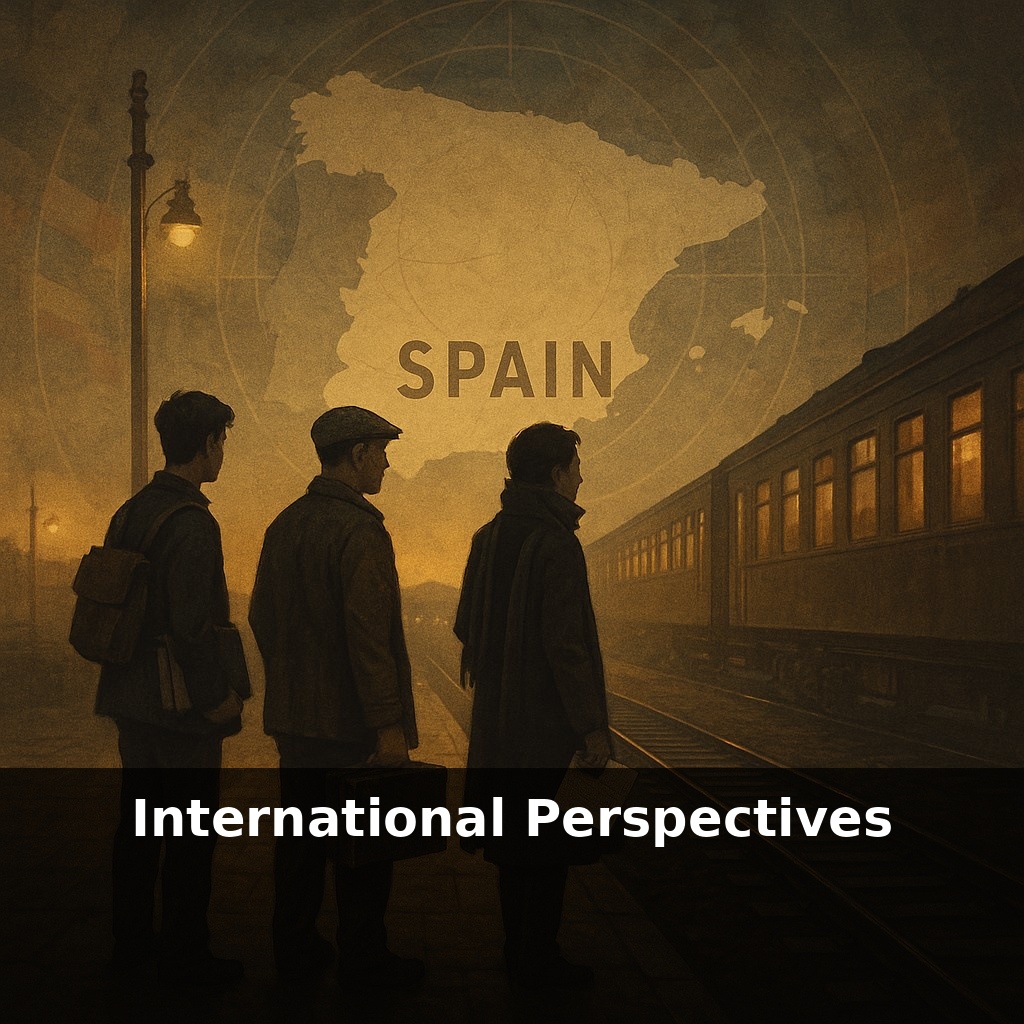
A civil war in one country draws volunteers from over fifty others—students, poets, factory workers—risking their lives for a place they’ve never seen. Why? In this episode, we step onto the front lines of a war that belonged to the whole world, not just Spain.
Nearly 40,000 foreign volunteers crossed borders to fight in Spain, but they weren’t the only outsiders shaping the conflict. While idealists wrote farewell letters and boarded night trains, distant cabinets and corporate boardrooms were quietly redrawing the odds. Nazi Germany’s pilots tested bombing strategies; Fascist Italy shipped men and machines; the Soviet Union traded weapons for Spanish gold; Britain and France balanced fear of fascism against fear of another European catastrophe. On paper, many powers swore off taking sides. In practice, their decisions stacked up like loaded dice on one end of the table. In this episode, we’ll trace how distant capitals, secret deals, and public “neutrality” turned a domestic struggle into a preview of the global showdown to come.
Spanish leaders weren’t just battling over Madrid or Barcelona; they were also being weighed, priced, and measured in distant capitals. Diplomats watched railway lines, harbors, and radio messages the way traders track stock charts, hunting for clues about who was gaining the upper hand. Each shipment of fuel, each “volunteer” air squadron, shifted expectations about the future map of Europe. Meanwhile, ordinary people abroad argued in cafés, union halls, and universities, treating Spanish headlines like a weather report warning of storms moving steadily closer.
Those “distant capitals” didn’t all move at once; they slipped in, tested the temperature, then waded deeper. Berlin acted fastest. Even before formal agreements, German officers quietly arranged airlifts for Franco’s stranded troops in Morocco, turning a risky sea crossing into an air bridge. Soon after, the Condor Legion arrived—not just as extra planes, but as a self-contained package: pilots, mechanics, radios, even specialists to study wreckage and refine tactics. Every mission doubled as live-fire training and a data-collection exercise.
Rome followed with its own mix of caution and swagger. Italian “volunteers” landed in growing numbers, their status carefully worded so Mussolini could still pretend this was a limited bet, not a full commitment. Italian ships shadowed key sea routes, sometimes “inspecting” cargo that seemed a little too friendly to Madrid. Their goal wasn’t merely to help an ally, but to project influence across the western Mediterranean, watching how far they could push before London or Paris reacted.
The Soviet response looked different from the outside—merchant ships docking at odd hours, crates labeled as machinery, advisers traveling under aliases. Inside Republican zones, Soviet tanks and aircraft arrived bundled with political conditions: preferred officers, approved training methods, and a wary eye on any left-wing faction that didn’t follow Moscow’s line. Aid was lifeline and leash at once.
Across the Channel, decision-making felt slower but no less consequential. British and French leaders spent late nights drafting rules that sounded neutral yet had lopsided effects. A ban on “all arms deliveries” hit the side that lacked friendly borders and major suppliers hardest. Like changing the rules of a game mid-match while insisting both teams are treated equally, it preserved appearances while altering outcomes.
Meanwhile, private actors threaded their own paths through these constraints. Oil tankers rerouted to discreet ports, banks extended quiet credit, and intelligence services used commercial deals as cover to plant agents, test ciphers, and probe rival networks. For them, Spain doubled as a battlefield and a laboratory in the emerging contest over information and influence.
Foreign powers didn’t just choose sides; they modeled different futures for Europe. Think of Spain as a prototype arena where each outside player ran its own “beta test.” One especially stark example: while some governments blocked official arms sales, commercial contracts found side doors. Oil, trucks, and machine tools slipped through legal gray zones, reshaping combat capacity without a single formal alliance being signed.
Inside Republican territory, Soviet-style political police methods and party discipline competed with more plural, grassroots experiments in Catalonia and Aragon. Foreign advisers watched which model held together longest under pressure. On the other side, military observers quietly noted how quickly authoritarian command structures could turn outside matériel into coordinated offensives.
For smaller states—from Scandinavia to Latin America—Spain functioned like an early-warning system. Embassy cables dissected each new policy from London, Rome, Berlin, and Moscow, testing one question: if a crisis reaches us, whose playbook will we be forced to live under—and whose rules will shape our survival options next time?
Spain also became an early arena for shaping opinion abroad: censored dispatches, staged atrocity stories, and rival newsreels fought for space in foreign cinemas and newspapers. Today’s hashtag campaigns and satellite leaks echo that scramble to fix a narrative before facts settle. As new archives surface, they won’t just adjust numbers; they’ll test how resilient our stories are when fresh evidence quietly moves the goalposts.
Spanish skies became crowded not just with planes but with clashing agendas, like overlapping radio stations on one frequency. Each outside power left behind blueprints—doctrines, alliances, even legal loopholes—that outlived the fighting itself. Your challenge this week: spot a current conflict shaped less by bullets than by the rules outsiders quietly write.