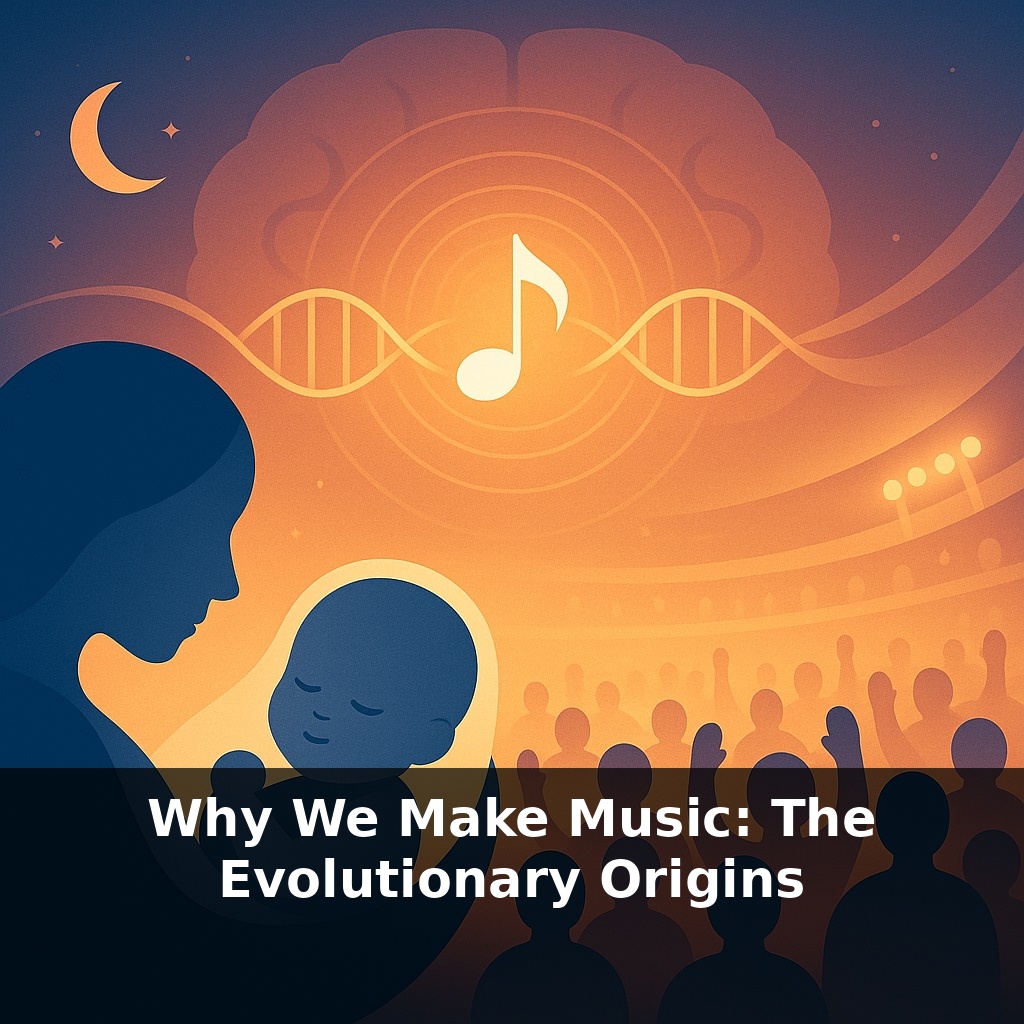
Why We Make Music: The Evolutionary Origins
📝 Transcript
A baby, before it can walk or talk, will move in rhythm and calm down to a lullaby. Now jump to a crowded stadium, thousands chanting the same melody. Same species, same brain, same strange urge to sync in sound. So here’s the puzzle: why did evolution keep this useless habit?
Here’s the strange part: if music really were “useless,” nature had millions of years to delete it. Yet across continents, climates, and cultures, people who never met still sing to their babies, drum at ceremonies, and move their bodies to repeating beats. No one had to invent that from scratch in each place, the way we invented writing or the smartphone. And our brains don’t treat music as background noise; they light up reward circuits, motor areas, and social networks all at once, as if a song were part dessert, part roadmap, part group handshake. That suggests music isn’t an evolutionary typo—it’s more like a hidden operating system running under our social lives, quietly shaping which groups hold together, which leaders we trust, and even who we fall in love with. The real question becomes: what, exactly, was music doing for our ancestors that was so valuable it had to stay?
To answer that, we zoom out from the concert hall and into deep time. Archaeologists have dug up bone flutes older than most riverside cities, evidence that structured sound mattered long before agriculture or writing. Anthropologists surveying hundreds of societies find songs woven into births, farewells, hunts, healing rites, and love stories, not parked off in a “fine arts” corner. And developmental studies show that even tiny infants lean toward certain intervals and pulses, as if their ears arrive pre-tuned. So we’re not asking why people *like* music; we’re asking why our species is built to expect it at all.
When anthropologists reconstruct early Homo life, one pattern keeps appearing: survival favored groups that could coordinate quickly and trust deeply. Music fits that pressure set almost suspiciously well.
Start with danger. A scattered camp facing predators or rival bands needs everyone alert, aligned, and moving as one. Rhythm is perfect for that. Pulses traveling through air reach many bodies at once, even in low visibility, and can shape how fast people move, how long they persist, and when they surge or stop. A chant or drum pattern can act like a shared timer—no vocabulary needed. In small foraging groups without written plans or clocks, this kind of “felt schedule” would have been a powerful advantage.
Then think about quieter, slower crises: grief, conflict, fatigue. Group living is emotionally volatile. Songs at funerals, laments after loss, or repetitive work chants during hard labor don’t just decorate those moments; they smooth them. When voices stack in harmony, individuals literally have to listen to one another’s timing and pitch. That enforced mutual adjustment can cool anger, reframe pain, and bring out empathy before words are available or acceptable.
There’s also the matter of who got chosen, and for what. To produce steady rhythm, hold a melody, or improvise variations under pressure, you need fine motor control, respiratory endurance, and a brain that can predict patterns and adapt when they shift. Those are not trivial traits in harsh environments. A skilled singer or drummer might implicitly advertise health, coordination, and composure—qualities desirable in hunters, caretakers, and partners long before anyone talked about “talent.”
Crucially, the machinery doing this work wasn’t built from scratch. Circuits that once helped track footsteps in the dark or decode vocal tone for threat versus comfort could be re-purposed to track tempo and tune. Systems that rewarded cooperation with tiny biochemical “bonuses” could be amplified by activities that synchronize breathing, heart rate, and movement. Over generations, groups that stumbled into more elaborate rhythmic and melodic practices would have reaped more of those bonuses—staying together a bit longer, defending more effectively, sharing more generously, and raising more children who, in turn, were oddly ready to move to a beat.
A hunter-gatherer band circling a fire is not just “entertaining itself.” The same pulse that keeps feet stamping also lets dozens of bodies negotiate space without collision, like a crowded kitchen staff moving in time around open flames and knives. Over hours, shared tempo means fewer accidents, smoother handoffs of tools, and an easier read on who tires first or recovers fastest. In some Arctic groups, drum-songs doubled as a justice system: rivals “sang out” disputes, trading verses until laughter or consensus dissolved the threat of a violent split. Elsewhere, shamans used repetitive melodies to guide breathing and attention, shaping perception long before anyone named “trance states.” Even in recent history, armies have marched to drums not just for morale but to standardize step length and speed across hundreds of legs. Strip away the uniforms and microphones, and you’re left with the same ancient trick: organized vibration as a low-cost way to sense, sort, and steer the collective body.
Having explored music's influence on past social structures, we can now consider how its deep roots hint at future tools we're only starting to design. Rhythmic group therapy could become standard in clinics, not as background but as treatment—like a carefully tuned exoskeleton for fragile social skills. AI composers, trained on physiology as much as style, might craft scores that calm isolated astronauts or energize remote teams. And field-recorded village songs could guide engineers, the way old maps guide city planners, revealing how soundscapes keep cultures resilient under stress.
If music is ancient social tech, the next step is learning to use it on purpose. Film scores already steer billions of hearts like a remote control, and protest chants can flip a nervous crowd into a single, steady voice. Your challenge this week: notice when a song quietly changes what risks you’ll take—or what truths you’re suddenly brave enough to say.
From this course
The Story of Music: How Sound Became Art
8 episodesUnlock all episodes
Full access to 8 episodes and everything on OwlUp.
Subscribe — $1.99/monthLess than a coffee ☕ · Cancel anytime