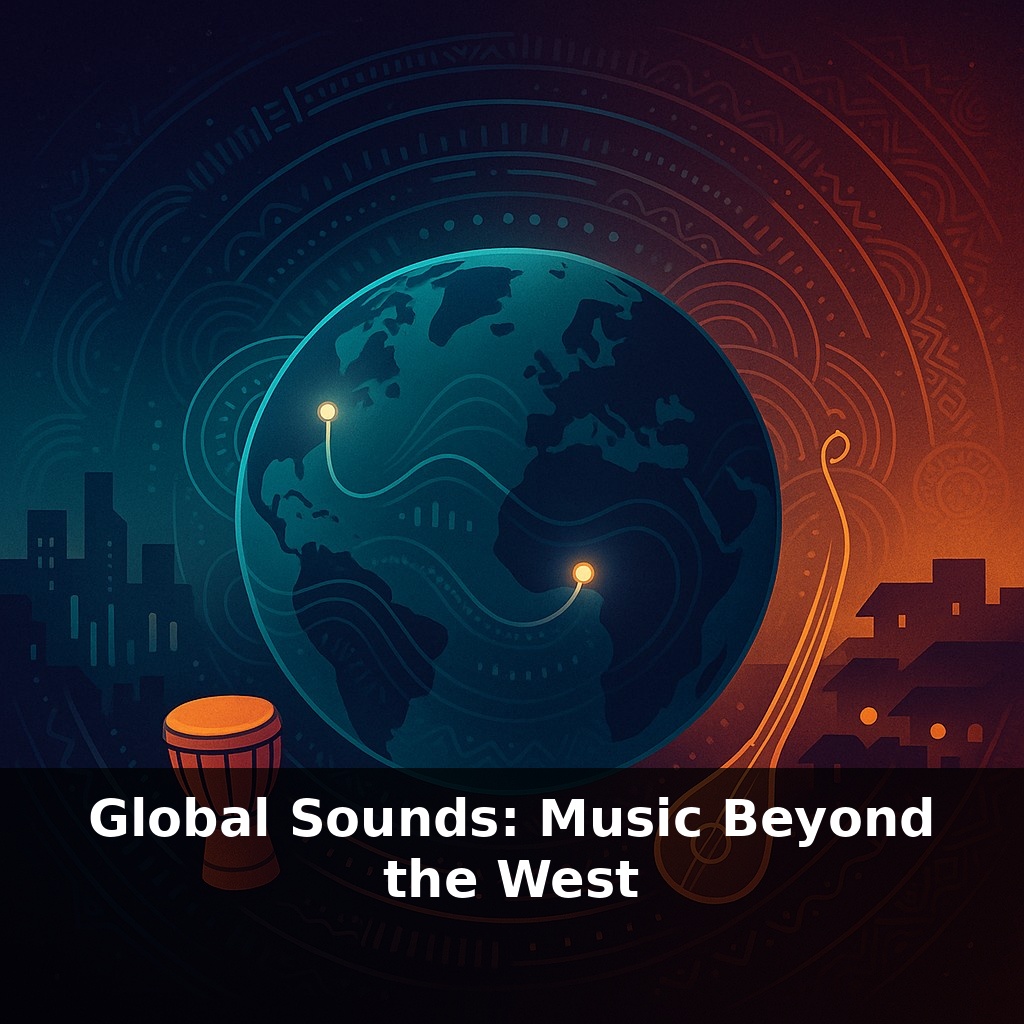
From a bustling London club scene to the vibrant streets of Lagos, music transcends borders, yet it's the deeply rooted ancient rhythms and scales that weave an invisible thread through these diverse sounds. The influence of long-standing traditions is more potent than ever, as they shape the global soundscape we hear today.tions.
Listen closely to today’s charts and you’ll hear it: drum patterns traced back to West African ceremonies, melodic turns shaped by centuries of Indian raga practice, vocal inflections that carry echoes of griots and qawwals. A Nigerian pop hit might jump effortlessly into a UK playlist, the way a familiar spice slips into a new recipe; it feels fresh, but also strangely at home. Streaming platforms, film industries, and global tours haven’t just widened audiences—they’ve turned local traditions into shared creative tools. To understand “global pop” now, you have to follow where those tools came from, and how artists are quietly rewriting who gets to define the sound of “mainstream.”
In 2022, most of the growth in global music listening came from outside North America and Europe—a quiet power shift hiding in the charts. That growth isn’t just about more listeners; it’s about different musical logics becoming impossible to ignore. West African pentatonic shapes seep through gospel choirs and guitar solos; North Indian ragas guide film composers who think in moods and hours, not just keys and chords. When a Yoruba talking drum can echo spoken language across villages, or Afrobeats streams jump 550% in five years, you’re not just hearing hits—you’re watching the map of influence redraw itself.
Western classical theory is built on harmony and chord progressions; much of the world organizes sound around something else entirely. In many African traditions, it’s about interlocking parts: one player holds a repeated pattern, another nudges against it, a singer floats above. No single strand is “the song”—the hook is the way they fit. That’s part of why these structures travel so well into funk, hip-hop, and Afrobeats: producers can mute, loop, or sample any fragment and it still feels alive.
In North India, the core unit isn’t a chord but a raga–tala pairing: a melodic universe set against a repeating cycle of beats. Film composers raised on this system often think in narrative arcs more than “verse–chorus.” A piece might begin almost motionless, then curl gradually into tension, then bloom into a refrain that only appears once. When those writers work in pop, they sneak in long, winding melodic lines or key changes that feel more like plot twists than harmonic exercises.
Latin American styles add another layer to this global toolkit. Samba schools in Brazil function like neighborhood laboratories: thousands of people refining groove and arrangement for a single parade. In Colombia’s cumbia, a European-derived accordion sits beside African-rooted drums and Indigenous flutes—a centuries-old lesson in forced globalization turning into a new identity. Reggaeton later lifts Jamaican dancehall’s rhythmic engine, routes it through Panama and Puerto Rico, and ends up dominating playlists from Madrid to Miami.
Technology accelerates the blending. A kid in Seoul can drag a Moroccan gnawa loop into a DAW, stack it under a trap hi-hat pattern, and top it with a melody learned from K‑pop. None of those ingredients lose their origin; they become traceable layers inside a new hybrid. Like a well-designed app built from open-source libraries, modern hits often embed code written in dozens of places, by people who never meet, but still collaborate through shared patterns.
What’s shifting now is power. For decades, major labels treated non-Western catalogs as niche “world music” side shelves. Today, Nigerian and Indian stars negotiate from the center, not the margins: headlining festivals, dictating terms for samples, and pulling Western artists into their structures instead of merely decorating Western songs with “ethnic” color.
A straightforward way to hear this shift is to follow a single song across borders. Take a Nigerian track that tops local charts, then gets a remix with a US rapper, then appears in a Brazilian DJ’s festival set. Each version keeps a recognizable core—tempo, hook, language—and swaps other elements to fit new contexts. Or look at Bollywood producers hiring Turkish, Arabic, or Balkan session players for film scores, not as exotic decoration but as structural voices: a Turkish clarinet line might carry the central theme instead of sitting in the background. In K‑pop, teams routinely bring in Kenyan or Ghanaian choreographers so that stage movement reflects the same cross‑border mix as the audio. Meanwhile, independent artists sample old cumbia records, vintage Thai pop, or obscure devotional recordings, then clear rights directly with families or tiny labels. The result isn’t a single “global sound” but a web of specific lineages, each leaving fingerprints on how hits are written, staged, and monetized.
As archives go online and AI learns from everything at once, tomorrow’s “folk song” might start as a bedroom file, then quietly seep into games, ads, and sample packs. Copyright and credit will matter more: who gets paid when a singer’s village lullaby becomes a blockbuster hook? Your challenge this week: trace one sound you love back two layers—remix, sample, influence—and notice where the money and recognition actually stop.
As new tools slice and shuffle audio like a chef dicing ingredients, ideas slip borders faster than passports can. Tomorrow’s hit might start as a festival chant, pass through a beatmaker’s laptop, then resurface in a film trailer. The puzzle isn’t whether cultures will keep mixing—they will—but how we’ll honor the cooks as much as the finished dish.
Before next week, ask yourself: What’s one non‑Western genre or artist mentioned in the episode (like Afrobeats, qawwali, or Japanese city pop) that genuinely intrigued me, and how can I carve out 20 minutes today to listen to a short playlist or album from that scene with full attention—no multitasking? When I notice a rhythm, instrument, or vocal style that feels “unusual” to my ears, can I pause and ask myself whether I’m judging it by Western pop standards, and what shifts if I instead treat it as the norm and Western music as the “different” one? After listening, what’s one concrete step I can take to weave these global sounds into my daily life this week—maybe swapping one commute playlist for music from a specific region discussed, or sharing a track from the episode with a friend and talking about what surprised us?