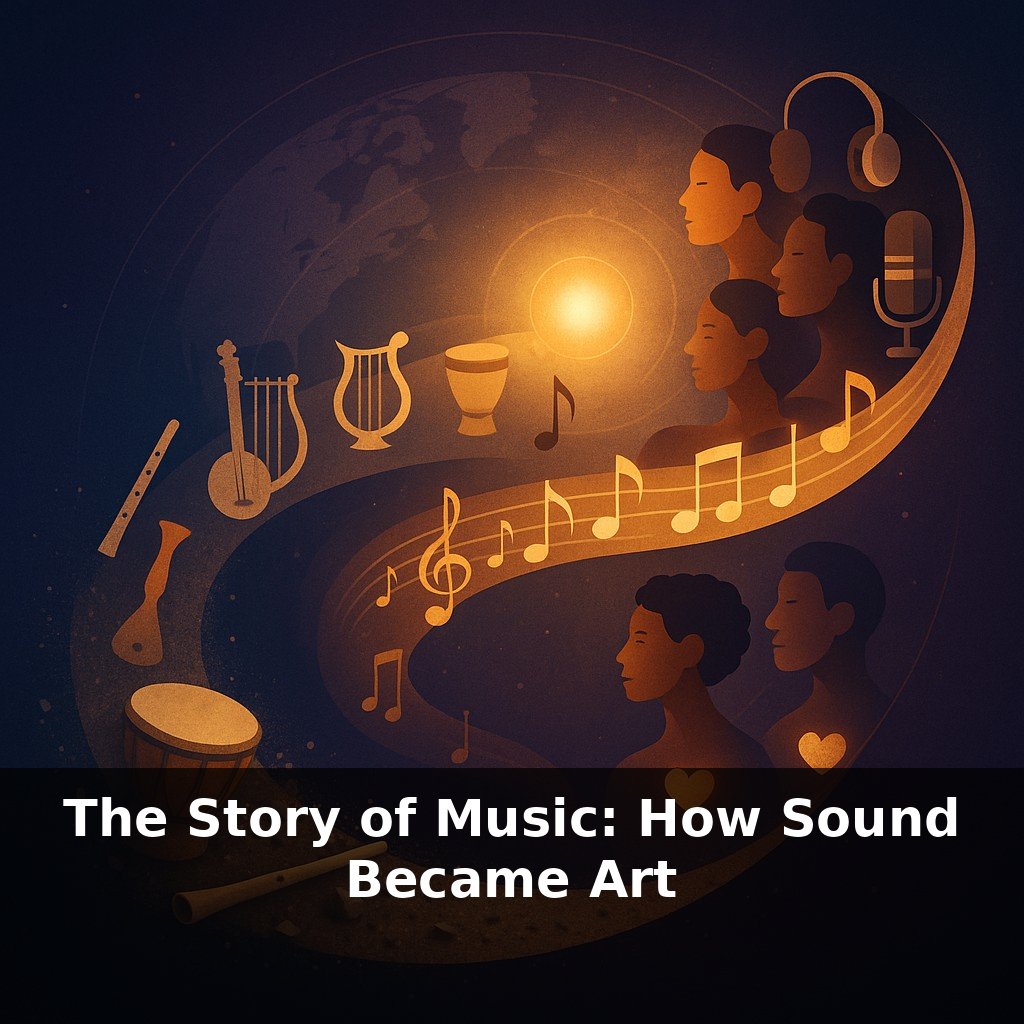
A song written over three thousand years ago is still playable today. Not from a recording, but from clay. Tonight, we drop into a torchlit courtyard, where singers chant from wet tablets, flutes echo in stone, and music is not entertainment—it’s a spell, a map, a memory.
That clay song isn’t a lone miracle; it sits on a whole buried playlist. Across continents and millennia, our ancestors left clues that let us not only *guess* at their music, but sometimes *hear* it with startling precision. Archaeologists dig up bone flutes; acousticians test ancient theaters the way sound engineers tune concert halls; programmers feed cuneiform formulas into software to resurrect long‑silent hymns.
Think of each artifact like a separate audio track in a modern mixing app—one track from a tomb, one from a ruined temple, one from a windswept cave. On their own, they’re thin and incomplete. Layered together, they begin to form something like a song.
In this episode, we’ll listen for three things: how ancient instruments were tuned, how spaces were built to shape sound, and how early notation turned fleeting performance into something that could survive fire, flood, and oblivion.
Those tracks don’t all come from the same culture—or even the same kind of place. Some are dug out of royal graves, packed beside weapons and jewelry, as if a person’s playlist mattered as much as their crown. Others are scratched into everyday objects: a drinking song on a shard of pottery, a tuning hint squeezed into the margin of a ritual text. And then there are the instruments themselves, worn smooth where hands gripped them thousands of times. Taken together, they hint at a world where sound marked status, stitched communities, and timed everything from work to war.
Walk into the deep past by ear, and three kinds of evidence start talking at once.
First, there are the instruments that still *work*. When archaeologists found the Hohle Fels flute in a German cave, they didn’t just admire it as an artifact; they treated it like a slightly broken piece of gear. Which holes? What fingerings? What pitch range? When researchers finally played it, they heard steps that fell close to the same do‑re‑mi ladder you’d recognize from a children’s song. That doesn’t mean Ice Age bands were jamming to major scales the way we do, but it suggests that carving “nice‑sounding” intervals into bone pushes you toward patterns humans keep rediscovering.
Across the world and much later in time, Neolithic makers at Jiahu drilled holes in crane bones so carefully that CT scans and measurements show a deliberate spacing matching something like our modern major third. That precision implies repeatability: not a toy, not a noisemaker, but an instrument built to hit the same relationships between notes again and again—exactly what you need for shared songs, calls, or ceremonies.
Then there are instruments that are more like machines than flutes. King Tutankhamun’s silver trumpet is basically a controlled noise cannon: when acousticians tested it, they found three clear harmonic pitches and little else, a design almost perfect for carrying simple patterns over chaos—ideal for signaling troops who can’t see each other through dust and heat.
Next comes the problem of *scores without sound*. The Hurrian Hymn No. 6 from Ugarit survives not as a melody line but as cuneiform instructions about strings, intervals, and tuning. Modern scholars argue over the exact reading—shift one interval and the whole tune tilts in a new emotional direction—but they agree on this: by the mid‑second millennium BCE, someone was already formalizing “do this, not that” rules for composing and teaching.
Ancient Greek theorists pushed that impulse further, treating scales and modes almost like software libraries: choose this mode for lament, that one for battle, another for drinking. Their theaters’ limestone seats, which scatter and clarify sound, show that at least some builders were thinking like acoustic engineers, linking physical design to psychological impact. The result was a world where melody, math, and architecture were all part of the same experiment: how far can you sculpt human feeling with organized vibration?
Ancient musicologists sometimes work more like field recorders than historians. They’ll bring reconstructions of Jiahu‑style flutes or Mesopotamian lyres into modern landscapes—open fields, courtyards, small stone rooms—and test which settings make particular patterns *useful*. A rising three‑note call that vanishes in the city can cut clearly across a forest at dusk. That suggests why certain motifs might have evolved: not just because they’re pretty, but because they travel.
To probe emotional impact, researchers run low‑tech experiments. Play different reconstructions of Hurrian melodies to people with no background in ancient history, then ask them to tag each one with a feeling or imagined scene. Even allowing for cultural bias, clusters emerge: some tunings evoke “procession,” others “lullaby,” hinting that specific interval choices once guided behavior.
In a way, these tests are like beta‑testing an old app on new hardware. The “code” is ancient, but we’re running it on contemporary ears and spaces to see which musical functions still compile—and which were tuned to worlds that no longer exist.
By 2030, decoding old sound worlds may feel less like scholarship and more like time‑travel prototyping. AI models will sift patterns in broken notations the way finance algorithms hunt signals in noisy markets, proposing “probable” versions of lost tunes. 3‑D printed instruments and VR amphitheaters will let students *debug* those reconstructions in real time, tweaking tunings and spaces. That loop could push schools to treat music, coding, and archaeology as one connected creative discipline.
So the next time you press play, treat it as a duet across millennia: your earbuds, their echoes. Modern hooks, drops, and loops still lean on intervals, patterns, and spaces our ancestors tested by firelight and stone. Your challenge this week: notice one musical moment that feels “ancient” in its pulse, and ask what older ear it might quietly be pleasing.