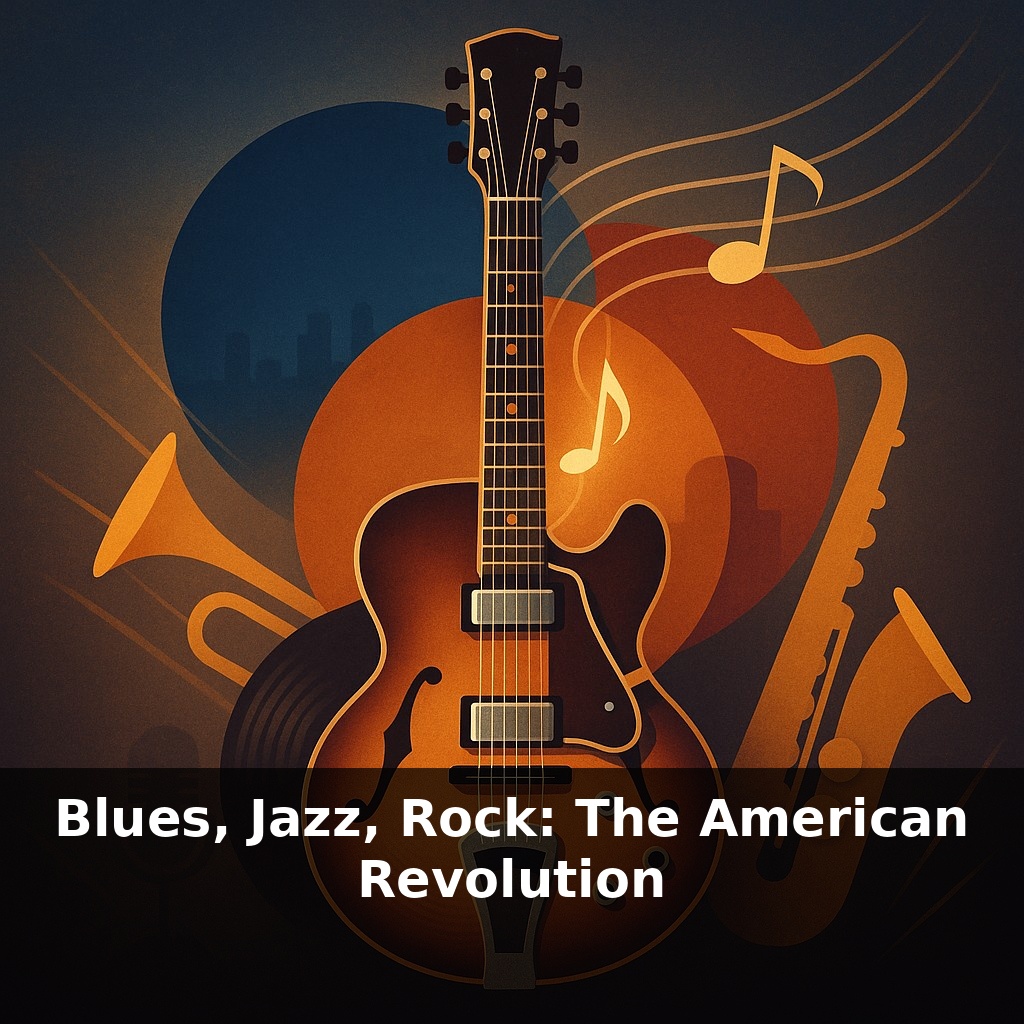
A single blues song recorded in the 1930s quietly rewired the brains of rock’s greatest guitar heroes. In smoky bars, cramped studios, and teenage garages, three sounds—blues, jazz, and rock—kept colliding, breaking rules, and accidentally inventing modern music.
By the time Robert Johnson, Miles Davis, and Chuck Berry were on record sleeves, something bigger than any one artist was underway: American music was quietly exporting a new way of thinking. It wasn’t just fresh chords or cooler solos—it was a shift in who got to speak, how loudly, and on whose terms. Songs became battlefields where race, class, and youth identity crashed into one another, then pressed onto vinyl.
Follow the money and you see the impact: a U.S. industry worth billions, with older rock tracks still pulling in a huge slice of streaming plays. Follow the family tree and it’s just as dramatic—hip‑hop’s beats, indie’s guitar textures, even pop’s vocal melismas trace back to these earlier shocks.
Think of this era like a recording studio control room: every new track pushes a fader—freedom, technology, rebellion—a little higher, until the whole mix of global culture sounds different.
Before these sounds filled stadiums or dominated playlists, they lived in cramped church halls, front porches, and segregated clubs—spaces where amplification meant a louder feeling, not a bigger speaker. Early recordings were made on cheap gear, in single takes, often by artists paid less than the cost of a modern concert ticket. Yet those rough cuts became source code for future stars. A 78‑rpm disc worn down on a juke joint turntable might, decades later, be sampled, studied, or stolen by a producer on a laptop, the way a startup quietly reverse‑engineers an industry giant’s secret.
Robert Johnson stepped into a San Antonio hotel room in 1936, played into a corner of the makeshift studio, and walked out with “Cross Road Blues.” The record barely moved the needle then. Decades later, British teenagers—Eric Clapton, Keith Richards, Jimmy Page—would slow that track down like detectives, decoding each bent note and turned phrase. What sounded to Johnson’s neighbors like a local story became, in their hands, a blueprint for arena‑sized riffs. This is how these genres travel: not through official channels, but through obsession, imitation, and tiny acts of theft that feel more like devotion.
Something similar happened with Miles Davis’s *Kind of Blue*. It wasn’t marketed as a manifesto; it was a session with a loosely sketched plan. But players today still treat it like a university course in sound: how to leave space, how to trust a single scale over a forest of chords, how to solo without showing off. Every time a film soundtrack leans on its cool, suspended mood, it’s cashing in on ideas first tested in that room.
And when Chuck Berry recorded “Maybellene,” he wasn’t trying to found a new genre. He was arguing with country and R&B at the same time—revving up the rhythm, slicing through with that ringing guitar, writing lyrics that turned a car chase into teenage scripture. DJs noticed. So did kids who heard their own speed and nerves in the track and decided, often without permission, to form bands.
Women were wired into this transformation from the start. Sister Rosetta Tharpe was touring with an electric guitar in the 1940s, blasting gospel through overdriven amplifiers long before rock solos were a thing to “invent.” Watch her on surviving TV clips: suit, stomp, grin, and a right hand that could out‑pick half the later canon. History tried to file her under “influence”; players hear her and realize she’s also “origin.”
Think of the business around all this like a volatile startup portfolio: most recordings stayed small, but a few—Johnson’s sides, *Kind of Blue*, “Maybellene”—became compound interest machines, generating not just revenue, but whole careers and subcultures built on their risk.
Think of this evolution like a long‑term investment strategy: early artists deposit tiny musical “assets” that later generations leverage, remix, and compound into whole new sounds. When James Brown tightens the groove in the 1960s, producers decades later slice those drum breaks into the backbone of hip‑hop. When indie bands chase lo‑fi textures, they’re not just being retro; they’re choosing the sonic equivalent of hand‑drawn animation over 3D CGI—imperfection as proof of touch.
Real-world consequences follow these aesthetic choices. Lawsuits over sampling forced courts to decide whether a two‑second horn stab is property or raw material. Streaming platforms quietly tilt listening habits: algorithmic playlists slip a 1960s deep cut beside a 2020 bedroom track, training ears to hear lineage without ever saying the word “history.” And in classrooms and community studios, teens load cracked software, drag a vintage drum loop under their own lyrics, and, with one export click, extend a creative conversation that started long before they were born.
AI tools now crawl archives the way crate‑diggers once combed flea markets, but training on old tracks is more like feeding a remix engine than teaching a cover band. Expect legal fights over who owns a “feel,” not just a file. Spatial audio and VR rigs will turn headphones into moving stages, letting you “sit” between solos or beside the drum kit. And as more countries digitize their local scenes, riffs will travel like memes—sped up, flipped, and replied to in entirely new accents.
So where does that leave you, listening now? Every playlist is a tiny time machine, stitching those past experiments into your commute, your workout, your late‑night scrolling. Your challenge this week: follow one song backward. Trace its samples, its cover versions, its inspirations. Watch how fast a “new” track turns into a century‑long conversation.