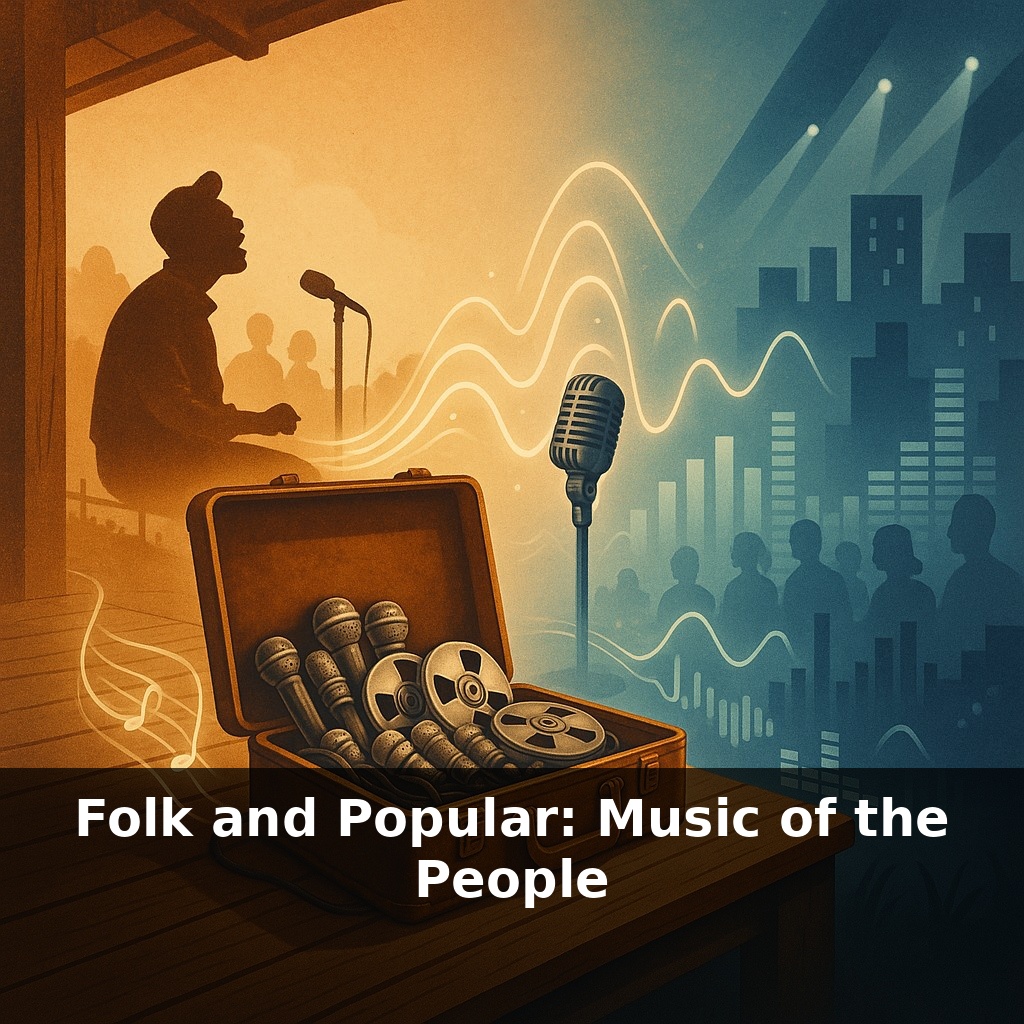
A man with a suitcase of microphones once crisscrossed America, recording strangers on porches and prison yards. Decades later, their rough voices echo inside glossy pop hits. How did local work songs and front-porch ballads quietly become the backbone of global music?
Alan Lomax’s tape machine wasn’t just preserving sound; it was catching songs mid‑evolution. Each recording froze a community moment that, in real life, kept mutating—new verses for new problems, fresh rhythms for shifting work, joy, and protest. That’s the secret thread running from an unamplified voice in a field to a charting track in your playlist: music as a living commentary system.
When microphones, radios, and record labels entered the story, they didn’t erase that function; they amplified and edited it. The same way a home-cooked dish becomes narrower when bottled for supermarket shelves, songs that once flexed with each singer were trimmed, polished, and standardized for mass release. Yet traces of that flexibility survive in covers, remixes, and samples—tiny rebellions where folk habits sneak back into popular music’s polished surface.
Suddenly, creativity had an audience it would never meet. When Lomax logged thousands of performances for the Library of Congress, he wasn’t just archiving; he was feeding a future feedback loop. Those once-local sounds could now leap from archives into dorm rooms, studios, and protest marches half a century later. That’s how a folk refrain might surface in a Bob Dylan lyric, then reappear inside a hip‑hop hook via sampling. As streaming platforms rise and studio tools fit in a backpack, the distance between a kitchen-table song and a global release keeps shrinking—and the “people” in “music of the people” gets drastically bigger.
Numbers can be misleading, but they tell a story here. When Alan Lomax captured those 5,000 performances, he wasn’t just filling shelves; he was massively expanding the raw material future musicians could draw from. Each recording became a kind of “seed” that could sprout again decades later in a different genre, city, or language.
You can hear that regrowth in the way certain songs refuse to stay put. Take protest material: a spiritual sung in a 1940s work camp might resurface in the 1960s as a civil‑rights anthem, then again in the 2000s as a sampled hook under a verse about police violence. Different tempos, different audiences, same core grievance, updated for the moment. Even the fact that “Blowin’ in the Wind” was rapidly covered by dozens of artists isn’t just trivia—it shows how quickly a song can become communal property again once it speaks to something widely felt.
What changes under a commercial spotlight is who gets heard first. Folk expression used to spread outward in small circles: neighbors, kin, local rituals. Once radio charts and later playlists become the main filters, a narrower slice of those voices breaks through. Yet the social function doesn’t vanish. Punk bands in tiny clubs, mixtape‑era rappers, and today’s bedroom producers all use mass‑market tools to do something recognizably “folk”: narrate daily life from below, complain upward, test new identities in sound.
The economics matter. A global market in the tens of billions, dominated by streaming, makes it possible for a song written in a village, favela, or housing estate to register on the same platforms as major-label releases. But it also pressures tracks toward certain lengths, structures, and moods that algorithms favor. The tension between these forces—local specific voices and global standardized formats—is where much of modern musical innovation happens.
In that sense, folk and pop aren’t opposites. They interlock: one hyper‑local and constantly mutating, the other engineered for reach, both feeding each other ideas, stories, and sounds in an ongoing exchange.
A drill rapper in London flips a centuries‑old sea shanty melody into a hook about gig work and visa stress. In Seoul, a producer threads a pansori‑inspired vocal line through glossy K‑pop, keeping the melismatic twists but dropping them over 808s. A cumbia band in Los Angeles sneaks regional brass riffs into songs built for dance‑club subwoofers, then watches them jump to festival stages in Europe via fan‑shot clips.
One vivid pattern: verses carry hyper‑specific detail (street names, slang, local foods), while choruses flatten into phrases millions can shout along to. That split is where “of the people” meets “for the many.” In Brazil’s funk carioca, for instance, neighborhood references sit on top of beat templates traded online like open‑source code. The same happens when Indigenous artists on TikTok stitch traditional chants into 15‑second hooks, then expand them into fuller tracks once they see which fragments resonate beyond their own circles.
Folk melodies that once needed a village square now only need a signal bar. An endangered lullaby can be recorded on a phone, dropped into an AI-assisted session, and reborn as a beat that travels farther than its original language. But as tools sharpen, so do dilemmas: who signs off when a great‑grandmother’s song becomes a festival hit? Future musicians may need roles closer to archivist and lawyer, tracing lineages like genealogists to keep shared memory from becoming pure commodity.
In the next decade, the “people” behind folk‑to‑pop currents may be small online swarms instead of single stars—Discord servers finishing each other’s verses, beatmakers trading stems like gardeners swapping cuttings. Your playlist becomes a voting booth: each replay funding which stories get amplified, which unheard accents step up to the global mic.
Before next week, ask yourself: Where in my daily listening could I swap a polished pop track for a field recording, protest song, or traditional ballad that actually reflects my community or family history—and how does that swap make me feel? When I hear a chart-topping hit that borrows from folk traditions (like a sampled chant, a country riff, or a “crowd singalong” chorus), whose voices and stories are being amplified—and whose are being erased or commercialized? If someone recorded “the music of my people” in my living room tonight—our accents, jokes, lullabies, sports chants, or worship songs—what would they capture, and how does that version of “folk music” challenge what I usually think of as real or important music?