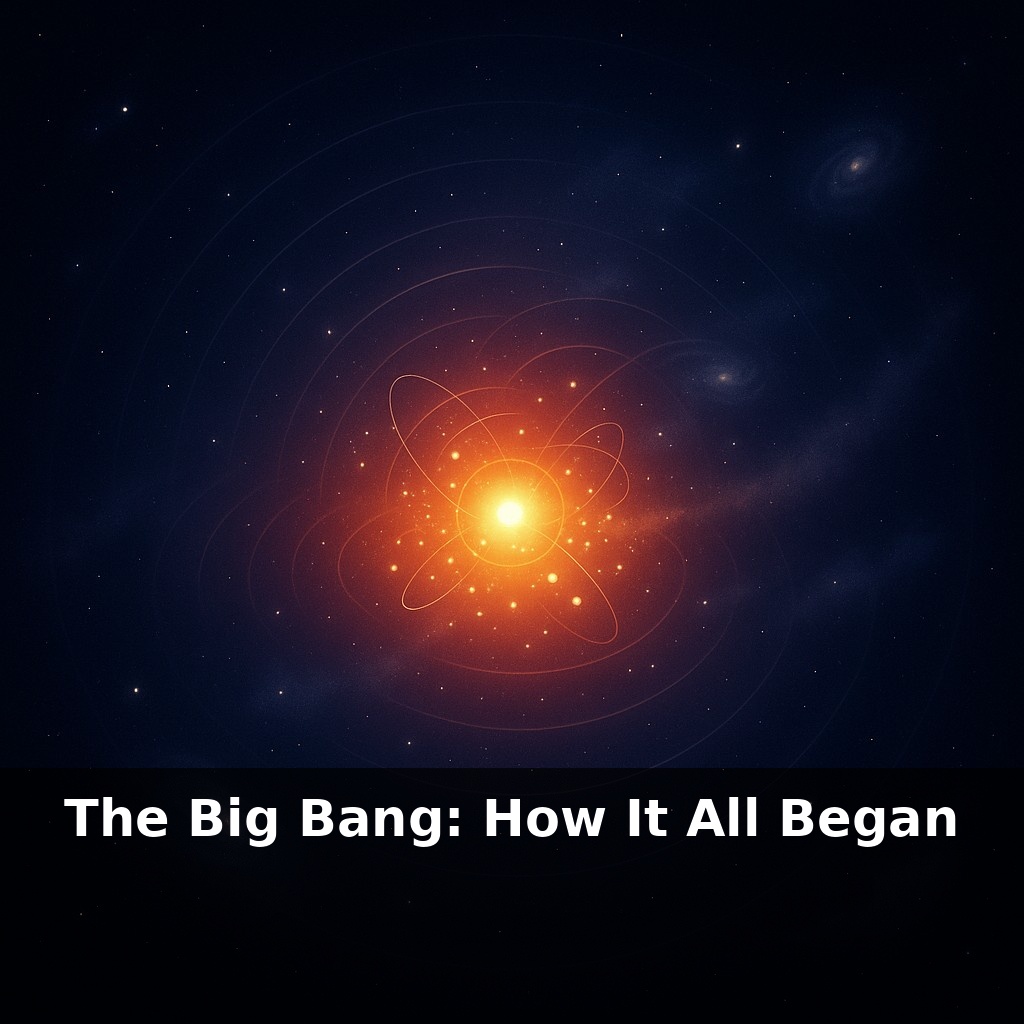
The universe used to be smaller than a grain of sand—and hotter than the core of any star. Now pause on this: every atom in your body was once part of that blinding, newborn fireball. So how did “everything” erupt from “almost nothing,” and why is it still racing outward?
Thirteen point eight billion years sounds impossibly distant, yet the story of the Big Bang is written into things you touch every day. The helium in birthday balloons? Most of it was forged in the universe’s first few minutes. The glow of your microwave oven? It operates at frequencies not so different from the faint afterglow of that first, hot moment—the cosmic microwave background, now chilled to just 2.7 degrees above absolute zero. As space has stretched, that ancient radiation has cooled and softened, like a once‑boiling soup left to sit and gradually come down to room temperature. Today, the universe looks calm and dark, but its structure, its chemistry, even its mysterious budget of dark matter and dark energy all trace back to how that early expansion unfolded.
If you could rewind cosmic history, you wouldn’t see an explosion from one point in empty space; you’d see space itself shrinking, temperature climbing, matter and radiation blending into an opaque, seething fluid. Time, distance, even the idea of “before” start to break down as we approach that first fraction of a second. Modern cosmology doesn’t just guess at this story—it reconstructs it from clues: faint temperature ripples across the sky, the way galaxies cluster, even the exact mix of light elements left behind by the universe’s brief, intense early “chemistry experiment.”
In that early, hot phase, the universe was astonishingly simple. There were no stars, no planets, not even atoms as we know them—just an almost uniform mix of energy and the most basic particles. Yet tiny variations in density—differences of only about one part in 100,000—were already imprinted. Those slight imbalances were enough. Over billions of years, gravity would patiently amplify them into galaxies, clusters, and vast cosmic webs.
The first major milestone came within the universe’s first three minutes. As it expanded and cooled, conditions briefly became just right for protons and neutrons to fuse into light nuclei: mostly hydrogen, some helium, and a trace of lithium. This process, called primordial nucleosynthesis, essentially set the universe’s initial “chemical recipe.” Billions of years later, astronomers can still measure those original proportions in ancient gas clouds and find that they match calculations to within a few percent. That agreement is one of the key reasons scientists are so confident in the overall picture.
Fast‑forward to roughly 380,000 years after the beginning. By then, the universe had cooled enough for electrons to settle into orbits around nuclei, forming neutral atoms. Suddenly, light that had been constantly scattered could travel freely. That radiation, stretched over eons of expansion, is what we now detect as the cosmic microwave background—our oldest direct snapshot of the cosmos.
But that snapshot doesn’t show galaxies; it shows a smooth fog with only faint mottling. The next chapter is often called the “cosmic dark ages.” There was matter, there was light streaming through space, but no luminous structures yet. Gravity quietly gathered gas into denser clumps, especially where invisible dark matter had already pooled. Eventually, in regions where the pull was strongest, clouds collapsed enough to ignite the first stars.
When those pioneers lit up—perhaps a few hundred million years in—they fundamentally changed the universe. Their ultraviolet radiation carved bubbles in the surrounding hydrogen fog, making space more transparent again. Their deaths seeded heavier elements—carbon, oxygen, iron—that later generations of stars and planets, and eventually life, would require.
Today, telescopes like JWST are pushing closer and closer to that transition era, catching galaxies whose light began its journey when the universe was less than 2% of its current age. Each new detection sharpens the timeline of how structure emerged from that initially simple, expanding fireball.
Think of the early universe as a kitchen running a very strict, one‑time recipe. In the first minutes, conditions were tuned so precisely that they “baked in” specific proportions of hydrogen, helium, and a sprinkle of lithium. Billions of years later, astronomers sample pristine gas clouds and see the same ratios, like tasting crumbs to reconstruct a long‑eaten cake.
The expansion itself shows up in another way: light from distant galaxies is stretched as space grows, shifting it toward the red. By mapping how this redshift changes with distance, teams like those behind the Sloan Digital Sky Survey have built 3D maps of millions of galaxies, revealing a foamy, web‑like structure on the largest scales.
And then there’s the faint microwave afterglow. Satellites such as COBE, WMAP, and Planck turned the whole sky into data, measuring its temperature to thousandths of a degree. From those tiny variations, they inferred the universe’s age—13.799 billion years—and even its “budget”: mostly dark energy and dark matter, with just a small fraction left for stars, planets, and us.
How it all began still shapes what’s possible now. Tiny quantum jitters in that first instant may have planted the seeds of whole superclusters—and the voids between them. Future surveys will trace those patterns like tree rings, testing whether gravity itself behaves differently across cosmic scales. If new missions spot subtle twists in ancient light, they could expose hidden particles or fields, forcing us to rewrite the opening chapter of space and time.
We may never see the very first instant, but each new telescope is like adding another lens to a growing cosmic microscope. As we probe earlier times and finer details, our origin story might shift—from a single bang to a richer prelude. Your challenge this week: follow one new space discovery and ask, “What early‑universe clue does this reveal?”