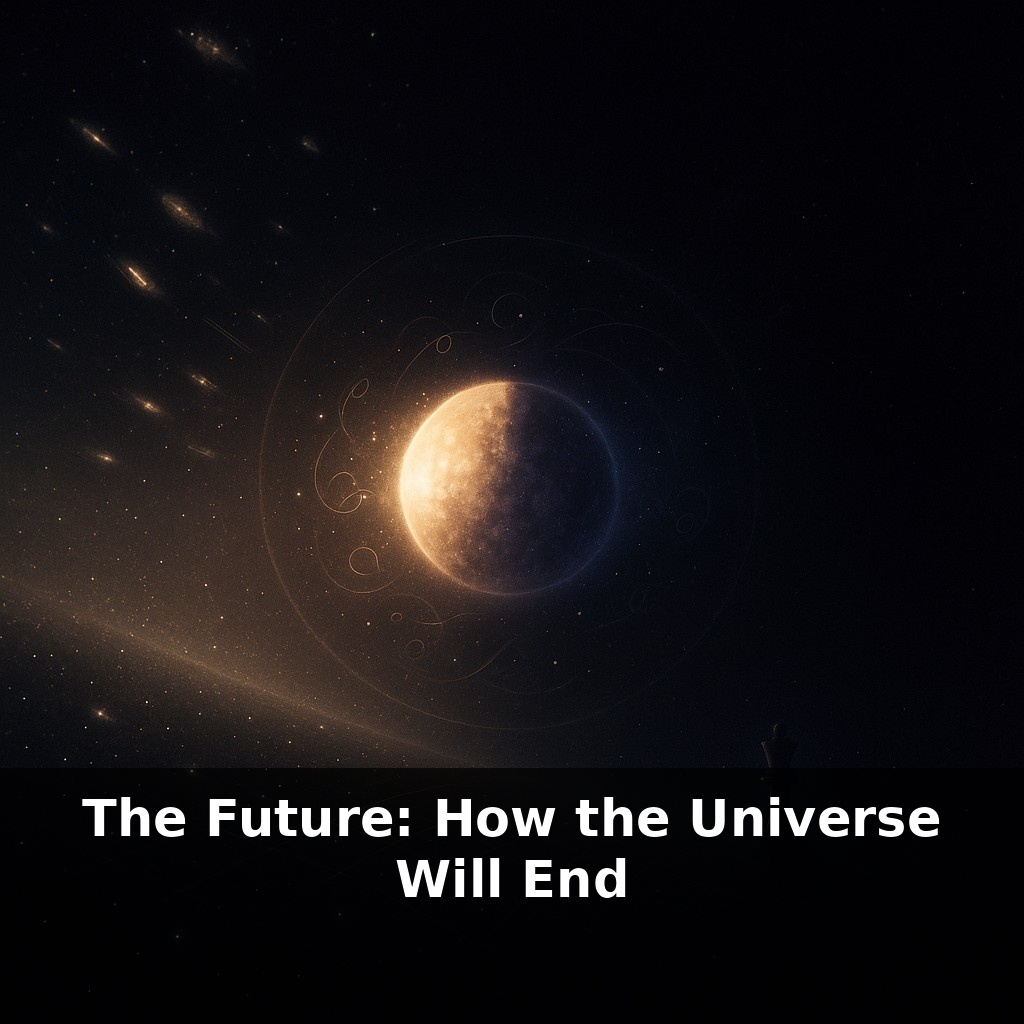
Some physicists say the universe has already lived through most of its “interesting” era. Galaxies are drifting apart faster and faster. In this episode, we drop into the far future and ask: does everything end in a freeze, a tear, or a cosmic reset button?
By the time the last bright stars burn out, the universe’s story won’t be over—just slower, darker, and much stranger. Today, we see only the opening moves of its long endgame. Tiny quantum effects that don’t matter on human timescales—like particles popping in and out of existence—start to run the show when you give them trillions of years. Gravity, which once pulled matter into vast structures, will compete with an ever-stronger push from dark energy that stretches space itself. The outcome depends on exquisite details: how fast that stretching continues, whether dark energy stays constant or mutates, and exactly how much matter is left to resist it. In this episode, we’ll track three radically different futures: a universe that thins into cold ash, one that tears itself apart, and one that turns around and collapses.
To forecast which ending we’re heading for, cosmologists treat the universe like a crime scene and the present-day cosmos as forensic evidence. They measure how fast distant objects recede, how matter clumps on the largest scales, and how faint whispers from the early cosmos were stretched and cooled. From this, they reconstruct a “cosmic budget” of matter, radiation, and the still-mysterious dark energy, then project its evolution forward. Each ingredient steers the long-term story differently, so tiny shifts in their values can flip the universe from gentle fade-out to catastrophic finale.
The first clue to the universe’s fate is how much “stuff” it actually contains. Add up all ordinary matter, dark matter, and radiation, and compare it to a special threshold called the critical density. Today, that threshold corresponds to only about 5.7 protons per cubic meter—vanishingly thin, yet still a precise dividing line. Above it, gravity could eventually halt expansion; below it, expansion wins forever. Current measurements put us extremely close to this line, but just on the side where a long-term turn‑around looks unlikely.
Next comes how fast space is currently stretching. That’s encoded in the Hubble constant, which we infer in two main ways: from the relic light of the early cosmos (Planck satellite data), and from distances to relatively nearby exploding stars (the SH0ES project). Planck favors a value around 67 km/s/Mpc, SH0ES around 74 km/s/Mpc. This “Hubble tension” doesn’t change tomorrow’s weather, but it might hint that we’re missing a subtle ingredient in our cosmic recipe—possibly a twist in how dark energy behaves.
To capture that twist, cosmologists summarize dark energy’s behavior with a single number, w, which relates its pressure to its energy density. If w equals −1 exactly, dark energy acts like a perfectly steady background. Observations so far give roughly w = −1.03 ± 0.03: consistent with −1, but leaving a sliver of room for more exotic behavior. If w stays just below −1, dark energy slowly grows in relative importance, and in extreme cases could lead to space ripping apart in a finite time. Push it much lower, say below about −1.5, and even atoms would be torn apart in under ten billion years—a terrifyingly “soon” date on cosmic calendars.
The alternative—dark energy fading or reversing sign—could one day let gravity regain control and trigger a global collapse. But current data lean toward the more placid outcome: a universe that keeps expanding, structures drifting ever farther apart, while individual islands like galaxies or black holes remain coherent for unimaginably long stretches. In that far-future regime, even the slowest processes we know—like a lone black hole gradually losing mass over 10⁶⁴ years through Hawking radiation—become central players in the story.
In the Big Freeze picture, fast‑forwarding means tracking how cosmic “jobs” disappear. First, no new stars get hired: gas supplies shrink, and only small, red embers persist. Then even they retire, leaving compact remnants that slowly cool. Think of it like leaving a pot of coffee on a warming plate: at first it seems fine, but over long stretches it drifts toward the temperature of its surroundings, molecules losing vigor while never quite stopping. On still longer scales, close‑orbiting remnants merge, sometimes feeding central black holes. Those, in turn, leak energy away via Hawking radiation so slowly that an entire galaxy could age and fade while a single modest black hole evaporates. A more radical forecast, the Big Rip, would reorder this timeline: first galaxy clusters unbind, then individual systems unravel, and finally matter’s own internal glue fails. A Crunch, instead, would erase the far future and redirect every trajectory back inward, concentrating today’s vast separation into tomorrow’s final convergence.
In the long view, the universe’s finale is less a single event and more a schedule we’re still drafting. Each new survey slightly shifts the dates: a tweak in w, an anomaly in the CMB, a subtle pattern in distant supernovae. Like a doctor reading faint changes on a long‑term ECG, cosmologists look for tiny drifts that, over trillions of years, decide whether everything slowly fades, tears apart, or one day turns back. Our measurements are, quite literally, advance notes on the last chapter.
So the real mystery isn’t just how everything ends, but what that ending lets us ask. As we refine w, map the CMB in finer detail, and probe black holes, we’re also testing whether today’s “constants” can drift. Your challenge this week: follow one new astronomy result, and view it as a tiny clue about the last line of the universe’s story.