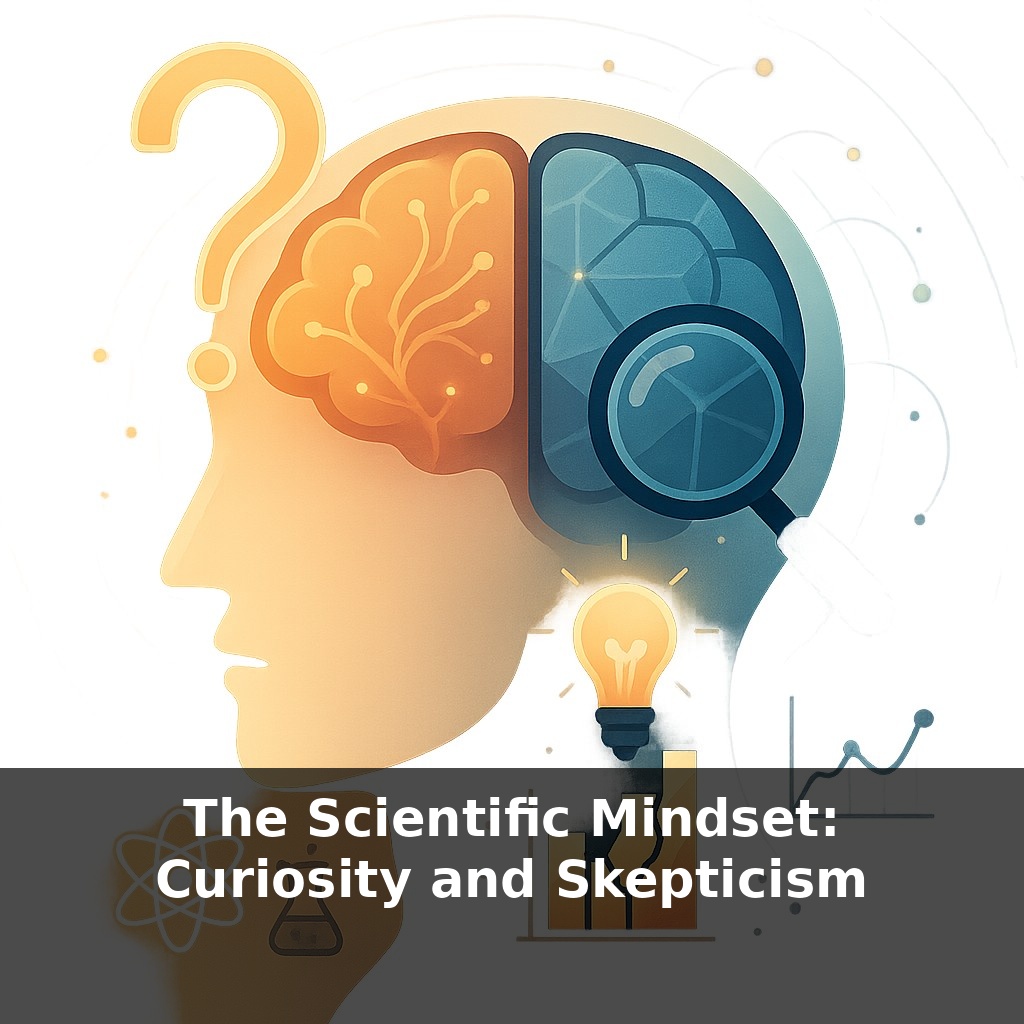
The Scientific Mindset: Curiosity and Skepticism
📝 Transcript
About half the “proven” results in famous psychology studies fell apart when other scientists tried to repeat them. Yet those failed do-overs sparked fresh discoveries. In this episode, we’ll step into that tension: how to be wildly curious and sharply skeptical at the same time.
Dopamine in your brain can jump by roughly 30% when you chase answers to your *own* questions, not ones handed to you on a test. That surge isn’t just about feeling good; it’s your biology rewarding you for exploring. But here’s the twist: the same mind that lights up with curiosity is also prone to seeing patterns that aren’t there, trusting stories that “feel” right, and clinging to first impressions.
That’s where a scientific mindset becomes less about lab coats and more about mental habits. It’s learning to ask, “What am I missing?” right after “That’s fascinating.” It’s noticing when you want something to be true—and then testing it harder, not softer. In daily life, this shows up in how you read headlines, interpret feedback at work, or judge your own hunches. In this episode, we’ll turn those moments into a training ground for thinking more like a scientist.
Curiosity pulls you toward every “Why?” and “What if?” that crosses your path; skepticism asks, “Compared to what?” and “Says who?” A scientist learns to let both voices into the room without letting either one take over. That balance is trained, not gifted. In practice it looks less like grand breakthroughs and more like tiny upgrades: checking the source on a viral chart, asking a colleague how they got their numbers, or pausing before accepting your own first draft of a story about why something went wrong. Each small move is a rep that strengthens your ability to explore boldly while doubting wisely.
A Nobel‑winning physicist once said, “The first principle is that you must not fool yourself—and you are the easiest person to fool.” That’s the core problem a scientific mindset is built to solve: your own brain is both the engine of insight and the source of most errors.
Curiosity on its own is like opening every browser tab that looks interesting. You collect headlines, hot takes, impressive charts. But without a second process that checks, compares, and tests, you end up with what feels like understanding instead of the real thing.
Scientists cope with this by separating three phases that most of us blur together:
1. **Generation.** Here, almost anything goes. You ask uncomfortable questions, sketch wild explanations, list multiple “maybe it’s because…” stories before you pick a favorite. The key move: keep your options open longer than feels natural.
2. **Interrogation.** Then you turn and ask, “What would prove this wrong?” not just “What would make this look good?” In medicine, a new drug doesn’t “work” because a few patients improved; it faces randomized trials, control groups, and careful statistics designed to kill weak ideas. Everyday version: you deliberately look for the email that contradicts your impression of how the meeting went.
3. **Revision.** When data don’t match your story, you don’t have to throw out the whole story. You update. Maybe your colleague isn’t “always unreliable,” just swamped on Fridays. Maybe the productivity hack you loved…helps only on deep‑work tasks. Scientific thinking is less about being right and more about becoming *less wrong* over time.
Peer review is a formalized version of this loop. Before a result joins the scientific record, other experts attack its methods, poke holes in its logic, and check whether the conclusions reach farther than the evidence. That adversarial collaboration slows things down, but it also means knowledge is never just one person’s untested enthusiasm.
You can build a similar circuit into daily life by intentionally splitting roles: first, you as the enthusiast who collects possibilities; later, you as the critic who trims, tests, and demands receipts. Over time, that rhythm trains you to treat your own best ideas as hypotheses, not trophies.
You can see this double‑move most clearly in people who get paid to be right *later*, not *now*. A good product manager, for instance, doesn’t just fall in love with a feature idea and ship it. They start by hunting for real user frustrations, then sketch multiple ways to solve them, even ones that feel strange or risky. Only after that do they run A/B tests, watch how people actually behave, and kill the versions that don’t hold up. The same pattern shows up in good journalists: they begin with a hunch, but then call sources who might disagree, pull documents, and look for holes before publishing.
In your own life, this can be as small as drafting three possible reasons a project slipped—your mistake, bad luck, broken process—then asking which one your calendar, emails, or teammates actually support. Over time, you’re not just reacting; you’re running miniature studies on your own assumptions.
Your future may depend on how well you can *ask* and then *doubt*. In classrooms, that will mean students designing tiny “mini‑experiments” on homework methods instead of memorizing steps. In tech policy, leaders will treat bold claims about safety like raw ingredients in a kitchen—nothing goes to the table before it’s cleaned, tested, and combined with care. In public debates, the people we trust most will be the ones who can say, “Here’s what we know—and here’s what might change my mind.”
Use your days like a small kitchen lab: try a new way to handle one belief, one decision, one headline, and note what “taste” it leaves. Over time, you’re not chasing certainty so much as refining a personal menu of methods that spare you from stale thinking and empty claims—while still leaving room for surprise on the next plate.
Start with this tiny habit: When you notice yourself agreeing (or disagreeing) with something you hear or read, quietly ask yourself, “What evidence would change my mind on this?” and name just one example out loud. You don’t have to research it or prove anything—simply practice forming that “what would change my mind?” question. This tiny move trains both curiosity (by opening possibilities) and skepticism (by tying beliefs to evidence), in the exact way the episode described.
From this course
Think Like a Scientist: Evidence-Based Decision Making
7 episodesUnlock all episodes
Full access to 7 episodes and everything on OwlUp.
Subscribe — $1.99/monthLess than a coffee ☕ · Cancel anytime