 2min preview
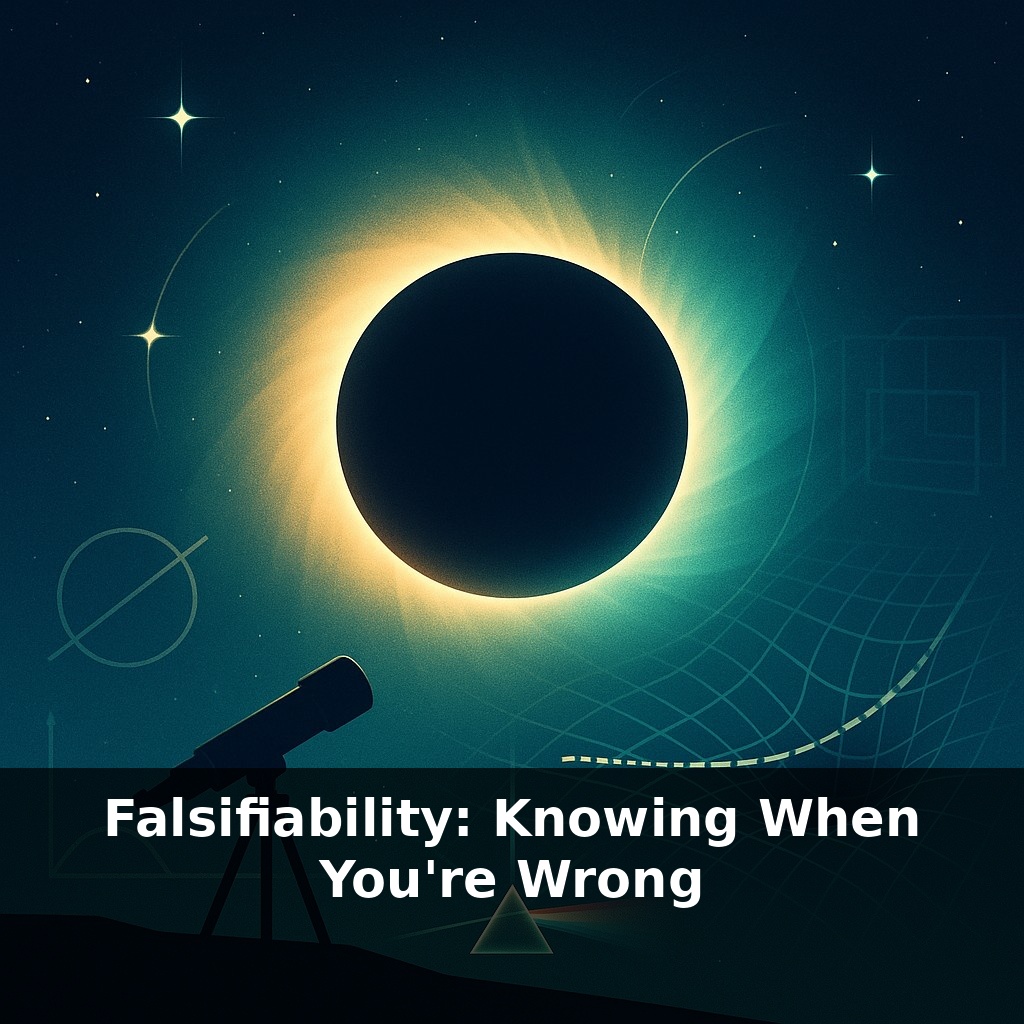
Falsifiability: Knowing When You're Wrong
📝 Transcript
About a century ago, a solar eclipse quietly overthrew Isaac Newton. Astronomers pointed telescopes at the sun, checked the starlight, and found a tiny mismatch with his prediction—just enough to crown Einstein instead. This episode asks: what lets an idea lose that clearly?
Feynman said science is a way of trying *not* to fool yourself—but in daily life, most of us run the opposite experiment. We collect confirming evidence, avoid hard tests, and quietly move the goalposts when reality disagrees. That’s how diets become “it works if you do it right,” business strategies become “the timing just wasn’t right,” and pet theories about people turn into “you don’t really know them like I do.”
This episode is about a simple but ruthless question: “What observation would make me admit I’m wrong?” Popper argued that until you can answer that, you’re not really doing science—you’re just telling stories. We’ll see how falsifiability shapes real research, why preregistered studies changed parts of psychology, how drug trials are built to break promising ideas, and how you can borrow the same mindset to stress‑test your own beliefs before the world does it for you.
Subscribe to read the full transcript and listen to this episode
Subscribe to unlockSubscribe for $1.99/month to unlock the full episode.
From this course
Think Like a Scientist: Evidence-Based Decision Making
7 episodesUnlock all episodes
Full access to 7 episodes and everything on OwlUp.
Subscribe — $1.99/monthLess than a coffee ☕ · Cancel anytime